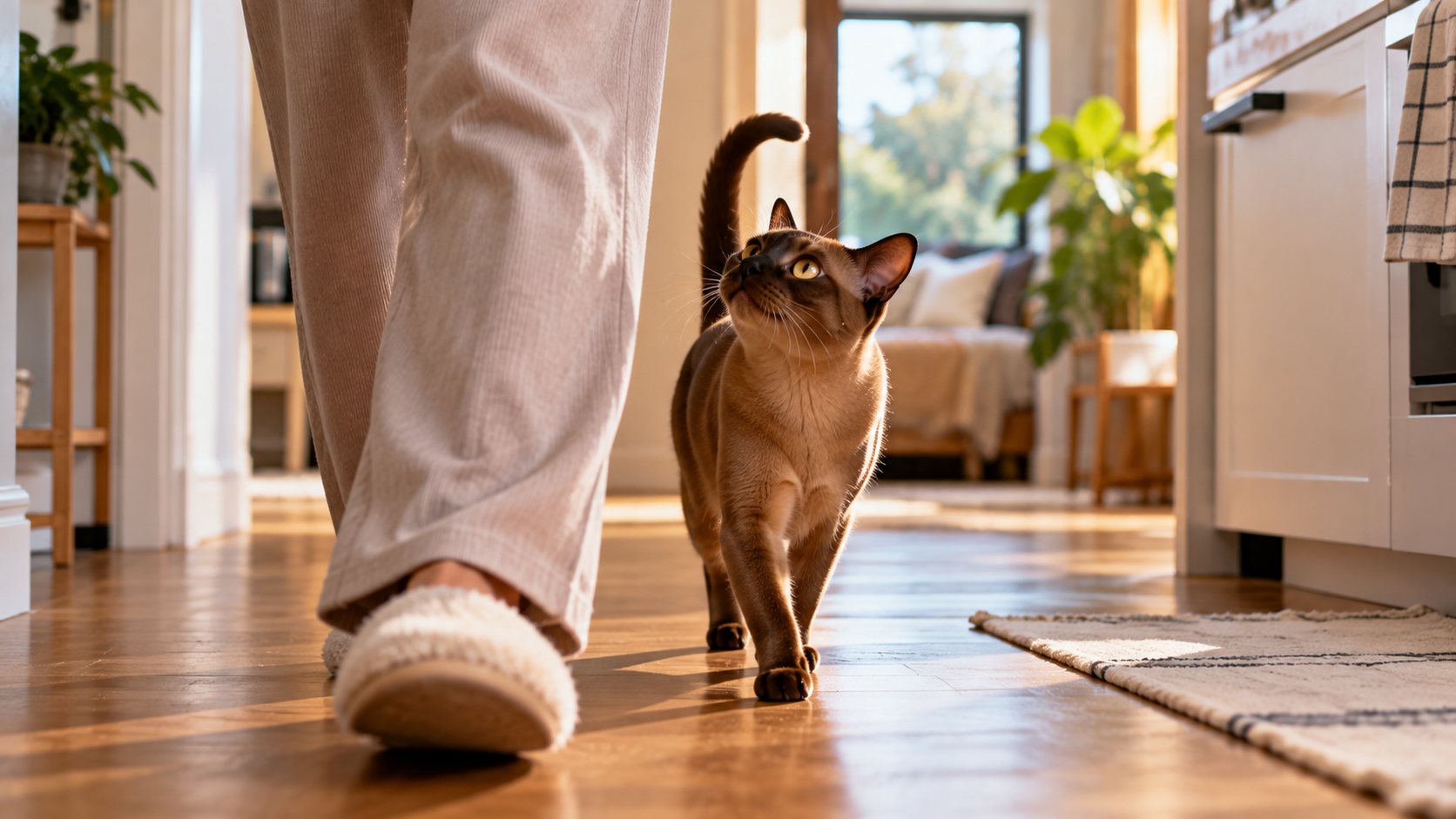
You get up from the couch.
Your cat gets up too.
You walk into the kitchen.
A few seconds later, there is a cat sitting behind you.
You go upstairs.
The cat follows.
You enter the bathroom and close the door, only to discover a paw appearing underneath it.
For some cat owners, this becomes such a normal part of everyday life that they barely notice it anymore. Their cat simply seems determined to participate in everything happening around the house.
But why does my cat follow me everywhere?
The behavior can have several explanations. Your cat may enjoy your company, associate you with interesting activities, anticipate food or play, feel safer near you, or simply be curious about what you are doing.
For highly social cats, including many Burmese cats, following a favorite person can also become an ordinary part of the relationship.
Understanding the behavior starts with looking at the entire pattern rather than assuming every cat follows people for exactly the same reason.
Following You Can Be a Social Behavior
Cats are sometimes described as independent animals that barely care what their humans are doing.
Anyone who has lived with a particularly social cat knows that description can be misleading.
Cats vary considerably in personality.
Some prefer spending much of the day alone.
Others regularly seek interaction and choose to remain close to members of the household.
A cat that follows you from room to room may simply prefer being where you are.
Your movement becomes a signal that something is happening somewhere else.
Naturally, the cat comes to investigate.
Your Cat May Simply Enjoy Your Company
Not every feline behavior needs a complicated explanation.
Sometimes your cat follows you because being around you is rewarding.
You provide familiar sounds.
Familiar smells.
Physical affection.
Play.
Warmth.
Routine.
And social interaction.
If your cat regularly chooses to sleep near you, sit beside you, greet you, and follow you without constantly demanding something, companionship may be a major part of the behavior.
Burmese Cats Are Often Highly People-Oriented
Burmese cats are widely known for their social and affectionate personalities.
Many enjoy being involved in household activity rather than observing everything from a distant corner.
That can make the classic “shadow cat” behavior particularly noticeable.
A Burmese may move from room to room with its person, settle nearby while someone works, appear during household chores, and investigate whatever family members are doing.
Individual personalities still vary.
Breed tendencies should never be treated as guarantees.
But for a naturally social cat, staying near people may simply be part of everyday life.
Your Movement Is Interesting
Imagine spending much of the day inside the same environment.
You already know where the sofa is.
The window has not moved.
The scratching post remains in the same corner.
Then suddenly your human stands up.
Something is changing.
For a curious cat, that movement is worth investigating.
Where are you going?
Are you opening a cupboard?
Is someone arriving?
Are you about to play?
Your movement creates a small event in an otherwise familiar environment.
Cats Learn Household Patterns Extremely Well
Cats pay attention to routines.
You may not realize how predictable your day has become.
Wake up.
Walk toward the bathroom.
Enter the kitchen.
Make coffee.
Open a particular cabinet.
Sit at the desk.
Leave for work.
Return home.
Prepare dinner.
Your cat experiences this sequence repeatedly.
Over time, individual actions can begin predicting what happens next.
That makes following you useful.
The Kitchen Has Probably Trained Your Cat
You walk toward the kitchen.
Your cat immediately appears.
This does not necessarily mean your cat was desperately hungry.
The kitchen is simply associated with interesting possibilities.
Food is prepared there.
Treats may be stored there.
Bowls are filled there.
Packages are opened there.
People spend time there.
If following you into the kitchen occasionally results in food, the behavior becomes even more worthwhile.
Cats Learn Through Successful Outcomes
Suppose your cat follows you ten times.
Nine times, nothing special happens.
On the tenth occasion, you give the cat a treat.
From the cat’s perspective, following still had a potential reward.
Behaviors that occasionally produce something desirable can persist.
The reward does not always need to be food.
It might be:
Attention.
Petting.
Play.
An open door.
Access to a favorite room.
A warm seat.
Or simply an interesting event.
You May Reward Following Without Realizing It
Your cat enters the room behind you.
You look down.
“Hi!”
Then you pet the cat.
Perhaps you pick up a toy.
From your perspective, you were simply acknowledging your pet.
From the cat’s perspective, following you produced social interaction.
Repeat that pattern hundreds of times and it becomes part of the household routine.
This is not necessarily a problem.
It simply helps explain why the behavior continues.
Following Does Not Always Mean Asking for Something
Owners sometimes respond immediately:
“Do you want food?”
But cats can follow without making a specific request.
Watch what happens after your cat reaches you.
Does the cat immediately walk toward the food bowl?
Vocalize?
Bring you toward a door?
Or does it simply sit nearby?
A cat that follows you and then quietly settles down may be seeking proximity rather than a particular resource.
Body Language Provides Important Context
Following alone tells you relatively little.
Look at the rest of the cat.
A relaxed cat may approach with:
A neutral or upright tail.
Relaxed ears.
Normal movement.
Soft facial expression.
Comfortable posture.
It may rub against furniture or your legs and then settle nearby.
That looks very different from a cat showing obvious agitation or distress.
Behavior should always be interpreted as a complete picture.
The Tail Can Tell You Something About the Interaction
An upright tail is commonly seen during friendly feline approaches.
Some cats may approach their people with the tail held vertically, sometimes with a slight curve at the tip.
The cat might then rub against the person’s legs.
This social approach is different from following while crouched, tense, or repeatedly looking toward a perceived threat.
Do not interpret one body part in isolation.
But tail position can contribute useful context.
Your Cat May Be Checking on You
Cats learn where household members normally spend their time.
If you suddenly disappear into another room, a socially attached cat may investigate.
This can look almost like a small inspection.
The cat walks in.
Looks at you.
Perhaps sniffs something.
Then leaves.
Nothing was requested.
The cat simply gathered information about where you went and what was happening.
Closed Doors Can Make You More Interesting
A cat that ignored a room five minutes ago may suddenly become fascinated when the door closes.
Why?
Because access has changed.
The cat can no longer observe what is happening.
For a curious animal that normally moves freely around the home, this can make the closed room unusually interesting.
Scratching or waiting outside a bathroom door does not automatically indicate severe separation distress.
Sometimes the cat simply dislikes being excluded from an area it normally considers accessible.
Bathrooms Are Surprisingly Interesting to Cats
Many owners discover that privacy becomes difficult after adopting a social cat.
Bathrooms contain plenty of interesting features.
Running water.
Sinks.
Bath mats.
Cool surfaces.
Warm surfaces.
Interesting smells.
Small spaces.
And, importantly, a human who often sits relatively still.
From a cat’s perspective, this can be an excellent opportunity for attention.
Your Cat May Associate Certain Rooms With Activities
Cats create associations with locations.
Bedroom:
Sleep and warmth.
Kitchen:
Food.
Office:
A human sitting still for long periods.
Living room:
Play or family activity.
Bathroom:
Running water or uninterrupted attention.
Your cat may follow because it knows what usually happens after you enter each space.
Some Cats Follow One Person More Than Everyone Else
A household may contain several people.
Yet the cat consistently follows one.
This can happen for many reasons.
That person may feed the cat most often.
They may play more.
Their interaction style may be calmer.
Their daily routine may be predictable.
The cat may simply have developed a particularly strong social preference.
This does not necessarily mean the cat dislikes everyone else.
Predictability Can Make a Person Attractive to a Cat
Cats often appreciate environments where they can anticipate what happens.
A person who interacts consistently may become especially easy to understand.
They pet the cat gently.
They respect when the cat walks away.
They feed at roughly predictable times.
They play in familiar ways.
They do not suddenly grab or chase the cat.
Predictable interactions can help build trust.
Following Can Be Part of a Daily Greeting Routine
Some cats begin following as soon as their owner arrives home.
You open the door.
The cat approaches.
Then follows while you put down your bag, change clothes, enter the kitchen, and move through the house.
Part of this may reflect excitement about your return.
After spending time apart, your arrival creates one of the most interesting events of the day.
The cat may simply want to remain involved.
Boredom Can Increase Attention-Seeking Behavior
A cat living indoors depends heavily on its environment for stimulation.
If the environment contains few interesting activities, the human may become the most entertaining thing available.
Every time you move, something potentially exciting happens.
This can increase following behavior.
The solution is not necessarily to discourage companionship.
Instead, make sure the cat also has independent opportunities for exploration and play.
Indoor Cats Need More Than Toys on the Floor
Enrichment is not simply buying several toys and leaving them in one corner.
Cats benefit from different types of opportunities.
Climbing.
Scratching.
Chasing.
Searching.
Watching.
Hiding.
Exploring.
Resting at different heights.
Interacting with people.
The environment should allow multiple natural behaviors.
A richer home gives the cat choices beyond waiting for a person to create entertainment.
Vertical Space Can Make a Big Difference
Cats use three-dimensional environments.
A room that looks full to a human may still offer very little usable territory to a cat if everything is located at floor level.
Cat trees.
Stable shelves designed for cats.
Window perches.
Safe elevated resting places.
These can increase the amount of functional space available.
A cat may still follow you, but it also gains more places to observe household activity independently.
Window Watching Can Provide Passive Stimulation
A secure window perch can provide hours of changing visual information.
Birds.
People.
Leaves.
Weather.
Vehicles.
Shadows.
Outdoor sounds.
The environment changes even when nobody inside the home is doing anything.
Make sure windows and screens are secure so the cat cannot escape or fall.
Play Should Give the Cat Something to Do
Interactive play can provide an outlet for hunting-related behavior.
Wand toys and other appropriate toys can simulate movement the cat can stalk and chase.
Short play sessions may be easier to incorporate into the day than one very long session.
Let the cat engage with the toy rather than simply waving it randomly in front of its face.
Different cats prefer different movement patterns.
Rotate Toys Instead of Leaving Everything Out Forever
A toy that remains on the floor for six months may become part of the furniture.
Try rotating available toys.
Put some away.
Bring them back later.
Novelty can make familiar objects interesting again.
Inspect toys regularly for damaged pieces, loose strings, or anything that could become unsafe.
Food Can Also Become Enrichment
Some cats enjoy working for part of their food.
Puzzle feeders and appropriate food-dispensing toys can encourage exploration and problem-solving.
Start easy.
If the puzzle is too difficult, the cat may simply become frustrated.
The goal is engagement, not creating an obstacle between the cat and necessary nutrition.
Any change in feeding routine should still account for the cat’s normal dietary needs.
Social Cats Still Need Independent Skills
There is nothing wrong with a cat enjoying human company.
The goal is not making an affectionate cat distant.
But a healthy home environment should allow the cat to feel comfortable when the owner is temporarily occupied.
A cat can love following you and still be able to:
Nap alone.
Watch through a window.
Play independently.
Explore.
Use a scratching surface.
Relax in another room.
Companionship and independence are not opposites.
Avoid Responding to Every Follow With Food
If every approach produces a treat, food can become strongly connected with following behavior.
That may be harmless in moderation, but it can also create constant food-seeking patterns.
Sometimes respond with:
Petting.
A short play session.
Verbal interaction.
Access to a favorite perch.
Or simply quiet companionship.
Not every social interaction needs to involve calories.
Your Cat May Be Following Because It Wants Dinner
Of course, sometimes the simple explanation is correct.
The cat wants food.
Look at timing.
Does following become intense shortly before normal mealtimes?
Does the cat repeatedly walk between you and the feeding area?
Does vocalization increase?
If so, the behavior may be connected to meal anticipation.
Cats can become remarkably accurate at learning feeding routines.
Feeding Time Can Become Earlier and Earlier
This pattern is familiar to many cat owners.
The cat asks for breakfast at 7:00.
One morning you feed at 6:45.
The next day the cat begins asking at 6:40.
Eventually, you have accidentally negotiated breakfast into the middle of the night.
Consistency can help prevent meal times from gradually shifting because of persistent requests.
Automatic feeders can also be useful in some households because food becomes less directly associated with waking a person.
Following May Be Connected to Play
Some cats become especially persistent when they have unused energy.
They follow.
Vocalize.
Run ahead.
Look back.
Then sprint away.
The behavior may effectively be an invitation.
Try an appropriate interactive play session and observe whether the cat becomes more settled afterward.
For playful breeds and young cats, regular activity can be particularly important.
Age Changes Following Behavior
Kittens often explore constantly.
Everything is new.
They may follow because you lead them toward new experiences.
Adult cats develop more established routines.
Senior cats may change their social behavior again.
Some become more affectionate.
Others become less active.
Changes in hearing, vision, mobility, or cognitive function can also influence how an older cat interacts with people.
Sudden Behavioral Change Matters More Than the Habit Itself
A cat that has followed you for years is different from a previously independent cat that suddenly refuses to leave your side.
Any significant behavioral change deserves attention.
Ask what else changed.
Appetite?
Thirst?
Weight?
Vocalization?
Litter box habits?
Activity?
Sleep?
Movement?
Grooming?
One behavior alone may be harmless, but a cluster of changes can provide important information.
Cats Can Seek More Attention When They Feel Unwell
Animals cannot explain symptoms verbally.
Sometimes behavioral changes appear before owners recognize a physical problem.
A cat may become more withdrawn.
Another may become unusually clingy.
Neither response proves illness.
But if increased following is sudden and accompanied by other unusual signs, do not assume the cat has simply become more affectionate overnight.
Changes in Appetite Should Be Taken Seriously
If your cat follows you constantly toward the food area and appears unusually hungry, pay attention.
An increase in appetite can have many possible explanations.
So can a decrease in appetite.
If the change is persistent, significant, or accompanied by weight change, vomiting, diarrhea, increased thirst, or other symptoms, contact a veterinarian.
Avoid diagnosing medical conditions from behavior alone.
Increased Vocalization Can Add Context
Some cats naturally talk a lot.
Burmese cats in particular may be quite communicative.
But again, baseline matters.
If your normally quiet cat suddenly follows you while vocalizing repeatedly, consider whether something has changed.
The cat may want:
Food.
Play.
Access to a room.
A clean litter box.
Attention.
Or assistance with something else.
Persistent unexplained changes warrant closer observation.
Litter Box Changes Are Important
Following behavior may be unrelated to the litter box.
But if clinginess appears alongside changes in urination or defecation, the combination should not be ignored.
Straining to urinate, repeatedly entering the litter box with little or no urine produced, crying during urination, or obvious distress can require urgent veterinary attention.
Do not wait for a behavioral explanation if the cat appears physically unwell.
Stress Can Change Social Behavior
Cats respond to environmental change differently.
A new home.
A new person.
Another pet.
Construction.
Visitors.
Schedule changes.
Moving furniture.
Outdoor animals visible through windows.
All can affect behavior.
Some stressed cats hide.
Others seek more contact with a familiar person.
Following may therefore increase temporarily during periods of change.
Routine Can Help During Transitions
When the household changes, maintaining predictable elements can provide stability.
Try to keep important resources consistent.
Feeding routine.
Litter box access.
Resting areas.
Play.
Quiet spaces.
Familiar bedding.
Do not force interaction.
Allow the cat to choose when to approach.
Multi-Cat Homes Create Different Social Dynamics
A cat that follows you may be seeking your company.
But in a multi-cat home, also consider relationships between the cats.
Is another cat blocking access to a favorite resting area?
Food?
Water?
A litter box?
A hallway?
Subtle tension is not always obvious.
One cat may spend more time near a person because that location feels socially safer.
Resources Should Not Create Constant Competition
Multiple cats need adequate access to important resources.
Food and water arrangements depend on the household and individual cats.
Resting places should be available in multiple locations.
Scratching opportunities should not exist in only one contested area.
Litter box setup is especially important.
The goal is to reduce situations where one cat must repeatedly pass another cat to meet basic needs.
Following Can Become More Noticeable After Losing Another Pet
If a cat previously spent significant time with another animal, the loss of that companion can change its daily routine.
The remaining cat may spend more time near people.
It may vocalize more.
It may search familiar areas.
Responses to loss vary greatly between animals.
Maintain routine and provide appropriate interaction while monitoring for concerning changes in appetite, activity, or health.
Do Not Punish a Cat for Following You
A social cat is not misbehaving simply because it wants to be nearby.
Yelling, spraying water, or frightening the cat can damage trust without teaching an appropriate alternative.
If the behavior becomes inconvenient, manage the situation calmly.
Provide another attractive location.
Offer enrichment.
Close a door when necessary.
Reward the behavior you want.
The objective is coexistence, not making the cat afraid to approach.
Boundaries Are Still Allowed
Loving your cat does not mean it needs access to every activity.
There are situations where keeping a cat away is appropriate.
Cooking around hot surfaces.
Cleaning with unsafe products.
Repair work.
Open exterior doors.
Certain workspaces.
Medication preparation.
Other potentially dangerous situations.
Create a safe alternative area instead of assuming the cat understands why today’s activity is dangerous.
Teach an Alternative Place to Settle
If your cat constantly walks across the keyboard while you work, consider creating a nearby spot that is more appealing.
A bed.
A box.
A small cat tree.
A blanket.
A window perch.
Reward the cat for using that area.
The cat can remain close without occupying the exact surface you need.
This often works better than repeatedly moving the cat without offering an alternative.
Boxes Can Be Surprisingly Effective
You buy an expensive bed.
Your cat chooses the cardboard box.
This is almost a universal cat-owner joke for a reason.
Boxes provide enclosed resting spaces and opportunities to observe from partial cover.
A simple box near your workspace may become an excellent alternative to the keyboard.
Make sure it is clean, stable, and free from staples or unsafe materials.
Warmth May Explain Some “Clingy” Behavior
Cats often seek comfortable warm locations.
A laptop.
Your lap.
A blanket beside you.
A sunny chair.
The cat may appear determined to stay close because your location is also physically comfortable.
If this creates problems, provide another warm and safe resting option nearby.
Your Scent Is Familiar
Cats rely heavily on scent.
A person’s clothing, bedding, chair, and frequently used spaces contain familiar odors.
Familiar scent can become part of a predictable environment.
This may help explain why some cats choose:
Your bed.
Your laundry.
Your chair.
The spot where you were sitting five minutes ago.
Following you and resting in your spaces can be connected parts of the same social environment.
Cats Also Communicate Through Scent
When a cat rubs its face or body against you, furniture, and familiar objects, scent communication is involved.
This does not mean your cat thinks it legally owns you.
Rather, scent is part of how cats interact with their environment and social partners.
Rubbing can accompany friendly greetings and comfortable social behavior.
A cat following you may stop repeatedly to rub against your legs or nearby furniture.
Purring Does Not Have Only One Meaning
A following cat may purr when it reaches you.
That often occurs during comfortable social interaction.
But purring should not automatically be interpreted as proof that everything is perfect.
Cats can also purr in other contexts, including stressful or painful situations.
Again, use the complete context.
A relaxed cat seeking petting is different from a cat showing physical signs of illness.
Learn Your Individual Cat’s Baseline
Generic behavior guides are useful.
But nobody observes your cat as frequently as you do.
Learn what is normal for that individual.
How often does it follow?
How much does it vocalize?
Where does it sleep?
When does it play?
How does it ask for food?
How does it behave around visitors?
Baseline behavior makes changes easier to notice.
Personality Matters as Much as Breed
Breed characteristics can provide useful expectations, but every cat remains an individual.
Two Burmese cats raised in the same household can still have different preferences.
One may want constant physical contact.
Another may follow people but dislike being held.
One may sleep under the blankets.
Another prefers a nearby chair.
Do not force your cat into a stereotype because of its breed.
Observe the animal in front of you.
Kittens Can Learn That Humans Are Worth Following
Early positive experiences with people can influence how comfortable kittens become around human activity.
Gentle handling.
Play.
Predictable feeding.
Safe exploration.
Positive household experiences.
These help kittens learn that people are part of a secure environment.
However, interaction should remain appropriate to the kitten’s age and comfort.
Socialization is not the same as overwhelming a young cat with constant handling.
Give the Cat a Choice
One of the simplest principles for building a good relationship with a cat is allowing choice.
Offer interaction.
Do not always demand it.
Provide places near you and places away from you.
Let the cat leave when it wants.
Respect signals that interaction has gone on long enough.
A cat that knows it can walk away may feel more comfortable choosing to stay.
When Following Becomes Separation Distress
Most cats that follow their owners everywhere are not necessarily experiencing a behavioral disorder.
However, concern increases if the cat appears unable to cope when left alone.
Possible signs may include unusual vocalization, destructive behavior, inappropriate elimination, excessive grooming, agitation, or other significant behavioral changes associated with separation.
These behaviors can have multiple causes, including medical ones.
A veterinarian should be involved before assuming the problem is purely behavioral.
Do Not Diagnose Anxiety From One TikTok Checklist
Online videos often turn ordinary pet behaviors into diagnoses.
“My cat sleeps beside me.”
“My cat follows me.”
“My cat waits outside the bathroom.”
Therefore, according to the video, the cat supposedly has anxiety.
Behavior is not that simple.
Following can occur in perfectly comfortable, socially engaged cats.
A diagnosis requires more context than a list of relatable behaviors.
Video Can Help Document Concerning Behavior
If your cat behaves differently when you leave, a home camera may provide useful information.
You might discover the cat simply sleeps.
Or you may observe persistent vocalization or agitation.
Recordings can provide useful context when discussing behavior with a veterinarian.
Avoid relying on video alone to diagnose a condition.
It is evidence, not a diagnosis.
A Veterinary Check Comes Before Complex Behavioral Explanations
If a behavior changes significantly, especially in an adult or senior cat, physical health should be considered.
Pain.
Changes in sensory function.
Hormonal or metabolic problems.
Neurological changes.
And many other conditions can affect behavior.
A veterinarian can assess the cat in context.
Only after medical concerns are considered does it make sense to focus entirely on environmental or behavioral management.
Following You Can Be Perfectly Normal
Sometimes there is no problem to solve.
Your cat eats normally.
Uses the litter box normally.
Sleeps comfortably.
Plays.
Explores.
Can relax alone.
Shows no distress when you leave.
And simply prefers spending a lot of time near you when you are home.
That may just be your cat’s personality.
For a social companion cat, following is often one of the ways daily life is shared.
You Do Not Need to Make an Affectionate Cat More Independent
Pet advice sometimes treats every strong attachment as unhealthy.
That can lead owners to unnecessarily discourage normal social behavior.
Independence is useful when a cat can remain comfortable during ordinary periods alone.
But there is no reason to prevent a cat from choosing companionship when both cat and owner enjoy it.
A cat following you into the next room is not automatically a behavioral problem.
Create a Life That Does Not Depend Entirely on You
At the same time, companionship should not be the cat’s only source of stimulation.
Provide an environment containing:
Comfortable resting places.
Vertical space.
Scratching surfaces.
Interactive play.
Independent toys.
Safe observation points.
Food enrichment when appropriate.
Quiet areas.
Then your cat has choices.
It may still choose you frequently.
That is different from having nothing else to do.
Watch What Happens After You Stop Moving
Here is a simple observation.
Walk into another room.
Let your cat follow.
Then do nothing.
What happens?
Does the cat settle down nearby?
Walk to the food bowl?
Bring a toy?
Vocalize at a door?
Inspect the room and leave?
The next behavior can tell you more about the reason for following than the following itself.
Look for Patterns Instead of One Explanation
Your cat may follow you for different reasons at different times.
Morning:
Breakfast.
Afternoon:
Curiosity.
Evening:
Play.
Night:
Warmth and companionship.
When you work:
Attention.
When visitors arrive:
Security.
There does not need to be one universal answer.
Behavior changes with context.
Conclusion
So, why does my cat follow me everywhere?
Often, the answer is reassuringly simple.
Your cat knows you.
Your routines are predictable.
You provide food, play, warmth, safety, stimulation, and social interaction. When you move through the house, something interesting may be about to happen.
For naturally social cats, including many Burmese cats, remaining close to people can simply be part of their normal personality.
But context still matters.
Watch what your cat does after following you.
Look at body language.
Notice whether the behavior is longstanding or sudden.
Make sure the cat has independent enrichment, comfortable resting areas, vertical space, play opportunities, and access to important resources.
Most importantly, learn what is normal for your individual cat.
If a lifelong shadow follows you into the bathroom and then peacefully falls asleep on the mat, you may simply have a very social companion.
If a previously independent cat suddenly becomes extremely clingy while also showing changes in appetite, vocalization, litter box habits, activity, weight, or general behavior, that deserves closer attention and potentially veterinary evaluation.
Sometimes following is a request.
Sometimes it is curiosity.
Sometimes it is routine.
And sometimes your cat simply decided that wherever you are is the best room in the house.