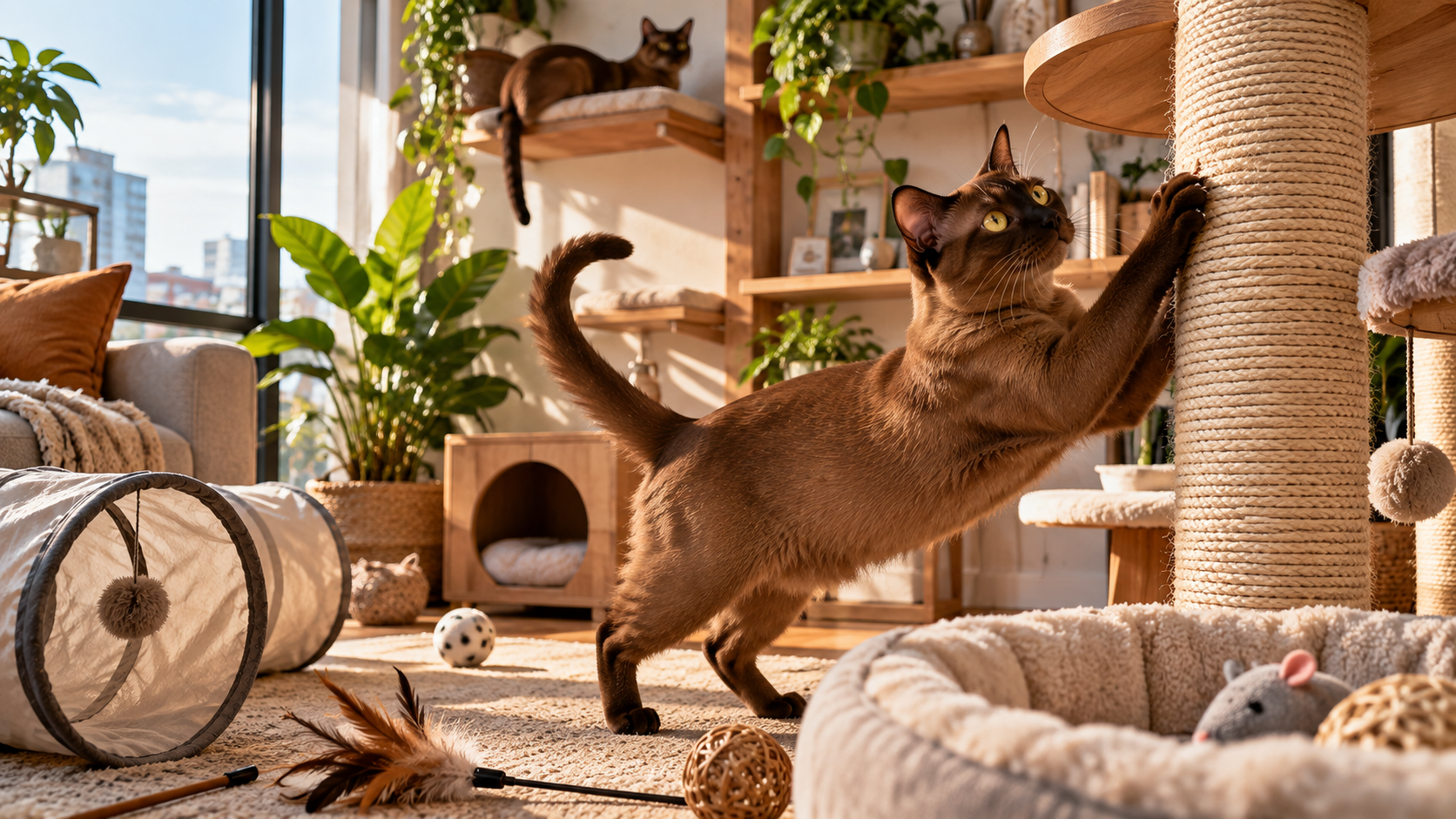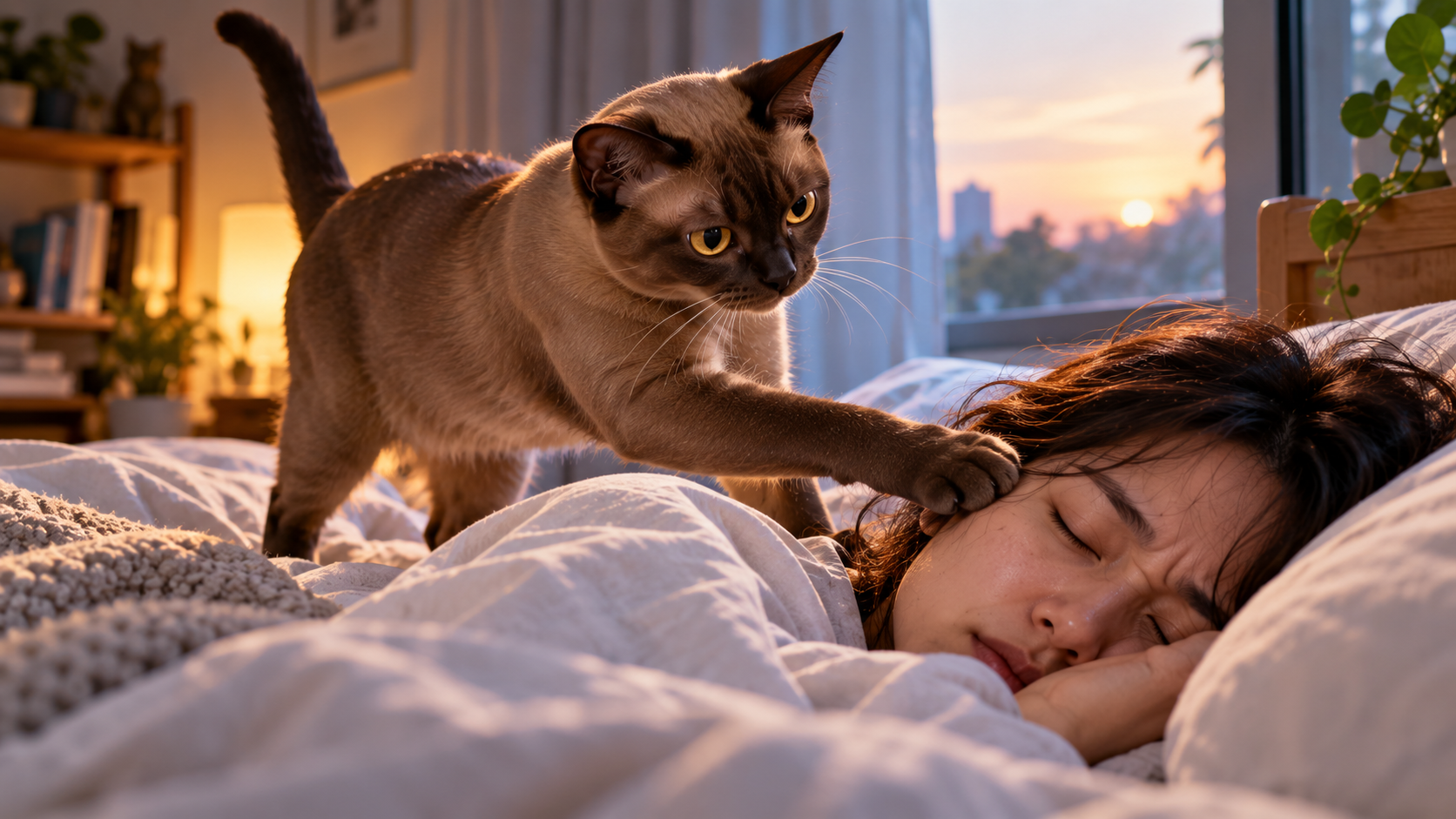
You are sleeping comfortably when something touches your face.
A paw.
Then another.
You ignore it.
A few seconds later, there is a quiet meow beside the bed. When that does not work, the meowing becomes louder. Perhaps your cat starts walking across your pillow, scratching lightly at the door, knocking something from the nightstand, or simply staring at you from a few inches away.
You check the time.
It is 4:47 a.m.
Again.
When your cat wakes you up early, it can feel as though your pet has somehow decided that everyone in the house should follow a completely unreasonable schedule.
However, cats rarely develop early-morning routines without a reason.
Food can certainly be part of it, but hunger is only one possibility. A cat’s natural activity pattern, household routines, attention, boredom, environmental cues, and even the way humans respond can gradually turn an occasional early wake-up into a remarkably reliable daily habit.
Understanding what maintains the behavior is usually more useful than simply trying to stop the meowing.
Why Your Cat Wakes You Up Early
Cats do not understand mornings in the same way humans do.
Your cat does not look at the clock and decide that 5 a.m. is an inappropriate time to start the day.
Instead, cats learn patterns.
Certain environmental changes predict activity.
Light begins entering the room.
Birds become active outside.
Someone normally gets out of bed.
Breakfast appears.
The household starts moving.
Once these events become predictable, a cat can begin anticipating them.
Sometimes that anticipation starts earlier and earlier.
Cats Often Become Active Around Dawn
Cats are frequently described as nocturnal, but that description is not completely accurate.
Many cats show increased activity around dawn and dusk.
Those periods can naturally become interesting times for movement, exploration, play, and feeding-related behavior.
For an indoor cat, this does not necessarily mean racing around the house every sunrise.
Domestic cats can adapt considerably to household schedules.
However, their natural activity tendencies can help explain why early morning is such a common time for unwanted wake-ups.
Your Cat’s Internal Clock Can Become Extremely Consistent
Cats are very good at recognizing routines.
Feed breakfast at approximately the same time every morning and your cat may begin appearing before the meal.
The same thing happens with other predictable events.
Your alarm rings.
You get out of bed.
You use the bathroom.
You walk toward the kitchen.
Food appears.
To you, these are separate actions.
To your cat, they can become one predictable sequence.
Eventually, the cat may try to start that sequence before your alarm does.
Breakfast Is One of the Strongest Explanations
If waking you results in food, the behavior makes perfect sense from the cat’s perspective.
Imagine the pattern.
The cat meows at 5:30.
You try to ignore it.
The cat continues.
At 5:45, you finally get up and provide breakfast because you want the noise to stop.
What did the cat learn?
Persistent meowing works.
The important detail is that the reward does not need to happen immediately.
If the behavior eventually produces food, it can still become stronger.
Giving In Occasionally Can Make the Habit Surprisingly Persistent
Perhaps you normally ignore early meowing.
But once every few days, you are too tired.
You get up and feed the cat.
That occasional success can be enough to keep the behavior going.
From the cat’s perspective, today might be the morning when persistence pays off.
So the cat keeps trying.
This is why inconsistency can make changing the routine difficult.
If one person ignores the behavior but another family member feeds the cat, the pattern can continue.
Attention Can Be a Reward Too
Food is not the only reward.
Suppose your cat meows beside the bed.
You say:
“Stop.”
The cat meows again.
You pet the cat.
Then you move it away.
You may feel that you are discouraging the behavior.
From the cat’s perspective, however, the interaction worked.
You looked at the cat.
You spoke.
You touched it.
For a social cat, that attention can be valuable.
Even Negative Attention Can Maintain a Routine
Owners sometimes respond by talking loudly, pushing the cat away, or repeatedly getting out of bed to move it.
These responses may not feel rewarding to a human.
But they still create interaction.
The cat performs a behavior.
The human responds.
A predictable connection forms.
This does not mean you should become cold toward your cat.
It means affection and interaction are better provided at times that do not accidentally reward the unwanted wake-up behavior.
The Alarm Clock Can Become a Powerful Cue
Cats can learn that a particular sound predicts morning activity.
If your alarm rings at 6:30 every day and breakfast follows shortly afterward, your cat may eventually become active before 6:30.
This anticipation is similar to arriving early for something you know is about to happen.
The problem becomes noticeable when the anticipation keeps shifting earlier.
Breakfast at 6:30 becomes begging at 6:15.
Then 6:00.
Then 5:45.
Eventually, the cat appears to have invented its own alarm clock.
Light Can Also Signal Morning
Even without understanding human time, cats can respond to changes in their environment.
Sunrise changes the amount of light in the room.
Outdoor sounds increase.
Bird activity begins.
Traffic may start.
Other animals become active.
These cues can indicate that the quiet nighttime period is ending.
During certain seasons, sunrise also occurs earlier, which can change a cat’s activity pattern even though the owner’s alarm remains at the same time.
Seasonal Changes Can Affect the Routine
An early-waking problem may become more noticeable during part of the year.
Morning light enters the bedroom earlier.
Birds outside become active sooner.
The home warms earlier.
Your cat notices these changes.
If the problem appears seasonally, consider whether environmental cues are contributing.
Blackout curtains may help in some households by reducing early morning light, although they will not solve a behavior that is primarily maintained by food or attention.
Boredom Can Make the Morning More Interesting
Indoor cats spend many hours in the same environment.
If the house becomes quiet at night and nothing interesting happens for a long period, the first signs of morning can become exciting.
Your cat may have slept for several hours.
Now it is awake.
You are still asleep.
From the cat’s perspective, waking you may be the easiest way to make something happen.
Food appears.
Doors open.
People move.
Toys become available.
The environment becomes interesting again.
A Cat With Unused Energy May Wake Earlier
Consider the cat’s evening.
Did it spend most of the evening sleeping on the sofa?
Was there much interactive play?
Did anything encourage climbing, chasing, searching, or exploring?
If a cat sleeps through much of the evening while the owner watches television, it may have plenty of energy several hours later.
That does not mean you need to exhaust your cat before bed.
However, providing appropriate activity during the evening can help create a more satisfying daily rhythm.
Play Before Bed Can Help
A short interactive play session in the evening can be useful.
Choose activities that encourage natural movement.
Chasing.
Pouncing.
Stalking.
Jumping when appropriate for the cat.
Let the cat occasionally catch the toy rather than creating an endless chase with no successful outcome.
The session does not need to last an hour.
Several focused minutes can be more engaging than leaving toys on the floor all day.
Finish Interactive Play Calmly
A high-energy play session immediately followed by darkness may leave some cats stimulated rather than relaxed.
Allow the activity to wind down.
Make movements slower.
Let the cat successfully catch the toy.
Then transition into the normal evening routine.
Depending on the cat’s feeding plan, a meal or portion of food may follow.
The goal is to create a predictable sequence that gradually moves toward rest.
Consider the Timing of the Last Meal
A cat that receives its final substantial food very early in the evening may genuinely be hungry by early morning.
Feeding schedules vary depending on age, health, diet, household routine, and veterinary recommendations.
For a healthy adult cat, adjusting how the daily food allowance is distributed may sometimes help.
That does not necessarily mean feeding more food.
It can simply mean changing when part of the existing daily amount is offered.
Do Not Automatically Add Extra Food
When a cat repeatedly asks for breakfast, it is easy to keep adding meals.
That can unintentionally increase total daily calorie intake.
If you change meal timing, consider the cat’s total daily food allowance rather than treating every early wake-up as a reason to add another portion.
Body condition, activity level, age, and health all matter.
If you are unsure how much your cat should eat, discuss the feeding plan with a veterinarian.
An Automatic Feeder Can Break the Human-Food Connection
For food-motivated cats, an automatic feeder can be particularly useful.
Why?
Because breakfast no longer comes directly from waking the human.
The machine provides the food.
The owner becomes less relevant to the early-morning feeding sequence.
This can help weaken the association:
Wake human → human gets up → food appears.
Instead, food becomes connected to the feeder’s schedule.
But Do Not Simply Schedule the Feeder for 4 a.m.
If your long-term goal is a later breakfast, setting an automatic feeder to the exact unwanted wake-up time may simply preserve the early schedule.
One approach is to use the feeder at a manageable starting time and gradually move the feeding time later.
Changes should be realistic rather than dramatic.
Moving breakfast from 5 a.m. directly to 8 a.m. overnight may produce a very unhappy cat.
Small adjustments are often easier.
Shift the Schedule Gradually
Suppose your cat reliably wakes you at 5:00.
Instead of expecting an immediate change to 7:00, begin with a smaller delay.
5:10.
Then 5:20.
Then 5:30.
The exact progression depends on the household and cat.
The principle is to change expectations gradually.
Consistency matters more than speed.
Do Not Feed Immediately After Getting Out of Bed
This is another useful strategy.
If waking up always leads directly to feeding, your own movement becomes part of the food cue.
Instead, create some separation.
Get up.
Use the bathroom.
Make coffee.
Complete another short part of your routine.
Then feed the cat.
Over time, getting out of bed becomes less directly connected to the food bowl.
The Goal Is to Make Your Wake-Up Time Less Valuable
Ideally, the cat should stop viewing your eyes opening as the event that produces breakfast.
Automatic feeding can help.
So can delaying food slightly after waking.
The more directly breakfast depends on waking you, the more motivation the cat has to control when you wake.
Breaking that connection can reduce the usefulness of early-morning pestering.
Consistency Across the Household Matters
One person may follow the plan perfectly.
Another person wakes up at 5 a.m. and gives the cat a snack.
Now the cat has a reason to continue.
Everyone involved in the cat’s routine should understand the strategy.
Who feeds breakfast?
At what time?
What happens if the cat meows early?
What behavior receives attention?
Consistency makes learning easier.
Expect the Behavior to Become More Intense Before It Improves
This can surprise owners.
Imagine that meowing has successfully produced breakfast for months.
One morning, it suddenly stops working.
The cat may not immediately think:
“I suppose this behavior is no longer effective.”
Instead, it may try harder.
The meow becomes louder.
The scratching becomes more persistent.
The cat tries a different strategy.
This temporary increase can happen when a previously rewarded behavior stops producing the expected result.
This Is Where Many Owners Accidentally Restart the Cycle
The cat meows for ten minutes.
You ignore it.
Twenty minutes.
Still ignoring.
Thirty minutes.
You finally give up and feed the cat.
The cat may effectively learn:
Ten minutes is not enough.
Thirty minutes works.
The next morning, persistence may increase.
This is why changing an established behavior requires a plan that the household can realistically maintain.
Do Not Punish the Cat
Yelling, spraying water, frightening the cat, or using other punishment is not a good solution.
Punishment can create stress and damage the cat’s sense of safety around people.
It also does not necessarily address the reason the behavior exists.
Instead, focus on changing the routine and the consequences surrounding the behavior.
Make unwanted wake-ups less rewarding while creating appropriate opportunities for food, play, attention, and activity at better times.
Bedroom Access Changes the Problem
Some cats sleep in the owner’s bedroom.
Others sleep elsewhere.
Neither arrangement is automatically correct.
However, changing bedroom access can create a new behavioral challenge.
If a cat has slept beside you every night for years and is suddenly locked outside because it started waking you, scratching and vocalization at the door may increase.
If you decide to change access, think about the alternative environment.
Does the cat have a comfortable sleeping location?
Water?
Litter access?
Appropriate enrichment?
A secure space?
Simply closing the door may not solve the underlying routine.
Door Scratching Can Become Its Own Learned Behavior
A cat scratches.
The owner opens the door.
The cat learns scratching works.
The next morning, it scratches again.
Even if the owner only opens the door occasionally, the behavior can remain persistent.
The same reinforcement principle applies.
If the bedroom is going to remain closed, the rule needs to be reasonably consistent while the cat has appropriate resources elsewhere.
Give the Cat Attractive Sleeping Options
Cats often choose sleeping areas based on comfort, temperature, height, security, and proximity to people.
Provide several options.
A soft bed.
A covered resting space.
A perch.
A blanket in a preferred location.
A warm sleeping area where appropriate.
You cannot force a cat to choose a particular bed.
However, making alternative locations comfortable can increase the likelihood that they are used.
Temperature Can Influence Where Cats Sleep
Some cats seek warm places during the night.
If the bedroom is warmer than the rest of the home, your cat may have another reason to remain nearby.
Similarly, seasonal temperature changes can alter sleeping patterns.
Consider whether the cat has a comfortable resting environment outside the bedroom if you are trying to change sleeping arrangements.
Environmental Enrichment Matters During the Day Too
A better night often starts with a better day.
Cats benefit from opportunities to engage in species-appropriate behavior.
Climbing.
Scratching.
Exploring.
Watching.
Playing.
Searching for food.
Resting in secure locations.
An environment that offers appropriate choices can reduce the need to depend entirely on the owner for stimulation.
Window Watching Can Be Excellent Enrichment
A secure window perch can provide hours of visual interest.
Birds.
People.
Leaves.
Changes in weather.
Outdoor movement.
However, window access can also contribute to early waking if dawn activity becomes extremely stimulating.
If your cat becomes excited by birds at 5 a.m., consider whether bedroom window access is part of the pattern.
The same enrichment can be available later in the day without necessarily being available beside your bed at sunrise.
Puzzle Feeders Can Add Activity
Instead of placing all food directly in a bowl, some cats enjoy working for a portion of their food.
Puzzle feeders and food-dispensing toys can encourage searching and manipulation.
Choose something appropriate for the cat’s ability.
A puzzle that is too difficult may simply create frustration.
Introduce it while the cat is awake and interested rather than expecting a new puzzle to solve the early-waking problem immediately.
Rotate Toys Rather Than Leaving Everything Out
A toy that sits in the same location for three months may become part of the furniture.
Keep some toys available and rotate others.
The return of a familiar but temporarily absent toy can make it interesting again.
Interactive toys involving the owner are still valuable because movement can be more unpredictable.
Remember to supervise toys that contain strings or components that could create a safety risk.
Burmese Cats Can Be Highly Social
Burmese cats are often appreciated for their strong interest in people and their tendency to participate in household life.
Individual personality always varies, but a socially oriented cat may find human interaction particularly rewarding.
That means early waking may not always be primarily about food.
Sometimes the cat simply wants you to be awake.
Talking, petting, moving around, or opening doors can all become part of the reward.
Social Cats Need Interaction at Appropriate Times
The answer is not to give the cat less affection overall.
Instead, provide meaningful interaction when you actually want the cat to seek it.
Play in the evening.
Offer affection when you are awake.
Include the cat in normal household activity.
Then avoid making 4:30 a.m. the most successful time to demand attention.
You are shifting the timing of reinforcement, not withdrawing companionship.
A Second Cat Is Not an Automatic Solution
People sometimes assume a bored cat simply needs another cat.
Sometimes compatible cats provide valuable companionship.
However, introducing another animal is a major decision.
Cats have individual social preferences.
A second cat also brings additional expenses, veterinary care, litter needs, feeding considerations, and introduction work.
Do not adopt another cat solely as a quick fix for early-morning meowing.
Choose another pet because you are prepared to care for another individual animal.
Age Can Change Sleep and Activity Patterns
A kitten has different activity needs from an adult cat.
Young cats may have enormous bursts of energy.
Older cats may experience changes in sleep patterns or behavior.
Therefore, a strategy that worked years ago may need adjustment as the cat ages.
Sudden changes deserve particular attention.
If an older cat that previously slept peacefully begins waking and vocalizing frequently at night, do not automatically assume it has developed a bad habit.
Sudden Nighttime Vocalization Can Have Medical Causes
Behavioral changes can sometimes reflect physical discomfort or health problems.
Increased hunger, increased thirst, pain, gastrointestinal discomfort, urinary issues, cognitive changes in older cats, or other medical conditions can alter behavior and sleep.
You do not need to assume something serious every time your cat meows early.
However, a sudden or unexplained change should not simply be treated as a training problem.
Watch for Other Changes
Pay attention to the whole cat.
Has appetite changed?
Is the cat drinking more?
Has body weight changed?
Are litter box habits different?
Is there vomiting or diarrhea?
Does the cat seem restless?
Is jumping more difficult?
Has grooming changed?
Is vocalization occurring at other times?
Does the cat appear confused?
A pattern involving several changes provides more reason to seek veterinary advice.
Increased Hunger Deserves Attention
If your cat suddenly seems dramatically hungrier than usual, repeatedly asks for food, and begins waking you despite previously sleeping normally, look beyond behavior.
Changes in appetite can have several explanations.
Some are simple.
Others deserve medical investigation.
A veterinarian can evaluate the cat in context, including age, body condition, diet, and other symptoms.
Do Not Put a Cat on a Restrictive Diet Just to Stop Morning Meowing
Reducing food below an appropriate amount is not a behavioral strategy.
Cats need adequate nutrition.
If weight management is necessary, it should be approached appropriately.
The goal is to adjust the timing and reinforcement surrounding feeding, not deprive the cat in hopes that behavior somehow improves.
Litter Box Problems Can Wake a Household
Sometimes the cat is not asking for breakfast at all.
The litter box may be dirty.
Access may be blocked.
Another pet may be interfering.
The cat may be uncomfortable using it.
If vocalization occurs near the litter area or the cat repeatedly moves between you and the box, investigate.
Changes in urination or defecation can also require veterinary attention.
Water Access Should Be Reliable Overnight
Fresh water should remain available according to the cat’s normal care needs.
Do not remove water simply because you want the cat to remain asleep.
If a cat is waking because basic resources are unavailable, the environment needs adjustment.
Similarly, ensure the cat can reach its litter box and appropriate resting areas throughout the night.
Noise Outside Can Wake the Cat First
Sometimes your cat is not the original alarm.
Something else wakes the cat.
Garbage collection.
Motorcycles.
Birds.
Outdoor cats.
People leaving for work.
Construction.
Once awake, the cat comes to wake you.
If the timing is extremely consistent, listen to what is happening outside around that time.
Environmental triggers can reveal why a new routine suddenly started.
Outdoor Cats Can Create Territorial Excitement
An unfamiliar cat walking past a window can cause significant interest or agitation.
Your indoor cat may stare through the glass, vocalize, pace, or become restless.
If this repeatedly happens early in the morning, blocking the lower portion of a particular window during the night may help.
The goal is not to remove all visual enrichment.
It is to manage a specific trigger that is disturbing the household.
Do Not Assume Every Meow Means the Same Thing
Cats vocalize for different reasons.
Food.
Attention.
Access.
Frustration.
Excitement.
Discomfort.
Social interaction.
Learn the context rather than treating every vocalization as identical.
Where is the cat standing?
What happens immediately before the meowing?
What does the cat do when you get up?
Does it run toward the food bowl?
Toward a door?
Toward the litter box?
Does it simply climb into your lap?
Behavior provides clues.
Keep a Simple Morning Log
If the pattern is confusing, track it for one week.
Write down:
When the cat first wakes you.
How it wakes you.
What you do.
When breakfast happens.
When the final evening meal happened.
Whether evening play occurred.
When you went to bed.
Any unusual environmental events.
You may notice a pattern that was invisible when every morning simply felt frustrating.
Change One Major Variable at a Time
If you simultaneously change breakfast, bedroom access, evening play, feeding location, curtains, and sleep schedule, you will not know which change mattered.
Start with the most likely driver.
If food appears to be the primary reward, address the feeding association.
If the cat clearly wakes in response to dawn activity outside, address that environment.
A focused approach makes the behavior easier to understand.
Establish a Morning Time That You Can Actually Maintain
Do not choose an ideal schedule that works only on weekdays.
If breakfast is 7 a.m. Monday through Friday but 10 a.m. on weekends, some cats may struggle with the inconsistency.
You do not need military precision.
However, a reasonably predictable schedule can make expectations clearer.
Choose something that fits real life.
Weekends Can Accidentally Reset Progress
After a long week, you may want to sleep late.
Your cat does not know it is Saturday.
If the household schedule changes dramatically, the cat may continue requesting the routine it expects.
Automatic feeders can be particularly useful here because feeding does not depend on whether the human is sleeping late.
Do Not Make the Cat Wait for Food as a Test of Willpower
The goal is not to prove that you control breakfast.
The goal is to build a sustainable routine.
Make gradual adjustments.
Provide appropriate food.
Maintain consistency.
Use environmental management.
Avoid unnecessary confrontation.
Behavior change tends to work better when the environment makes the desired routine easier.
Reward Calm Morning Behavior
When the appropriate wake-up time arrives, avoid making frantic behavior the requirement for attention.
If possible, wait for a brief moment of calm before interacting or beginning a desired activity.
This does not require waiting for ten perfect minutes of silence.
Even a short pause can help avoid creating a direct connection between escalating behavior and reward.
Morning Play Can Become Part of the New Routine
If your cat enjoys morning interaction, you do not have to eliminate it.
Move it.
Once you are awake at the intended time, provide play, affection, breakfast, or another enjoyable activity.
The cat still gets a rewarding morning.
The difference is that the reward occurs according to the new routine rather than after successfully waking you early.
Avoid Accidentally Rewarding Escalation
A cat begins with a quiet meow.
Nothing happens.
Then it scratches the door.
Nothing happens.
Finally, it knocks an object onto the floor.
You immediately get up.
The cat may learn that knocking objects is the effective strategy.
If certain items repeatedly become tools for waking you, remove them from accessible areas overnight while working on the broader routine.
Environmental management prevents rehearsal of disruptive behaviors.
Set the Bedroom Up for Success
Before bed, look around.
Are there objects the cat regularly knocks down?
Blinds it can rattle?
A noisy door?
Loose items on a nightstand?
Anything that reliably gets a reaction from you?
Reduce easy opportunities for creating noise.
This is not surrendering to the cat.
It is simply making the unwanted behavior harder to practice while you build a different routine.
Scratching Needs an Appropriate Outlet
If the cat scratches furniture or doors at night, make sure appropriate scratching surfaces are available.
Cats scratch for several reasons, including stretching and marking.
Provide suitable vertical or horizontal surfaces based on preference.
Place them where the cat is likely to use them.
Punishing scratching without providing an appropriate alternative does not address the underlying behavior.
Nighttime Zoomies Are Not Automatically a Problem
A cat running through the house occasionally at night can be perfectly normal.
The problem is whether the activity regularly disrupts the household or reflects an unmet need.
If your cat has a brief burst of activity and then settles, intervention may not be necessary.
If it consistently escalates into waking everyone, look at the overall routine.
Activity.
Feeding.
Environment.
Attention.
Sleep opportunities.
Cats Sleep a Lot, but Not in One Human-Style Block
Humans often expect pets to sleep through the same uninterrupted nighttime period we prefer.
Cats generally distribute sleep across multiple periods.
Your cat may sleep for several hours while you are awake during the evening.
Then wake while you are sleeping.
Understanding this difference can help set realistic expectations.
The goal is not necessarily eight hours of completely synchronized sleep.
It is a household routine that allows both cat and humans to rest adequately.
Daytime Naps Are Not Automatically the Enemy
Trying to keep a cat awake all day so it will sleep all night is neither realistic nor appropriate.
Cats naturally sleep for substantial portions of the day.
Instead of preventing normal rest, focus on adding meaningful activity during selected waking periods.
Quality of engagement matters more than attempting to eliminate naps.
Create Predictable Activity Windows
For example, your cat may have interactive play:
In the morning after you wake.
In the late afternoon.
Again in the evening.
The exact schedule depends on your life.
Predictability helps the cat learn when interaction is likely to occur.
When rewarding activity reliably happens at appropriate times, waking you randomly becomes less useful.
Everyone’s Ideal Solution Will Look Different
A person who starts work at 5 a.m. has a different routine from someone who works evenings.
A kitten differs from a senior cat.
A single-cat household differs from a multi-cat home.
A studio apartment differs from a large house.
There is no universal perfect schedule.
The useful question is:
What currently rewards the behavior, and what routine would work better for both the cat and household?
Give the New Routine Time
A behavior that developed over months may not disappear in two mornings.
The cat has learned that the existing routine works.
Changing expectations takes repetition.
Look for gradual improvements.
The cat wakes ten minutes later.
Meowing becomes shorter.
The cat waits near the feeder instead of your pillow.
One improvement builds on another.
Consistency usually matters more than expecting instant perfection.
When Professional Help Makes Sense
If the behavior is severe, suddenly appears, accompanies other physical or behavioral changes, or does not improve despite consistent environmental and routine adjustments, seek appropriate help.
A veterinarian can first consider whether health factors may be involved.
For persistent behavioral concerns, qualified feline behavior support may also be useful.
This is especially important if nighttime behavior includes significant anxiety, aggression, elimination problems, confusion, or other major changes.
A Practical Evening-to-Morning Routine
A simple routine might look like this.
During the evening, provide appropriate interaction and play.
Offer the final scheduled portion of food at a suitable time based on the cat’s normal feeding plan.
Before bed, ensure water, litter, scratching areas, and comfortable resting locations are available.
Reduce obvious early-morning environmental triggers where practical.
During the night, avoid turning unwanted wake-ups into predictable food or attention events.
At the intended morning time, begin the household routine.
Feed according to the schedule.
Provide interaction.
Repeat.
It is not complicated.
The challenge is consistency.
Focus on the Pattern, Not the Cat “Being Naughty”
Cats are not trying to ruin your sleep out of spite.
From their perspective, they are performing behaviors that make sense within the environment they have experienced.
If meowing has produced breakfast, meowing is useful.
If scratching opens the bedroom door, scratching is useful.
If knocking something down makes a human immediately sit up, that strategy works too.
Changing the outcome changes what the cat learns.
This perspective makes the problem easier to solve because it shifts attention away from punishment and toward routine design.
Conclusion
When your cat wakes you up early, the behavior usually has a pattern behind it.
Natural dawn activity may contribute.
Breakfast may have become strongly associated with waking you.
Attention can reinforce the behavior.
Boredom, environmental cues, household schedules, and unused energy may also play a role.
Start by identifying what happens immediately after your cat wakes you.
If food appears, change the food association.
If attention follows, move that attention to a more appropriate time.
If the cat lacks activity, improve enrichment and evening play.
If dawn light or outdoor animals trigger excitement, adjust the environment where practical.
Then remain consistent.
At the same time, pay attention to sudden behavioral changes, particularly when they occur alongside changes in appetite, thirst, weight, litter box habits, mobility, or general behavior. Those situations deserve more than a behavioral explanation.
The objective is not to force a cat into a perfectly human sleep schedule.
It is to build a routine in which your cat’s needs are met without making waking you before sunrise the most effective way to get food, attention, or entertainment.
With a predictable schedule and consistent responses, many households can gradually move those unwanted early wake-ups toward a much more reasonable morning.