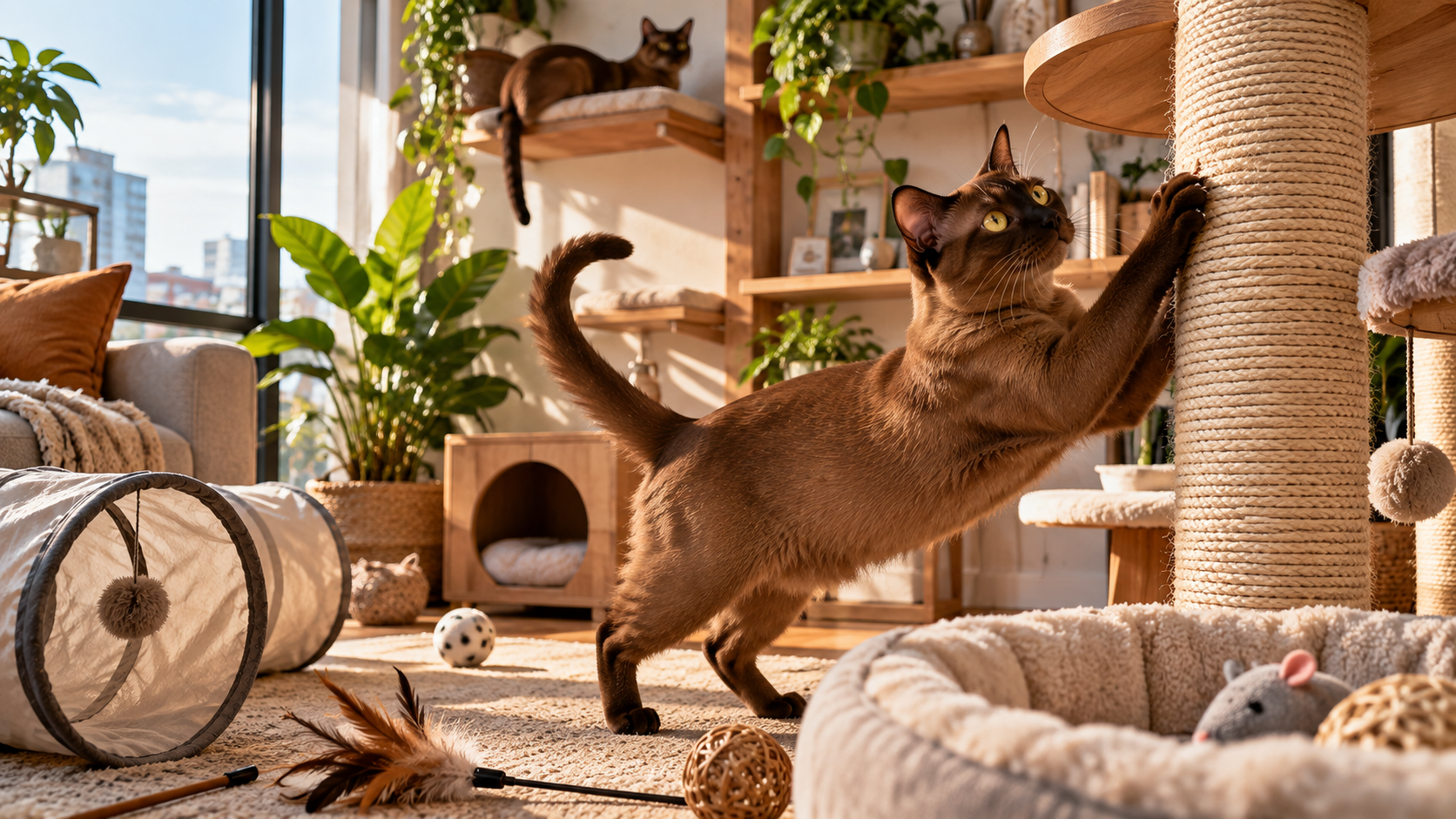
The food bowl is full.
There is fresh water.
A soft bed sits by the window.
Several toys are scattered across the floor.
Your cat has never had to worry about rain, traffic, predators, or finding the next meal.
From a human perspective, the arrangement sounds almost perfect.
Yet your cat is sprinting through the hallway at midnight.
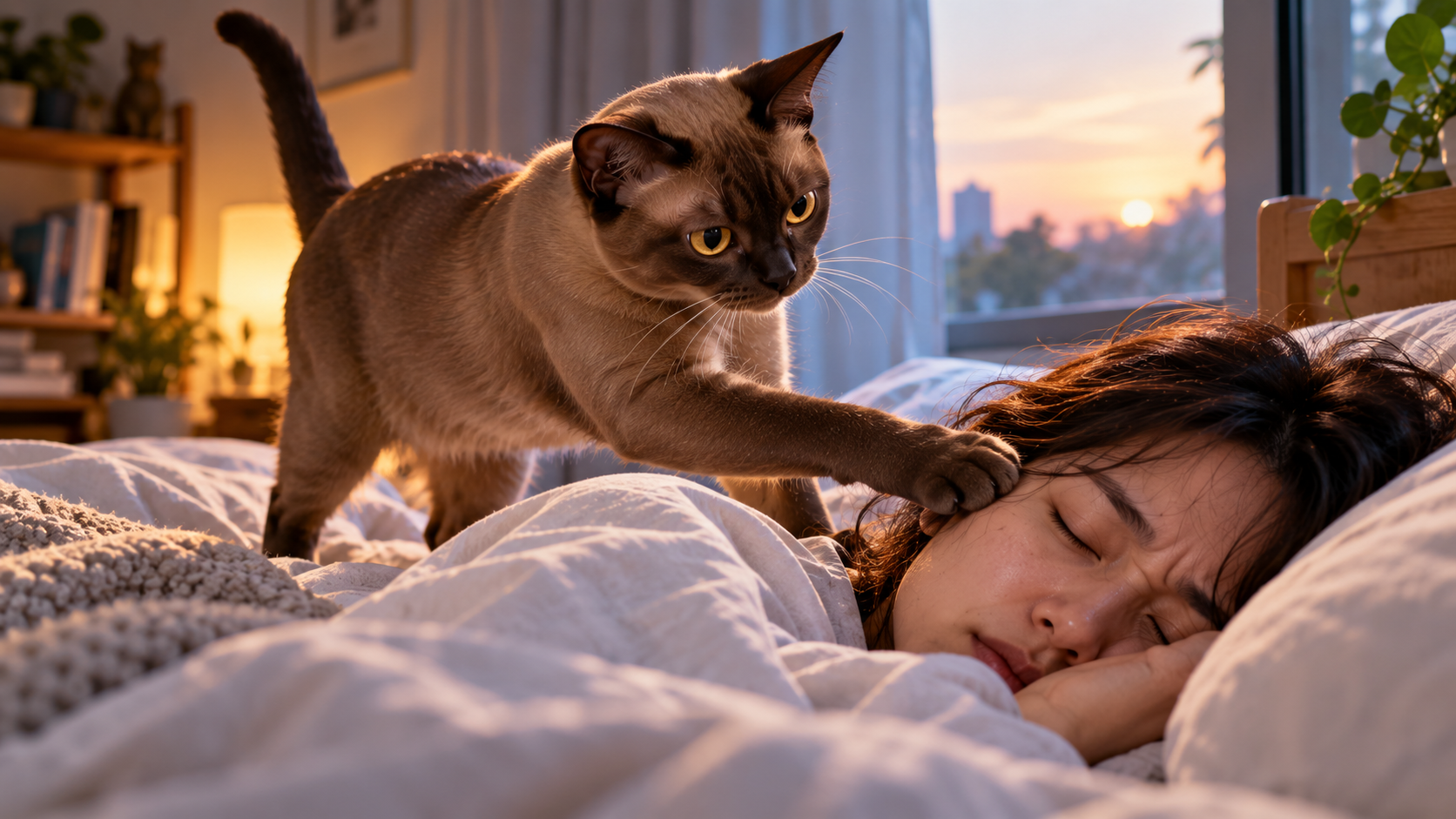
Scratching the side of the sofa.
Climbing onto shelves.
Knocking small objects onto the floor.
Following you from room to room.
Sitting beside the toy basket while apparently refusing to play with anything inside it.
It is easy to look at this behavior and conclude that the cat is simply demanding, mischievous, or impossible to entertain.
But a comfortable home and an interesting home are not necessarily the same thing.
Understanding indoor cat enrichment starts with recognizing that cats do not stop having natural behavioral needs simply because they live safely indoors.
They still want to climb.
Observe.
Hide.
Scratch.
Explore.
Chase.
Pounce.
Investigate unfamiliar objects.
Rest somewhere they consider secure.
And interact with their environment in ways that make them feel as though they have choices.
The goal of enrichment is not to keep a cat entertained every second of the day.
It is to create a home that gives normal feline behavior somewhere appropriate to happen.
Indoor Safety Doesn’t Automatically Create an Interesting Life
Indoor cats can have extremely comfortable lives.
The difficulty is predictability.
The sofa stays in the same place.
Food appears in the same bowl.
The hallway smells familiar.
Nothing moves unless a person moves it.
The same toys remain on the floor for weeks.
There may be very little reason to investigate anything.
For humans, predictability can feel peaceful.
For a curious animal, too much predictability can make an environment less stimulating.
That does not mean you need to constantly redesign your house.
Small changes can create meaningful opportunities for exploration.
Enrichment Is More Than Buying More Toys
This is one of the biggest misconceptions.
Cat seems bored?
Buy another toy.
Cat ignores it?
Buy five more.
Soon there is a basket containing twenty toys the cat barely touches.
The problem may not be the number of toys.
Enrichment includes the entire environment.
Where can your cat climb?
Where can they hide?
What can they scratch?
Can they observe activity from above?
Can they look outside?
Do they ever have to search for something?
Can they retreat somewhere without being disturbed?
Does play resemble hunting?
A single cardboard box placed somewhere interesting may occasionally provide more stimulation than an expensive toy permanently sitting in the same corner.
Cats Need to Do Cat Things
Many behaviors humans find inconvenient are perfectly normal feline behaviors.
Scratching is normal.
Climbing is normal.
Pouncing is normal.
Chasing is normal.
Exploring cabinets is normal.
Watching movement is normal.
Hiding is normal.
The conflict begins when the home provides no acceptable location for those behaviors.
The cat still scratches.
But the sofa becomes the scratching surface.
The cat still climbs.
But the kitchen counter becomes the observation platform.
The cat still hunts moving objects.
But your ankles become the moving target.
A better environment does not try to eliminate every instinct.
It redirects those instincts toward safer and more appropriate opportunities.
Start by Watching Your Cat
Before buying anything, observe.
Where does your cat naturally spend time?
Where do they scratch?
Where do they sleep?
Which window do they prefer?
Do they enjoy high places?
Do they hide under furniture?
Do they chase fast-moving toys or prefer something that moves slowly?
Do they like cardboard?
Fabric?
Paper?
Small balls?
Every cat has preferences.
Even cats living in the same household may interact with their environment differently.
Good indoor cat enrichment starts with the individual cat rather than a universal shopping list.
Vertical Space Can Make a Small Home Feel Much Larger
Humans mostly think about floor area.
Cats can use height.
A small apartment may feel limited to us while offering a surprising amount of usable territory if vertical space is accessible.
Cat trees.
Stable shelves.
Window perches.
Secure furniture.
Elevated beds.
These can create additional places for observation and rest.
For many cats, being above floor level is not merely entertainment.
It gives them another way to understand and navigate their environment.
Height Can Also Provide Distance
Imagine a home with children, visitors, or another pet.
A cat may want to remain in the room without participating in everything happening on the floor.
An elevated perch provides that option.
They can observe.
Rest.
Decide whether to approach.
That sense of choice matters.
A cat should not have to completely leave the social area every time they want some distance.
Put Cat Furniture Where Life Actually Happens
A beautiful cat tree is purchased.
Then placed in the quietest spare room because it fits the decor better there.
The cat barely uses it.
That does not necessarily mean the cat dislikes cat trees.
Maybe the location is uninteresting.
Try placing useful resources where your cat already wants to spend time.
Near a favorite window.
Close to the living room.
Beside a frequently used resting area.
Near a location where the cat already tries to climb.
Cat furniture becomes more useful when it participates in the cat’s existing routine.
Window Watching Can Be Enrichment
A window can provide constantly changing visual stimulation.
Birds.
People.
Leaves.
Weather.
Cars.
Shadows.
Other animals.
A secure perch beside a suitable window may become one of the most frequently used places in the house.
However, watch your individual cat.
Some cats calmly observe outdoor activity.
Others may become frustrated or highly aroused by certain animals outside.
Enrichment should improve the environment, not repeatedly create distress.
Give Your Cat Somewhere to Hide
Enrichment is often imagined as activity.
Running.
Jumping.
Playing.
But security is equally important.
A cat should have places where they can retreat.
A covered bed.
Cardboard box.
Open carrier.
Quiet shelf.
Protected corner.
The important feature is not how attractive the hiding place looks to us.
It is whether the cat considers it safe.
Don’t Constantly Pull a Hiding Cat Out
You bought a beautiful bed.
Your cat chooses the cardboard box it came in.
Fine.
Cats often have their own opinions about what feels secure.
Unless the location is dangerous or access is required for an important reason, allowing the cat some control over when they emerge can make hiding spaces more meaningful.
A safe place works because the cat expects it to remain safe.
Scratching Is Not Bad Behavior
A cat scratching furniture can be frustrating.
But scratching itself is not the problem.
Cats scratch as part of normal behavior, including claw maintenance, stretching, and communication.
Trying to eliminate scratching entirely sets up a conflict you are unlikely to win.
Instead ask:
What does my cat prefer to scratch?
And where?
Some Cats Prefer Vertical Scratchers
They stretch upward.
Front paws high.
Long scratches down the surface.
These cats may prefer a tall vertical post.
The post needs to be stable.
If it wobbles every time the cat places weight on it, the sofa may feel much more reliable.
Height matters too.
A small post that prevents a full stretch may be less appealing than a large piece of furniture.
Other Cats Prefer Horizontal Scratching
Your cat ignores the expensive vertical post.
Then destroys a cardboard box lying flat on the floor.
That is useful information.
Try horizontal cardboard scratchers or another suitable flat surface.
Some cats use both orientations.
Providing options can reveal preferences surprisingly quickly.
Texture Matters
Sisal.
Cardboard.
Wood.
Fabric.
Different cats may prefer different scratching materials.
If a cat repeatedly scratches one particular household surface, examine what makes it appealing.
Orientation?
Texture?
Location?
Stability?
Instead of simply placing a random scratching post somewhere else, provide an alternative that competes with the surface the cat already chose.
Location Matters as Much as the Scratcher
You place the scratching post behind a door.
The cat continues scratching the sofa.
Why?
Because the sofa is located exactly where the cat wants to scratch.
Cats may scratch after resting, along common pathways, or in socially significant areas.
Try putting an appropriate scratching surface close to the existing target.
Once it is being used consistently, location adjustments can sometimes be made gradually.
A Worn Scratcher Isn’t Necessarily Ready for the Trash
Humans see shredded cardboard and frayed sisal.
We see something ugly.
The cat may see a perfectly established scratching spot.
If it remains safe and functional, do not automatically replace a scratcher simply because it looks used.
Heavy use often means the resource is doing exactly what it was supposed to do.
Play Should Resemble Hunting Sometimes
Rolling a toy toward a cat can be fun.
But interactive play can become more engaging when movement resembles prey.
A wand toy can:
Disappear behind furniture.
Pause.
Move slowly.
Suddenly dart away.
Change direction.
Hide.
Reappear.
The goal is not random frantic movement.
Let the cat watch.
Stalk.
Approach.
Chase.
Pounce.
That sequence can make play much more interesting.
Don’t Wave the Toy Directly in Your Cat’s Face
Imagine prey in nature.
It usually does not repeatedly slap a predator on the forehead.
Yet this is how people sometimes use wand toys.
Move the toy away from the cat.
Across the floor.
Behind an object.
Around a corner.
Give the cat something to pursue rather than something constantly invading their face.
Let Your Cat Catch the Toy
If the toy always escapes, the game can become frustrating.
Allow successful catches.
Pause.
Let the cat grab it.
Then resume when appropriate.
Play is not a competition between human and cat.
The objective is engagement.
Not winning.
Short Play Sessions Can Still Be Valuable
You do not necessarily need an uninterrupted hour.
Several short sessions can fit naturally into the day.
Before breakfast.
After work.
Before the household settles down at night.
The right length depends on the individual cat.
Watch engagement.
When interest disappears, forcing another twenty minutes rarely improves the experience.
Kittens and Young Cats May Need More Outlets
A young cat can seem like an unlimited source of energy.
Run.
Jump.
Climb.
Sleep.
Wake up.
Repeat.
Expecting a highly active young cat to spend the entire day quietly beside the sofa is unrealistic.
Provide appropriate ways to use that energy.
Interactive play.
Climbing.
Exploration.
Safe toys.
Scratching.
The environment should match the developmental stage of the animal living in it.
Adult Cats Still Need Play
Play is not only for kittens.
An adult cat may be calmer, but that does not mean environmental stimulation becomes unnecessary.
The style may change.
Sessions may become shorter.
Toy preferences may change.
Intensity may decrease.
Continue offering opportunities rather than assuming adulthood means a cat wants nothing except food and sleep.
Senior Cats Need Enrichment Too
Older cats may not leap onto the highest shelf anymore.
That does not mean enrichment should disappear.
Adapt it.
Lower platforms.
Easier access.
Shorter play.
Comfortable observation spots.
Gentle exploration.
Accessible scratching surfaces.
The objective is not to force an older cat to behave like a kitten.
It is to keep the environment engaging within the cat’s current abilities.
Sudden changes in mobility, activity, or willingness to jump should not automatically be dismissed as aging and may warrant veterinary attention.
Rotate Toys Instead of Leaving Everything Out
Imagine receiving ten new objects.
Interesting.
Now imagine those same ten objects lying in your bedroom for six months.
Eventually they become background.
Cats can also habituate to toys.
Try keeping only a selection available.
Put others away.
Later, rotate them.
An old toy may regain some novelty after being absent for a while.
This is cheaper than constantly buying replacements.
Novelty Doesn’t Need to Be Expensive
A cardboard box.
Packing paper.
A paper bag with handles removed.
A rearranged tunnel.
A chair placed near a window.
A familiar toy moved to another location.
A safe new object to investigate.
Enrichment does not require a luxury pet-store budget.
Often what matters is change, choice, and interaction.
Cardboard Boxes Work for a Reason
A box can become:
A hiding place.
Observation point.
Play tunnel.
Ambush location.
Sleeping area.
Object to investigate.
Two holes cut into the sides can completely change how the box is used.
Before recycling your next delivery box, see whether your cat has other plans for it.
Be Careful With Bags
Cats may enjoy exploring paper bags.
But handles can become dangerous if the cat gets caught.
Remove handles before offering a bag for play.
Avoid plastic bags as toys.
Supervise unfamiliar objects until you understand how your cat interacts with them.
Safety comes before novelty.
Not Every Household Object Is a Cat Toy
String.
Ribbon.
Thread.
Hair ties.
Rubber bands.
Small pieces of plastic.
They may look extremely exciting to a cat.
They can also be dangerous if swallowed.
Interactive wand toys with strings should generally be stored after play rather than left unattended.
Enrichment should create opportunities without introducing preventable hazards.
Your Hands Should Not Become Prey
A kitten attacking fingers can look adorable.
Then the kitten grows.
The teeth become stronger.
The claws become larger.
And the cat has learned that human hands are appropriate hunting targets.
Use toys for chase-and-capture play.
Hands can remain associated with gentle interaction, handling, and affection.
This distinction becomes increasingly useful as the cat matures.
Food Can Become an Activity
In many homes, eating requires almost no effort.
Walk to bowl.
Eat.
Leave.
For some cats, part of the daily food ration can become enrichment.
Puzzle feeders.
Food-dispensing toys.
Small portions placed in different appropriate locations.
Simple search games.
These can turn eating into an activity rather than a single event.
Start Food Puzzles Easy
A cat does not understand that the complicated plastic object you purchased contains a fun intellectual challenge.
They may simply think:
“My food is trapped.”
Start with something easy.
Make success obvious.
Then gradually increase difficulty if the cat enjoys it.
A puzzle should create engagement.
Not prevent the cat from getting enough food.
DIY Food Puzzles Can Be Simple
You do not necessarily need specialized equipment.
Depending on the cat and food being used, safe household materials can sometimes create simple searching or pawing activities.
The design should not contain sharp edges, loose pieces, or materials the cat can easily swallow.
Supervise new setups.
If your cat starts chewing the container rather than solving the puzzle, change the activity.
Use Part of the Normal Food Allowance
Food enrichment does not automatically mean adding extra calories.
For many activities, part of the cat’s normal daily ration can be used.
This becomes particularly relevant if treats are frequently used for:
Training.
Puzzle toys.
Rewards.
Interactive games.
Small extras accumulate quickly.
Diet and portion questions should be discussed with a veterinarian when needed, especially for cats with weight or medical concerns.
Water Placement Can Also Be Part of the Environment
Food and water are basic resources.
But placement matters.
Some cats may prefer water away from their food.
Some enjoy multiple drinking locations.
Some prefer moving water.
The best setup depends on the individual.
The broader principle is useful:
Do not think of cat resources only as objects.
Think about where those resources are placed and how easily the cat can access them.
Multiple Resources Matter in Multi-Cat Homes
Two cats sharing a home are not automatically best friends.
Even cats that sleep together may want space at certain times.
If everything important is concentrated in one corner, one cat can indirectly control access.
Food.
Water.
Litter.
Resting places.
Scratching areas.
Elevated spots.
Distributing important resources can reduce unnecessary competition.
One Cat Tree Isn’t Always Shared Territory
A large cat tree appears capable of holding three cats.
That does not mean all three cats want to use it simultaneously.
One confident cat may occupy the top.
Another avoids the structure entirely.
Look at actual behavior rather than assuming physical capacity equals social accessibility.
Sometimes several smaller options around the home work better than one impressive central structure.
Pay Attention to Quiet Conflict
Cat conflict is not always dramatic fighting.
One cat may stare.
Block a hallway.
Occupy a doorway.
Follow another cat away from a resource.
Guard access to a favorite perch.
The affected cat simply stops using part of the home.
If one cat suddenly changes routine in a multi-cat household, observe the social environment carefully.
The issue may not be boredom.
Enrichment Should Include Choice
A cat does not need to use every resource.
That is okay.
The value often lies in having options.
High bed or low bed.
Open resting place or enclosed hiding place.
Vertical scratcher or horizontal scratcher.
Window view or quiet room.
Social interaction or solitude.
An environment with choices allows the cat to participate in managing its own comfort.
Don’t Force Interaction Because the Cat “Needs Enrichment”
You decide your cat needs play.
Your cat decides it is nap time.
Dragging them out of the bed and repeatedly pushing a toy toward them is unlikely to create a positive experience.
Offer.
Invite.
Observe.
Try again later.
Enrichment should create opportunity rather than constant stimulation.
Cats Need Quiet Time Too
More stimulation is not always better.
Music.
Children.
Visitors.
Toys.
Movement.
Television.
Other pets.
Constant touching.
A home can become overwhelming.
Good enrichment includes places where nothing is demanded of the cat.
A quiet resting area can be as important as an exciting toy.
Predictability and Novelty Need Balance
This sounds contradictory.
Cats often benefit from predictable routines.
They also benefit from opportunities to explore.
Both can coexist.
Meals can happen around familiar times.
Litter boxes remain accessible.
Favorite resting places stay available.
Meanwhile, toys rotate.
Boxes appear.
Play patterns change.
Small exploration opportunities are introduced.
The foundation stays stable while parts of the environment remain interesting.
Use the Cat’s Existing Behavior as a Clue
Cat climbs the bookshelf?
They may value height.
Cat sleeps inside delivery boxes?
They may value enclosed spaces.
Cat scratches the rug?
Try horizontal scratching options.
Cat watches the window for hours?
Improve the perch.
Cat steals small objects and bats them across the floor?
Look for safe toys with similar movement.
Instead of constantly asking how to stop behavior, sometimes ask what the behavior is telling you.
Redirect Before You Punish
Cat scratches sofa.
Yelling may interrupt the behavior at that moment.
But the need to scratch still exists.
Provide a suitable scratching option.
Make it appealing.
Place it where it is likely to be used.
Reward appropriate use.
Environmental solutions tend to make more sense than expecting a cat to simply abandon a normal behavior without an alternative.
Punishment Can Create a Different Problem
A cat may learn:
“Scratching this chair while the human is watching causes something unpleasant.”
That is not necessarily the same as learning:
“This scratching post is the correct place to scratch.”
Worse, repeated punishment can make the cat wary of the person delivering it.
Focus on setting up the environment so the desirable behavior is easy and rewarding.
Reward What You Want to See Again
Cat uses the scratching post?
Great.
Cat enters the carrier voluntarily?
Great.
Cat settles on the intended perch?
Great.
Positive reinforcement can help desirable behaviors become more valuable.
Rewards do not always need to be food.
Depending on the cat, attention, play, or access to something enjoyable may also matter.
The Carrier Can Become Part of the Furniture
For many cats, the carrier appears only before something unpleasant.
Suddenly it comes out of storage.
The cat disappears under the bed.
Instead, if practical, consider leaving the carrier accessible as a familiar object.
Add comfortable bedding.
Occasionally place treats inside.
Allow exploration without immediately closing the door.
A carrier that exists in everyday life can become less mysterious.
Create Exploration Without Rearranging the Whole House
You do not need a new environment every morning.
Try small changes.
Move a box.
Create a temporary tunnel.
Place a toy behind a chair.
Move a perch to another safe window.
Hide a few pieces of food where appropriate.
Open access to a safe room the cat does not frequently explore.
Small novelty can be enough.
Scent Is Part of a Cat’s World
Humans design homes visually.
Cats experience them heavily through scent.
This matters when introducing:
New furniture.
New bedding.
New pets.
Visitors.
Cleaning products.
Strong fragrances.
Allow familiar scent to remain in important resting and scratching areas when possible.
A home does not need to smell “new” to feel comfortable to a cat.
Avoid Over-Cleaning Every Familiar Cat Scent at Once
We naturally want cat bedding and frequently used surfaces to be clean.
But replacing or washing everything simultaneously can remove familiar scent cues.
This does not mean leaving things unhygienic.
It means recognizing that familiar smells can contribute to environmental continuity.
Rotate cleaning when practical instead of resetting every resource at the same time.
Plants Need Special Attention
A cat sees an interesting leaf.
You see interior decoration.
Some plants can be harmful to cats.
Before bringing plants into a cat household, check whether the species is considered safe.
Do not assume a cat will ignore a plant simply because it has ignored others.
Curiosity can change.
Keep unsafe materials completely inaccessible.
Cat Grass Isn’t a Substitute for Checking Plant Safety
Providing a cat-safe plant does not guarantee the cat will avoid everything else.
If the household contains plants that could pose a risk, prevention matters.
Environmental enrichment should never depend on the cat consistently making the safe choice.
Cat-proofing remains part of responsible indoor living.
Balconies Need More Than Supervision
A balcony can appear like incredible enrichment.
Fresh air.
Birds.
Sounds.
Views.
But an unsecured balcony also presents obvious fall and escape risks.
If outdoor access is provided, the setup needs to be appropriately secured.
Do not rely on the assumption that a cat “knows not to jump.”
Unexpected movement can change behavior instantly.
A Secure Outdoor Enclosure Can Expand the Environment
Where practical, a properly secured catio or enclosed outdoor space can provide additional sights, smells, and sounds without unrestricted roaming.
It does not need to be enormous.
Even a secure window enclosure can provide a different sensory experience.
The key word is secure.
Inspect barriers regularly.
Weather, wear, and determined cats can find weaknesses humans overlook.
Harness Walking Is Optional, Not Mandatory
Some cats enjoy carefully introduced harness walks.
Others clearly do not.
Do not assume every indoor cat needs outdoor walks to have a fulfilling life.
A frightened cat being dragged around outside is not receiving meaningful enrichment.
If harness training is attempted, introduce it gradually and positively.
Individual temperament matters.
Social Interaction Is Enrichment Too
You may already be the most interesting thing in the house.
Cats can enjoy:
Play.
Gentle grooming.
Training.
Sitting nearby.
Following household activity.
Short predictable interaction.
Some Burmese cats in particular are often described as highly people-oriented, but breed tendencies never replace the personality of the individual cat.
One may want constant involvement.
Another may prefer interaction in smaller doses.
Affection Should Still Include Consent
A social cat is not necessarily asking to be touched constantly.
Watch body language.
A cat can enjoy sitting beside you without wanting to be picked up.
They may enjoy several strokes and then want to stop.
Respecting these boundaries helps interaction remain predictable.
The cat learns that approaching a person does not mean losing control over what happens next.
Training Can Be Enrichment
Cats can learn.
Simple reward-based training can add mental activity and improve communication.
Touching a target.
Entering a carrier.
Going to a mat.
Coming when called.
Stepping onto a scale.
The objective does not need to be entertainment for humans.
Useful behaviors can also reduce stress during everyday care.
Keep Training Sessions Short
A five-minute session can be enough.
Sometimes even shorter.
Stop while the cat is still engaged.
Use rewards the individual values.
If the cat walks away, the session is probably over.
Training should feel like an opportunity to earn something enjoyable, not a compulsory lesson.
The Best Enrichment Often Changes Over Time
The toy your kitten loved may become irrelevant at age five.
A senior cat may stop using a high perch.
A new window becomes interesting after furniture moves.
Another cat joins the household.
Your schedule changes.
The environment should evolve with the animal.
There is no single enrichment setup you install once and consider finished forever.
Watch for Changes That Don’t Look Like Ordinary Boredom
This distinction matters.
A cat suddenly stops playing.
No longer jumps onto a favorite surface.
Hides much more than usual.
Changes appetite.
Begins eliminating outside the litter box.
Becomes unusually aggressive.
Vocalizes differently.
Overgrooms.
These changes should not automatically be explained as boredom.
Behavior changes can accompany medical problems, pain, stress, or other issues.
When something changes suddenly or persists, veterinary guidance is appropriate.
A Simple Enrichment Audit for Your Home
Walk through your home from your cat’s perspective.
Not yours.
Ask:
Where can the cat climb?
Where can they observe from above?
Where can they hide?
Where can they scratch vertically?
Where can they scratch horizontally?
Where can they look outside safely?
What opportunities exist for interactive play?
What can they explore?
Can food occasionally involve searching or problem-solving?
Does the cat have somewhere quiet?
If multiple cats live together, are important resources distributed?
You do not need perfect answers to everything immediately.
The audit simply reveals where the environment may be too limited.
You Don’t Need to Turn Your Home Into a Cat Playground Overnight
Start with the behavior you already observe.
If the sofa is being scratched, improve scratching options first.
If the cat constantly seeks the highest furniture, work on safe vertical space.
If they wake you wanting to play, review their daily activity and interactive play routine.
If every toy is ignored, rotate them and experiment with different movement styles.
Solve real needs instead of purchasing everything marketed as enrichment.
Try One Change at a Time
This also helps you learn what works.
Add a window perch.
Observe.
Introduce a horizontal scratcher.
Observe.
Rotate toys.
Observe.
Try a simple food puzzle.
Observe.
If you change twenty things at once, you may never know which improvement your cat actually valued.
Cats give feedback through behavior.
Pay attention to it.
An Enriched Home Doesn’t Have to Look Chaotic
Cat enrichment and a pleasant living space can coexist.
Choose scratching furniture that works with your interior.
Use shelves that double as cat pathways.
Place attractive baskets or covered beds in quiet corners.
Store rotating toys out of sight.
Use furniture strategically.
The objective is not to fill every room with brightly colored pet products.
It is to make the existing home function better for the animal sharing it.
The Most Expensive Product Isn’t Necessarily the Most Valuable
A cardboard box may beat a designer bed.
A secure shelf may beat an elaborate toy.
Ten minutes of interactive play may beat another battery-powered gadget.
A stable scratching post in the correct location may beat three scratchers hidden in unused rooms.
Value comes from whether the cat actually uses the resource.
Not what it cost.
Your Cat Should Be Able to Make Small Decisions
Where to sleep.
Where to watch.
Whether to interact.
Which scratching surface to use.
Whether to sit high or low.
Whether to hide.
Which toy to chase.
These seem like tiny choices.
But together they make the indoor environment more flexible.
A home designed entirely around human convenience can unintentionally remove many of those options.
Good enrichment gives some of them back.
Conclusion
A cat can have excellent food, a warm bed, attentive humans, and a safe indoor home while still needing more opportunities to behave like a cat.
That is the real purpose of indoor cat enrichment.
It is not about filling the house with toys.
It is about creating appropriate outlets for climbing, scratching, hiding, observing, exploring, playing, hunting-style behavior, resting, and social interaction.
Watch what your cat already does.
Their behavior often tells you what the environment is missing.
A scratched sofa may point toward a scratching preference.
A cat constantly climbing furniture may need better vertical territory.
A toy that has been ignored for months may simply have lost its novelty.
A cat attacking ankles may need more appropriate opportunities for chase-and-pounce play.
Start small.
Create choices.
Rotate experiences.
Keep safety in mind.
And adjust the environment as your cat changes.
A good indoor home should do more than protect a cat from the outside world.
It should give them something meaningful to do inside it.