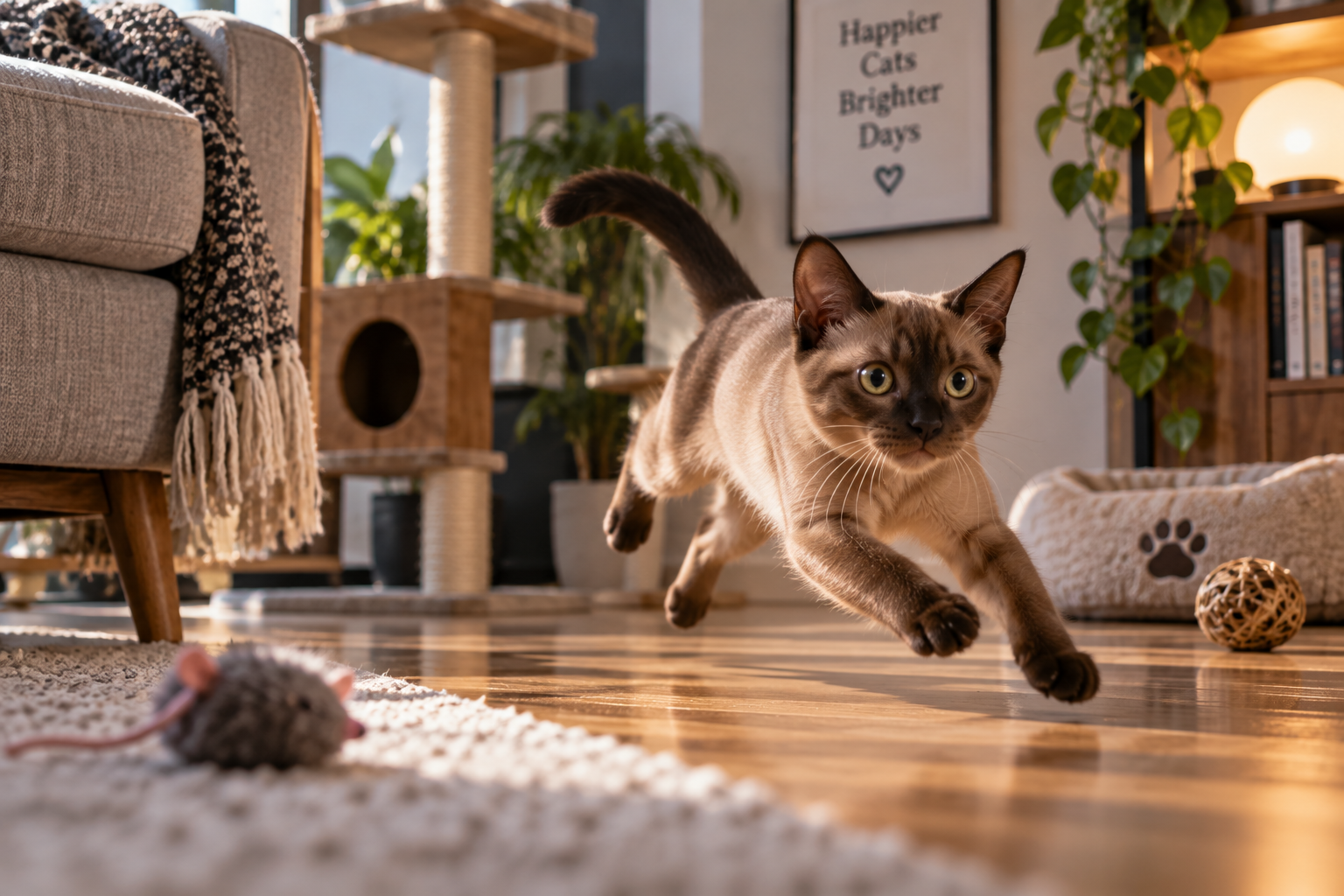
Five minutes ago, your cat looked completely finished with the day.
They were curled up on the sofa, eyes half closed, paws tucked underneath their body. Then, without any obvious warning, they launched themselves across the room.
Down the hallway.
Around the furniture.
Onto the chair.
Back across the room at full speed.
For many cat owners, these sudden bursts of activity are affectionately known as the “zoomies.” They can look completely random, particularly when they happen late at night while the rest of the household is trying to settle down.
So why do cats get the zoomies?
In many cases, these short bursts of intense activity are part of normal feline behavior. Understanding when and why they happen can also reveal useful information about a cat’s daily routine, environment, play opportunities, and natural activity patterns.
Zoomies Are Short Bursts of Intense Activity
The scientific-sounding term sometimes used for zoomies is frenetic random activity periods, or FRAPs.
The behavior can include sprinting, sharp turns, jumping onto furniture, running up and down stairs, chasing invisible targets, or suddenly initiating play.
A cat may appear extremely energetic for several minutes and then return to normal almost as quickly as the episode started.
That sudden contrast is what makes zoomies look so dramatic.
Your cat did not necessarily go from “tired” to “full of energy” in a few seconds. Cats naturally alternate between periods of rest and concentrated activity.
Cats Sleep a Lot Without Being Low-Energy Animals
Cats can spend a substantial portion of the day resting or sleeping.
That sometimes creates the impression that they should not have much energy left.
But feline activity is not necessarily distributed evenly across the day.
Instead of maintaining one constant activity level for hours, cats can conserve energy during long periods of rest and then use it in short, intense bursts.
That pattern makes much more sense when we consider how feline behavior developed around hunting.
Waiting and resting can be followed by sudden acceleration when an opportunity appears.
Your living room is obviously not a hunting ground, but many of the underlying behavioral patterns remain.
Their Natural Rhythm Does Not Always Match Yours
People commonly describe cats as nocturnal.
The reality is more nuanced.
Cats are often particularly active around dawn and dusk, although individual routines can shift considerably depending on household schedules, feeding, environment, age, and other factors.
This helps explain why a cat may become energetic just when their owner wants to relax.
From the human perspective, 10 PM may mean the day is ending.
For the cat who spent much of the afternoon sleeping, it may feel like an excellent time to run.
Indoor Cats Still Need Ways to Use Hunting Behaviors
A house cat may never need to hunt for dinner.
That does not mean behaviors associated with hunting disappear.
Cats can still have strong motivation to stalk, chase, pounce, grab, and explore.
When those behaviors do not have enough appropriate outlets during the day, sudden energetic play may become especially noticeable.
This is one reason interactive play can be valuable.
The goal is not simply to make a cat physically tired.
Good play gives them an appropriate target for behaviors they are naturally motivated to perform.
Wand Toys Can Create a More Complete Play Session
A toy lying on the floor may be interesting.
A toy that behaves like prey can be much more engaging.
Wand-style toys allow owners to move the target behind furniture, across the floor, around corners, or briefly out of sight.
Instead of waving the toy directly in front of the cat continuously, let the cat watch, stalk, chase, and occasionally catch it.
Catching matters.
A game where the “prey” remains permanently impossible to capture can be less satisfying than one that includes successful pounces.
Do Not Use Your Hands as the Prey
A kitten attacking fingers can look harmless.
The same habit becomes less entertaining when the cat is larger and stronger.
Use toys to create distance between teeth or claws and human skin.
This helps the cat learn what is appropriate to chase and wrestle.
If hands regularly become play targets, the cat receives a confusing lesson: sometimes attacking human body parts is part of the game.
Clear boundaries are easier to establish before the behavior becomes a habit.
Evening Play May Fit Some Cats Well
If your cat consistently becomes extremely active at night, consider what happens in the hours beforehand.
Did they spend most of the evening sleeping?
Was there little interaction or play?
Does the household suddenly become quiet just as the cat becomes active?
A planned interactive play session before your own wind-down routine may provide a more structured outlet.
It will not necessarily eliminate every nighttime sprint, nor should that always be the goal.
But it can help align part of the cat’s active period with a time that works better for the household.
The Hunt-Eat-Groom-Rest Pattern Can Be Useful
A commonly discussed way to structure feline routines is to imitate a simplified sequence of activity followed by food and rest.
Interactive play provides the chase and capture component.
A meal or portion of the cat’s normal food can follow.
After eating, some cats naturally move toward grooming and resting.
This is not a magic formula that guarantees a sleeping cat all night.
But predictable sequences can be more useful than trying to stop energetic behavior only after the cat is already racing through the house.
Kittens Can Have Spectacular Zoomies
If you live with a kitten, sudden chaos should not be especially surprising.
Young cats are learning how their bodies work.
Running, jumping, climbing, chasing, wrestling, and exploring all provide opportunities to practice coordination and interact with their environment.
Their energy can also appear in repeated bursts throughout the day.
A kitten may play intensely, collapse into sleep, wake up, eat, and then behave as though the previous sprint never happened.
The household needs to be prepared for that level of curiosity.
Kitten-Proof the Route, Not Just the Toys
Zoomies rarely respect your preferred play area.
A cat may race from one room to another using furniture as part of the route.
Look at the home from the perspective of an animal moving quickly.
Can a loose object fall from a shelf?
Are electrical cords easily accessible?
Could an unstable piece of furniture tip?
Are windows and balconies secure?
Are there fragile objects along common running paths?
You do not need an empty house.
But a safe environment allows normal energetic behavior without every sprint becoming an emergency.
Vertical Space Can Add More Usable Territory
For cats, floor area is only part of the environment.
Vertical space matters too.
Cat trees, stable shelves designed for feline use, window perches, and other secure elevated areas can create additional opportunities for climbing, observing, and resting.
This can be especially valuable in smaller homes.
Two rooms with identical floor space may feel very different to a cat if one provides multiple safe levels to explore.
Environmental enrichment is not always about adding more toys.
Sometimes it is about making better use of the space that already exists.
Rotate Toys Instead of Leaving Everything Out Forever
A mountain of toys on the floor does not automatically create an interesting environment.
Items that remain available continuously can become familiar and easy to ignore.
Rotating some toys can restore novelty.
Keep a selection accessible, put others away, then reintroduce them later.
Different cats prefer different textures and play styles, so pay attention to what actually generates engagement rather than buying toys based only on what looks appealing to humans.
The best enrichment is the enrichment the cat actually uses.
Food Puzzles Can Turn Eating Into an Activity
Not every form of enrichment needs to involve sprinting.
Food puzzles or suitable feeding toys can encourage cats to interact with an object to obtain part of their normal food.
This can add mental and physical activity to a routine that would otherwise consist of walking to a bowl and eating immediately.
Introduce new puzzles gradually.
If the challenge is too difficult from the beginning, the cat may simply walk away.
Enrichment should create engagement, not unnecessary frustration.
Zoomies After Using the Litter Box Can Happen Too
Some owners notice a particularly strange pattern.
The cat uses the litter box and immediately races away at full speed.
There are several proposed explanations for this behavior, and it is not always possible to assign one universal reason to every cat.
If the cat otherwise appears comfortable and the behavior is familiar for them, the post-litter-box sprint may simply be part of their individual routine.
However, context matters.
Changes involving elimination deserve more attention than the sprint itself.
Watch the Litter Box Behavior Around the Zoomies
A cat running after using the litter box is different from a cat showing signs of difficulty while using it.
Pay attention to straining, repeated attempts, unusual vocalization, blood, elimination outside the box, changes in urine or stool, or other signs that something is different.
If those appear, the important question is no longer “why is my cat running?”
The elimination change becomes the priority.
Urinary problems in cats can be serious, and difficulty passing urine—particularly an inability to urinate—requires prompt veterinary attention.
Normal-looking zoomies should not distract from abnormal litter box behavior.
Not Every Nighttime Noise Means Your Cat Needs More Play
Sometimes owners assume any nighttime activity is caused by boredom.
That can be too simplistic.
A cat may wake because they heard something outside.
Another pet may have moved.
There may be insects near a window.
The household schedule may have changed.
The cat may simply be entering a normal active period.
Before dramatically changing the routine, observe the pattern for several days.
Behavior makes more sense when you know what tends to happen immediately before it.
Avoid Accidentally Training a 3 AM Wake-Up Routine
Suppose your cat wakes you in the middle of the night.
You get up.
You talk to them.
You give food.
Maybe you even play for a few minutes so they will settle.
From the cat’s perspective, the strategy worked beautifully.
Wake the human, receive interaction.
If the behavior is not driven by a health or welfare issue, repeatedly rewarding nighttime demands can strengthen the pattern.
Household routines become easier when desirable activities happen at predictable times rather than whenever the cat successfully wakes someone.
Automatic Feeders Can Help With Food-Related Wake-Ups
For cats that consistently wake their owners because breakfast is expected, an automatic feeder may sometimes help separate food delivery from the sleeping human.
Instead of learning that meowing at a person produces breakfast, the food arrives independently.
This does not solve every nighttime behavior.
It also needs to fit the cat’s feeding plan and individual needs.
But for food-driven routines, changing who appears to “control” breakfast can be useful.
Do Not Punish Normal Energy
A cat racing through the house can be inconvenient.
Punishment is not a good substitute for understanding the behavior.
Yelling, spraying water, or frightening the cat may increase stress without teaching them an appropriate alternative.
If the problem is that the zoomies occur in an unsafe area, modify the environment.
If the issue is timing, work on the daily routine.
If the cat needs more appropriate play opportunities, provide them.
Management and redirection give the cat something useful to do rather than simply making normal behavior feel dangerous.
Multiple Cats Can Turn Zoomies Into a Chase
In multi-cat homes, one cat’s burst of energy may trigger another.
Suddenly the hallway becomes a racetrack.
Sometimes both cats are participating willingly in social play.
Other times one cat is trying to escape an interaction they do not enjoy.
Look at the broader body language.
Loose movement, taking turns chasing, brief pauses, and voluntarily returning to interaction can look different from persistent pursuit, hiding, flattened ears, defensive vocalization, or one cat repeatedly trying to disengage.
Do not assume every chase between cats is mutual play simply because they are running.
Older Cats Can Get Zoomies Too
Zoomies are strongly associated with kittens and young cats, but adult and older cats can also have sudden bursts of activity.
The intensity and frequency may change with age.
A senior cat may not race through the house with the same athleticism they had as a kitten, but short playful episodes can still be part of their routine.
What matters is the individual baseline.
A behavior that has been normal for years is different from a sudden major change in activity.
Sudden Behavioral Changes Deserve Attention
If a normally calm cat suddenly becomes unusually restless, vocal, frantic, or active—especially if the change is persistent—do not automatically label it as cute zoomies.
Look at the whole cat.
Have appetite or drinking patterns changed?
Is sleep different?
Has body weight changed?
Are there litter box changes?
Does the cat appear uncomfortable or distressed?
Behavior can sometimes be one of the first things owners notice when something else has changed.
If the pattern is new or concerning, a veterinarian is the appropriate person to help evaluate it.
Learn Your Cat’s Personal Pattern
One of the best things an owner can do is observe without immediately trying to correct everything.
When do the zoomies happen?
Before meals?
After the litter box?
After a long nap?
When you arrive home?
At roughly the same time every evening?
Does interactive play change the pattern?
Individual behavior becomes much easier to understand when viewed over time.
You may discover that what initially seemed completely random actually follows a surprisingly predictable routine.
You Do Not Need to Eliminate the Zoomies
A cat running around the house is not automatically a problem that needs solving.
If the environment is safe, the behavior is familiar, and the cat otherwise appears well, a few minutes of chaotic sprinting can simply be part of living with a cat.
The objective of enrichment is not to create an animal that remains quiet and stationary all day.
Cats need opportunities to move, investigate, climb, chase, and play.
A home that accommodates those behaviors is often more realistic than one that tries to suppress them entirely.
Conclusion
So, why do cats get the zoomies?
Often, the answer is less mysterious than the behavior looks. Cats naturally combine long periods of rest with shorter periods of concentrated activity, and indoor cats still retain strong motivations to chase, stalk, pounce, climb, and explore.
Age, daily routine, play opportunities, feeding patterns, and the home environment can all influence when those bursts of activity appear.
Instead of treating every sprint as unwanted behavior, give your cat safe outlets for energy. Use interactive play, create useful vertical space, rotate enrichment, and pay attention to the patterns surrounding nighttime activity.
At the same time, know your cat’s normal behavior.
Familiar zoomies in an otherwise comfortable cat are very different from a sudden behavioral change accompanied by changes in appetite, elimination, vocalization, or apparent discomfort.
Sometimes your cat really is just having five chaotic minutes.
And once you understand the pattern, the midnight sprint down the hallway starts looking a lot less random.