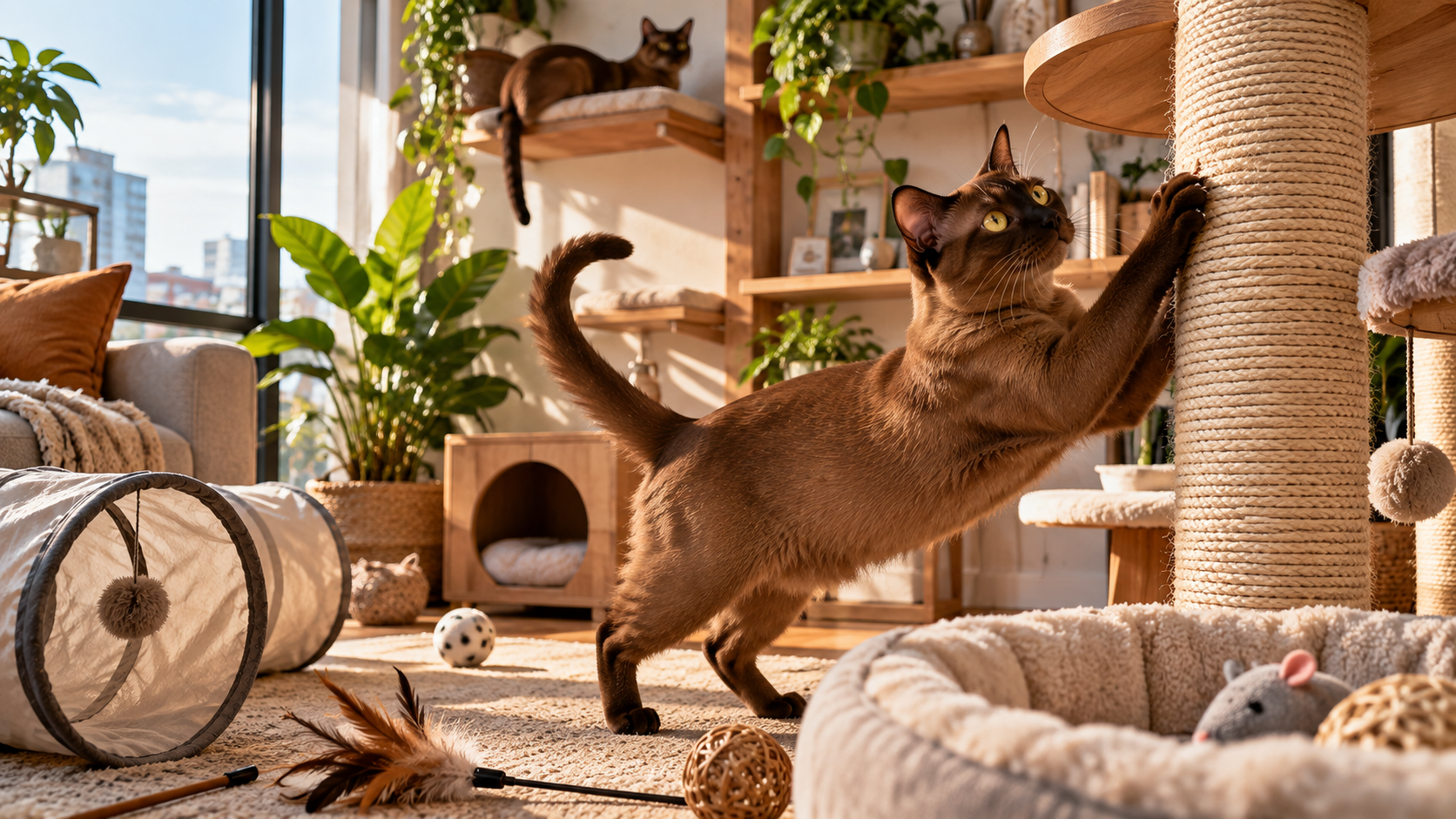
There is a basket full of cat toys in the corner.
Small balls.
Plush mice.
A tunnel.
A scratching toy.
Something with feathers.
A toy that makes noise when touched.
Your cat has options.
And yet the expensive toys remain exactly where you left them.
Meanwhile, your cat is climbing the bookshelf, scratching the side of the sofa, knocking objects from the table, attacking your feet in the hallway, and staring intensely at a cardboard box that arrived with a delivery.
It is tempting to conclude that cats simply prefer destroying things.
But the problem may be something much simpler.
Owning toys is not the same as having an enriching environment.
Good indoor cat enrichment gives cats appropriate opportunities to perform behaviors they are naturally motivated to perform: climbing, scratching, hiding, observing, exploring, hunting, playing, resting, and interacting on their own terms.
The goal is not to keep a cat entertained every minute.
It is to make the home interesting enough that normal feline behavior has somewhere appropriate to go.
Enrichment Is More Than Entertainment
People often think enrichment means toys.
Toys are part of it.
But enrichment is really about the environment.
Can the cat climb?
Can it hide?
Can it scratch?
Can it observe the room from above?
Can it retreat somewhere quiet?
Can it chase something?
Can it investigate changing objects?
Can it choose between different resting areas?
These opportunities matter because normal feline behavior does not disappear when a cat lives indoors.
The environment simply determines where those behaviors happen.
If there is no appropriate scratching surface, the sofa may become one.
If there is nowhere elevated to observe the room, the kitchen counter may become the lookout point.
If there is no interesting hunting-style play, moving ankles may become surprisingly exciting.
Start by Watching What Your Cat Already Does
Before buying anything else, observe.
Where does your cat spend most of the day?
Which furniture gets scratched?
Does the cat prefer high places or enclosed spaces?
Does it watch birds through a window?
Does it carry toys?
Does it chase moving objects?
Does it enjoy wrestling?
Does it hide when visitors arrive?
Does it follow you from room to room?
Cats reveal preferences through repetition.
The best enrichment plan begins with the cat you actually have, not a generic list of products every cat supposedly loves.
Different Cats Want Different Things
One cat may immediately climb to the highest available surface.
Another prefers staying close to the floor.
One loves chasing toys.
Another prefers stalking slowly before pouncing.
Some cats enjoy frequent human interaction.
Others want to participate from a distance.
Age matters.
Temperament matters.
Previous experience matters.
Physical ability matters.
That means effective indoor cat enrichment should offer choices rather than forcing every cat into the same routine.
Vertical Space Can Make a Small Home Feel Much Bigger
Humans usually evaluate floor space.
Cats also use height.
A room may seem small to you while offering several levels to a cat.
Floor.
Chair.
Sofa.
Shelf.
Window perch.
Cat tree.
Top platform.
Vertical space expands usable territory without requiring a larger home.
It can also provide observation points where a cat can watch activity without standing directly in the middle of it.
A Cat Tree Should Have a Purpose
Simply owning a cat tree does not guarantee the cat will use it.
Location matters.
A beautiful tower hidden in an unused corner may be less interesting than the back of the sofa beside a busy window.
Think about what the cat gains from climbing.
A view outside?
A view of the room?
Sunlight?
Distance from another pet?
A comfortable sleeping area?
Place climbing structures where the reward for using them is obvious.
Windows Can Become Natural Entertainment
A secure window can provide changing visual stimulation throughout the day.
Birds.
People.
Leaves.
Weather.
Cars.
Insects.
Shadows.
The outside world changes constantly without requiring you to operate a toy.
A comfortable perch near a safe window can therefore become one of the most consistently interesting places in the home.
Just make sure windows and screens are secure enough that observation cannot turn into an escape or fall.
Height Can Also Create a Sense of Security
Elevated spaces are not only about activity.
They can also provide distance.
A cat may prefer watching visitors from a shelf instead of hiding completely.
In a multi-pet household, an elevated resting place can offer another option for avoiding interaction.
The important word is choice.
A cat should not need to climb because there is nowhere else to rest.
It should be able to choose the position that feels comfortable.
Hiding Places Are Not a Sign of Failure
Owners sometimes become concerned when cats hide.
They buy an attractive bed and want the cat sleeping openly where everyone can see it.
The cat chooses a cardboard box under a chair.
That is not necessarily rejection.
Enclosed spaces can provide privacy and security.
A simple box may be appealing precisely because it is small, quiet, and partially concealed.
Providing safe hiding opportunities allows a cat to withdraw without needing to disappear into inconvenient or dangerous spaces.
Do Not Drag a Cat Out of Its Safe Place
A hiding space loses much of its value if humans constantly reach inside.
If the location is safe, let it function as a retreat.
This becomes especially important during:
Visitors.
Loud household activity.
Changes in routine.
Construction noise.
New pets.
Unfamiliar situations.
A cat that knows it can retreat may feel more comfortable exploring again later.
Cardboard Boxes Are Excellent Enrichment
You do not need an expensive product every time.
A clean cardboard box can become:
A hiding place.
A sleeping area.
A stalking location.
A play structure.
Something to investigate.
Cut safe openings into a larger box and it becomes even more interesting.
Rotate boxes occasionally rather than keeping an enormous permanent collection.
The novelty itself can be part of the enrichment.
Paper Bags Can Be Interesting Too
A plain paper bag can offer texture, sound, and a temporary hiding space.
But remove handles that could trap the cat’s head or body.
Avoid plastic bags.
As with other enrichment objects, supervise initially and remove anything that becomes damaged or unsafe.
Simple does not mean careless.
Scratching Is Normal Behavior
A cat scratching furniture is not necessarily trying to misbehave.
Scratching is a normal feline behavior.
Cats use scratching surfaces for several reasons, including maintaining their claws, stretching, and leaving visual and scent-related signals.
The practical goal is therefore not:
“How do I stop my cat from scratching?”
A better question is:
“How do I make appropriate scratching places more attractive?”
Put Scratchers Where Scratching Happens
This is one of the simplest changes owners can make.
If your cat repeatedly scratches one side of the sofa, placing a scratching post in another room may accomplish very little.
Put an appropriate scratching surface near the existing target.
Once the cat reliably uses it, placement can sometimes be adjusted gradually.
Work with the existing behavior before trying to redirect it.
Cats May Prefer Different Scratching Positions
Some cats like scratching vertically.
Others stretch forward across a horizontal surface.
Some enjoy angled scratchers.
Offer more than one orientation when possible.
Material preference also varies.
Sisal.
Cardboard.
Wood.
Other cat-safe textures.
If a cat ignores one scratcher, it does not necessarily mean the cat dislikes scratching posts.
It may dislike that particular post.
A Scratching Post Needs to Feel Stable
Imagine stretching your entire body against something that starts wobbling.
You probably would not use it again.
Cats may have the same problem with unstable scratching posts.
A good vertical scratcher should be sturdy enough to remain stable during vigorous use and tall enough for the cat to stretch comfortably.
The sofa has an advantage here.
It is large.
Stable.
And always available.
An appropriate alternative has to compete with that.
Play Should Resemble Hunting More Than Exercise
A common play mistake is simply moving a toy rapidly until the cat becomes tired.
Cats often engage more naturally with sequences resembling hunting.
Notice.
Watch.
Stalk.
Chase.
Pounce.
Catch.
The movement of an interactive toy can imitate prey more effectively when it occasionally disappears behind objects, pauses, changes direction, and becomes catchable.
The cat should not spend the entire session chasing something it can never capture.
Let the Cat Win
Imagine playing a game you are physically incapable of winning.
Eventually it becomes frustrating.
During interactive play, allow the cat to catch the toy regularly.
Pause.
Let it hold the toy briefly.
Then restart if the cat remains interested.
The objective is not to prove that the human controlling the wand is faster.
It is to create a satisfying play sequence.
Wand Toys Can Create Distance
Interactive wand-style toys allow movement away from your hands.
This can be especially useful for cats that become excited during play.
Instead of encouraging them to wrestle directly with fingers, you provide an appropriate moving target.
Hands can remain associated with gentle handling rather than prey.
Do Not Teach Kittens That Hands Are Toys
A kitten attacking fingers may seem harmless.
The kitten is tiny.
The bites barely hurt.
Months later, the cat is much stronger but the game has not changed.
Use toys for chasing, grabbing, kicking, and biting games.
Hands are better reserved for appropriate touch and handling.
Establishing that distinction early can make play easier as the cat grows.
Short Play Sessions Can Be Enough
You do not necessarily need one enormous play session.
Several shorter sessions may fit feline behavior and household schedules better.
A few minutes before breakfast.
Another session after work.
A short game in the evening.
Watch the individual cat.
Some want longer sessions.
Others lose interest quickly.
Quality matters more than forcing a predetermined duration.
Timing Play Can Solve Everyday Problems
Does your cat become extremely active just before bedtime?
Try scheduling interactive play during the evening.
Does the cat attack ankles while you prepare breakfast?
Consider giving it an appropriate play outlet before the routine begins.
Enrichment becomes especially useful when connected to predictable behavior.
Instead of reacting after the cat becomes disruptive, provide an appropriate activity before the usual problem begins.
Rotate Toys Instead of Leaving Everything Out
When twenty toys remain on the floor permanently, they become part of the furniture.
Try keeping some toys away.
Leave a smaller selection available.
Then rotate.
A toy that disappeared for two weeks may become interesting again when it returns.
Rotation creates novelty without requiring constant purchases.
Keep Favorite Toys Available
Rotation does not need to be rigid.
If your cat has one particular toy it carries around every day, there is no reason to remove it simply because a schedule says so.
Enrichment should respond to the individual.
Rotate toys that have lost interest.
Keep beloved items where appropriate.
Not Every Toy Should Be Left Unsupervised
Strings, ribbons, feathers, elastic materials, and toys with small detachable components can create hazards if damaged or swallowed.
Interactive toys should be inspected regularly.
Store items that require supervision when play is finished.
A toy does not remain safe forever simply because it was safe when purchased.
Food Can Become an Activity
Many indoor cats receive food in a bowl that requires almost no effort to access.
That is convenient.
But some of the daily food allowance can also provide mental activity.
Puzzle feeders.
Food-dispensing toys.
Treat searches.
Small portions hidden in safe locations.
These approaches can encourage investigation and problem-solving.
Introduce them gradually rather than making every meal difficult overnight.
Start Food Puzzles Easy
If the cat has always eaten from a bowl, do not immediately introduce an extremely complicated puzzle and expect enthusiasm.
Make success obvious.
Let the cat see and smell the food.
Use an easy mechanism.
Once the cat understands the concept, difficulty can increase gradually.
Enrichment should create engagement.
Not confusion.
DIY Food Puzzles Can Work
Simple household materials can sometimes become enrichment tools.
For example, cat-safe cardboard structures can encourage a cat to retrieve dry food or treats.
The design should not contain sharp edges, adhesives the cat can access, small pieces likely to be swallowed, or openings where paws or heads could become trapped.
Supervise new homemade enrichment before leaving it available independently.
Scatter Feeding Can Encourage Searching
For appropriate cats and diets, small amounts of food can be distributed across several safe locations instead of appearing in one bowl.
This encourages movement and investigation.
Start with easy locations.
The goal is not to hide food so effectively that the cat cannot eat.
The goal is to add a simple searching component.
Enrichment Should Not Cause Overfeeding
Treats make many enrichment activities easy.
But calories still count.
If puzzle toys and training use food repeatedly, consider using part of the cat’s normal daily food allowance rather than continuously adding extra treats.
This is especially relevant for indoor cats with lower activity levels.
Enrichment and nutrition should support each other.
Water Placement Can Be Part of the Environment
Cats need easy access to fresh water.
Some cats may prefer drinking locations separated from food, and providing multiple resources can be useful, particularly in multi-cat households.
Try different locations and appropriate bowl types.
The point is not to turn water into a game.
It is to provide accessible choices.
Training Is Enrichment Too
Cats can learn.
Simple reward-based training can provide mental stimulation while improving everyday handling.
A cat might learn to:
Touch a target.
Enter a carrier.
Come to a particular location.
Step onto a mat.
Accept brief handling.
Training sessions should remain short and positive.
The objective is cooperation, not domination.
Carrier Training Has Practical Value
Many cats only see the carrier immediately before something stressful happens.
The carrier appears.
The cat disappears.
The human begins chasing.
A better approach is to make the carrier part of normal life.
Leave it accessible if space allows.
Place familiar bedding inside.
Occasionally provide treats or play around it.
Allow the cat to investigate without immediately closing the door.
A carrier that functions as a familiar object may be less alarming when travel becomes necessary.
New Objects Can Create Novelty
Cats are often curious about changes.
A new box.
A paper packing material placed safely on the floor.
A tunnel moved to another room.
A chair positioned near a window.
A toy appearing from storage.
Enrichment does not always require adding more possessions.
Sometimes rearranging existing resources is enough.
But Do Not Constantly Rearrange Everything
Novelty can be stimulating.
Predictability can be reassuring.
Those ideas are not contradictory.
Cats often value familiar territory while still enjoying manageable new experiences.
Avoid turning the entire home upside down every few days in the name of enrichment.
Keep important resources predictable.
Introduce smaller changes around that stable foundation.
Give the Cat Choice
Choice is one of the most important principles in a cat-friendly environment.
High bed or low bed.
Open sleeping spot or enclosed hide.
Vertical scratcher or horizontal scratcher.
Interaction or distance.
Window view or quiet room.
A cat cannot verbally tell you what it prefers.
Providing alternatives allows behavior to answer the question.
Multi-Cat Homes Need More Than One of Everything
Two cats do not automatically want to share.
Even cats that appear friendly may prefer separate access to important resources at certain times.
Food.
Water.
Litter trays.
Resting places.
Scratching areas.
Elevated spaces.
Hiding places.
Separating resources can reduce competition and give cats more control over their environment.
Do Not Put Every Resource in One “Cat Corner”
It looks organized to humans.
Food here.
Water beside it.
Cat tree next to that.
Scratching post.
Beds.
Litter tray across the room.
Everything related to the cats is contained in one area.
But from a cat’s perspective, separated resources may be more useful.
One cat occupying the “cat corner” should not effectively control access to everything another cat needs.
Spread important resources through suitable areas of the home.
Litter Boxes Are Part of Environmental Quality
Enrichment does not mean ignoring basic resources.
A home filled with toys cannot compensate for inappropriate litter-box arrangements.
Boxes should be accessible, adequately sized, kept clean, and placed where cats can use them without unnecessary stress.
In multi-cat homes, providing multiple boxes in separate locations gives cats more options.
Fundamental needs come before entertainment.
Watch for Resource Blocking
One cat may not visibly attack another.
Instead, it sits in a doorway.
Occupies the stairs.
Sleeps beside the food area.
Controls the route to a litter box.
The other cat begins avoiding that space.
This subtle competition can be easy to miss.
Resource distribution helps because one blocked route does not remove every option.
Play Separately When Necessary
Two cats may have completely different play styles.
One immediately chases everything.
The other watches from a distance.
During group play, the confident cat gets all the opportunities.
The quieter cat appears uninterested.
Try separate sessions.
You may discover that the second cat loves playing when it does not have to compete.
Older Cats Still Need Enrichment
A senior cat may not leap across furniture like a kitten.
That does not mean enrichment is no longer important.
Adapt it.
Lower climbing opportunities.
Steps or ramps toward favorite elevated spots.
Gentler play.
Easy food puzzles.
Comfortable observation areas.
Accessible scratching surfaces.
Mental engagement remains valuable even when physical ability changes.
Accessibility Matters More Than Ambition
An elaborate wall-climbing system is not useful if the cat cannot comfortably reach it.
Think about the individual cat’s mobility.
Young cats may use large vertical jumps.
Older cats may prefer intermediate steps.
Cats with mobility limitations may need ramps or lower platforms.
The best enrichment is usable enrichment.
Kittens Need Safe Ways to Be Chaotic
Kittens explore with enormous energy.
They climb.
Bite.
Chase.
Wrestle.
Investigate.
Knock things over.
Instead of expecting kitten behavior to disappear, create safer outlets.
Interactive play.
Climbing structures.
Tunnels.
Scratchers.
Appropriate wrestling toys.
Short training sessions.
Safe exploration.
The environment should make desirable behavior easier.
Burmese Cats May Enjoy Frequent Interaction
Individual personality always matters, but Burmese cats are often described as highly people-oriented and playful.
That makes human interaction an important part of the environment for many individuals.
However, “social” does not mean the cat must be touched constantly.
Watch the cat’s response.
Some may enjoy interactive games, following family members around, or participating in household routines.
Others may want companionship while maintaining physical space.
Let the individual determine the style of interaction.
Do Not Confuse Attention With Enrichment
Petting the cat every time it approaches is interaction.
But enrichment can include many other things.
Play.
Exploration.
Training.
Watching the outdoors.
Climbing.
Searching for food.
Investigating a box.
Resting safely near people.
A socially engaged cat still benefits from an environment that offers independent activities.
Your Cat Does Not Need Constant Stimulation
There is another extreme.
Owners learn about enrichment and begin feeling guilty whenever the cat sleeps.
But cats naturally spend large portions of the day resting.
A sleeping cat is not automatically bored.
Enrichment means opportunities are available when the cat wants them.
It does not mean scheduling entertainment from morning until night.
Rest is part of a healthy environment too.
Learn Your Cat’s Activity Rhythm
Notice when your cat naturally becomes active.
Maybe early morning.
Late afternoon.
Evening.
These periods can be good times for interactive play.
Trying to force play when the cat clearly wants to sleep may lead to little interest.
Working with natural activity patterns makes enrichment easier for both cat and owner.
Use Routine Without Making Everything Identical
Cats often benefit from predictable household patterns.
Meals happen around similar times.
People leave and return.
Evening routines develop.
Interactive play can become part of those rhythms.
At the same time, the details of enrichment can change.
Different toy.
Different movement.
Different box.
Different food puzzle.
The schedule provides predictability while the activity provides variety.
Make the Environment Work When You Are Away
Enrichment should not disappear when everyone leaves for work.
Safe independent options might include:
Window viewing areas.
Appropriate scratchers.
Climbing structures.
Safe toys.
Resting places.
Hiding areas.
Food puzzles suitable for unsupervised use.
The exact setup depends on the cat.
Anything left unsupervised should be checked for potential hazards.
Do Not Leave Interactive Wand Toys on the Floor
A wand toy may be excellent when a human controls it.
That does not mean it should remain accessible all day.
Strings can become tangled.
Components can be chewed.
Feathers can detach.
Put supervised toys away after the session.
Use safer independent toys when nobody is present.
A Safe Balcony Needs More Than Supervision From Inside
A balcony can look like fantastic enrichment.
Fresh air.
Sounds.
Views.
Birds.
But an unsecured balcony can create obvious fall or escape risks.
If outdoor access is offered, the environment needs to be genuinely secure.
Do not assume a cat understands the danger of height or will never attempt a jump.
Safety comes before stimulation.
Controlled Outdoor Experiences Are Optional
Not every indoor cat needs outdoor access.
Some cats may enjoy a secure enclosure or carefully introduced harness activity.
Others may find the experience stressful.
Do not force outdoor exposure because it appears enriching from a human perspective.
An enriched indoor environment can provide many opportunities for natural behavior.
The individual cat’s comfort should guide the decision.
A Catio Can Expand the Environment
Where practical, a secure cat enclosure can provide additional sensory experiences while reducing some risks associated with unrestricted roaming.
The design needs to prevent escape and provide shelter, comfortable surfaces, and appropriate supervision or access arrangements.
A catio is not required for good cat care.
It is simply one possible environmental option.
Smell Is Part of a Cat’s World
Humans tend to focus heavily on visual enrichment.
Cats experience the environment through scent too.
New safe objects carry different smells.
Outdoor air through a secure window can bring changing information.
Objects from familiar environments may carry comforting scents.
Be cautious with concentrated fragrances and essential oils; “pleasant to humans” does not automatically mean appropriate for cats.
Familiar Scent Can Help a Space Feel Safe
Cats leave scent information through facial rubbing and scratching.
Constantly stripping every object of familiar scent may make the environment less predictable.
Cleanliness is important, particularly for food and litter areas, but the entire home does not need to smell like strong fragrance.
A cat-friendly environment considers the animal’s sensory experience, not only human preferences.
Do Not Punish Normal Behavior
Yelling at a cat for scratching does not provide an appropriate scratching location.
Spraying water at a cat for climbing does not remove the motivation to seek height.
Punishment may interrupt behavior temporarily, but it does not necessarily teach the cat what to do instead.
Environmental solutions are often more practical.
Block access where necessary.
Provide an appropriate alternative.
Reward use of that alternative.
Make the Right Choice Convenient
Suppose the sofa is beside the cat’s favorite sleeping area.
The scratching post is in the laundry room.
Which one is easier to use after waking?
The sofa.
Move an appropriate scratcher near the sleeping location.
The same principle applies elsewhere.
Put enrichment where behavior already occurs.
Do not expect the cat to reorganize its natural routine around your preferred furniture arrangement.
Observe What Changes After Adding Enrichment
Do not assume every intervention works.
You add a scratching post.
Is the cat using it?
Move a bed near the window.
Does the cat sleep there?
Introduce a food puzzle.
Does the cat engage or walk away?
Add a shelf.
Does the cat climb it?
The cat’s behavior is feedback.
Use it.
Give New Resources Time
Some cats investigate new objects immediately.
Others avoid them for days.
Do not assume something failed because the cat did not use it within five minutes.
Place it appropriately.
Allow exploration.
You can encourage interest with familiar scent, play, or treats where suitable.
Avoid forcing the cat onto an unfamiliar object.
Remove What Is Not Working
Your home does not need to become a warehouse of rejected cat products.
If something has been appropriately introduced, repositioned, and still receives no interest, it may simply not suit that cat.
Donate usable items where appropriate.
Repurpose safe materials.
Keep the resources the cat actually uses.
Enrichment should improve the home, not bury it.
Behavior Changes Can Also Signal Health Problems
This distinction matters.
A cat suddenly stops jumping onto a favorite shelf.
A previously playful cat becomes inactive.
A cat starts hiding much more.
Scratching behavior changes dramatically.
The cat stops grooming normally.
Not every behavior change means boredom.
Pain, illness, stress, and other problems can alter normal activity.
A significant or persistent change in behavior deserves attention and may warrant veterinary evaluation rather than simply adding another toy.
Enrichment Cannot Replace Veterinary Care
A cat that becomes lethargic is not necessarily under-stimulated.
A cat avoiding the litter box may have a medical issue.
A cat suddenly becoming aggressive may be experiencing pain or distress.
Environmental improvements are valuable, but they are not treatment for unexplained physical or behavioral changes.
When something changes suddenly or significantly, treat the change as information.
Build Enrichment Into the Home
The easiest enrichment routine is one that does not depend on remembering twenty tasks every day.
Keep a scratcher near a preferred location.
Maintain a comfortable window perch.
Leave safe hiding spaces available.
Keep the cat tree where it is genuinely useful.
Store interactive toys somewhere convenient.
Rotate a few independent toys.
Use occasional food puzzles.
Once these elements become part of the environment, enrichment requires much less effort.
You Do Not Need to Spend a Fortune
Cats regularly demonstrate this by choosing the packaging instead of the product.
Useful enrichment can include:
Cardboard boxes.
Safe paper.
Furniture arranged for observation.
Existing shelves adapted appropriately.
Simple homemade food puzzles.
Short interactive play.
Training.
A view through a secure window.
Money can buy excellent cat furniture and toys.
But enrichment comes from opportunity, not price.
Create a Simple Weekly Rotation
If you want structure, keep it easy.
One or two interactive toys remain in regular use.
A few independent toys rotate.
A cardboard box appears occasionally.
Food puzzles change.
Play movement changes.
One week the wand toy hides behind furniture.
Another week it moves through a tunnel.
The environment feels slightly different without becoming unpredictable.
Watch the Cat, Not the Shopping List
You can buy every item recommended online and still miss what your cat actually wants.
Maybe your cat ignores the expensive tower but loves one sturdy stool beside a window.
Maybe it dislikes balls but loves chasing a ribbon-style wand under supervision.
Maybe it prefers horizontal cardboard scratchers.
Maybe its favorite activity is learning simple behaviors for food rewards.
The cat decides whether something is enriching.
Not the price tag.
Conclusion
A basket full of toys does not automatically create an interesting life for an indoor cat.
Effective indoor cat enrichment comes from giving cats appropriate opportunities to climb, scratch, hide, observe, explore, hunt, play, search, rest, and interact.
Start with the behavior already happening in your home.
If the sofa is being scratched, provide a better scratching option where the cat actually wants to scratch.
If the cat constantly seeks high furniture, create safe vertical opportunities.
If toys are ignored, rotate them and make interactive play resemble stalking and catching rather than simply waving something around.
Provide hiding places.
Separate important resources.
Use food puzzles when appropriate.
Adapt the environment as the cat ages.
And remember that enrichment should offer choice rather than constant stimulation.
Your cat does not need a house filled with expensive products.
It needs a home that makes normal cat behavior possible.
Sometimes that means a well-positioned cat tree.
Sometimes it means ten minutes of interactive play.
And sometimes the best enrichment really is the cardboard box the toy arrived in.