One moment, your cat is sitting beside you with half-closed eyes while you gently stroke their back. They seem relaxed, comfortable, and completely happy with the attention.
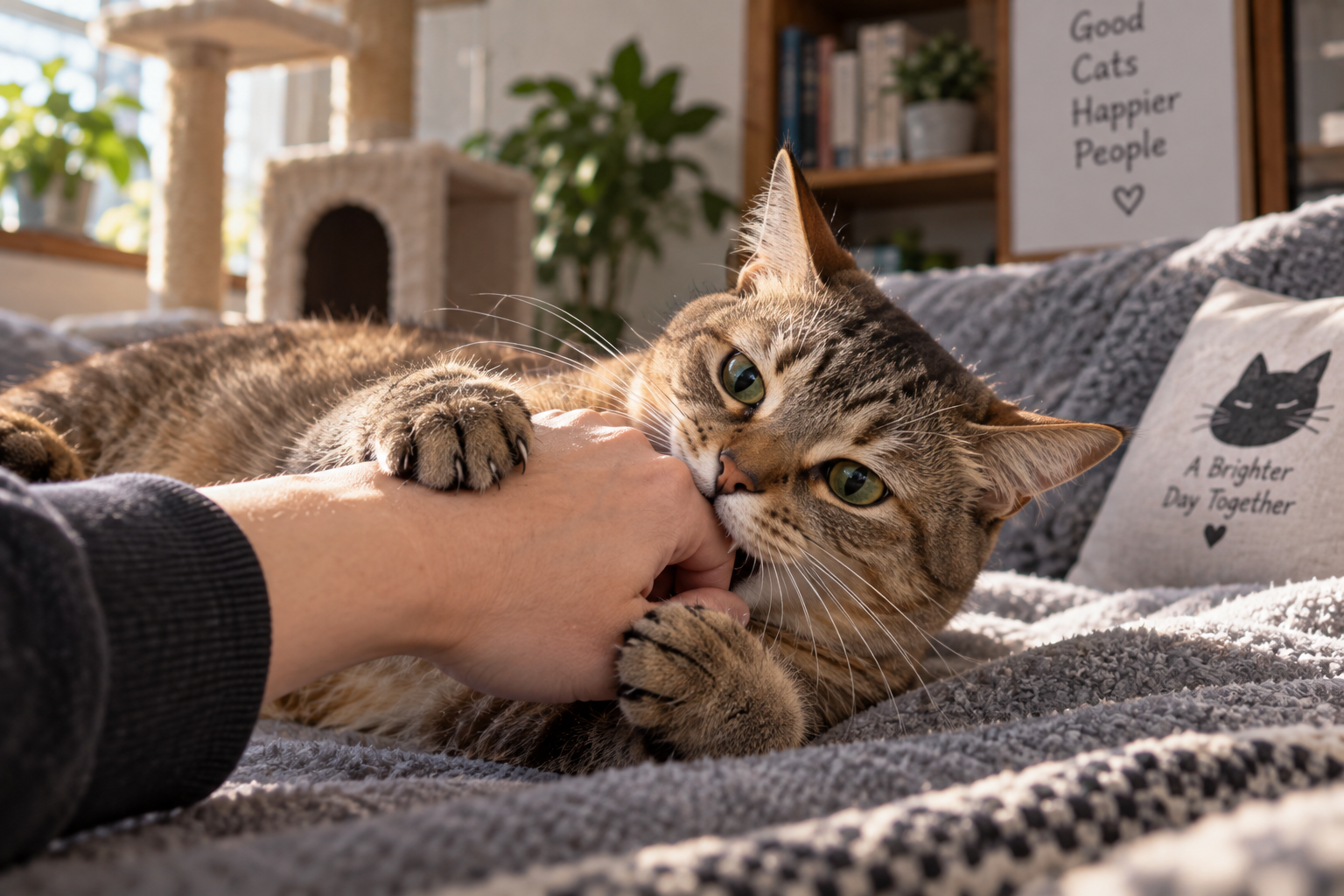
Then, without much warning, they turn around and bite your hand.
It can feel strangely personal. You may wonder whether you touched a painful area, annoyed them, or completely misunderstood what they wanted. But in many cases, a cat that bites during petting is not suddenly becoming aggressive.
Understanding why does my cat bite me when I pet him usually starts with recognizing that cats can enjoy physical affection while still having a limit. The difficult part is that their signal to stop may appear long before the bite itself.
A Cat Can Enjoy Petting and Still Want It to End
People often think of petting as a simple yes-or-no situation.
If the cat likes being touched, continue. If the cat dislikes it, stop.
Cats can be more complicated than that.
A cat may genuinely enjoy the first few strokes and then become uncomfortable as the physical stimulation continues. Their preference changed during the interaction; it does not necessarily mean the earlier affection was unwanted.
Think of it as a tolerance window.
For one cat, that window may last several minutes. Another may have had enough after only a few strokes.
Petting Can Become Overstimulating
Repeated touch creates continuous sensory input.
For some cats, there eventually comes a point where pleasant stimulation becomes irritating. This behavior is often described as petting-induced overstimulation.
The transition may happen faster than humans expect.
You are still performing exactly the same gentle motion, but your cat’s tolerance has changed.
The bite can therefore function as a very clear message:
“That was enough.”
The useful question is not only why the cat bit. It is whether there were earlier signals that the interaction was reaching that point.
The Bite Is Often the Last Signal, Not the First
Cats communicate heavily through body language.
The problem is that humans naturally pay attention to obvious signals such as hissing, scratching, or biting while overlooking smaller changes.
Before a cat bites during petting, you might notice subtle signs such as:
- the tail beginning to twitch;
- ears rotating sideways or backward;
- skin rippling along the back;
- the body becoming less relaxed;
- the cat turning its head toward your hand;
- pupils changing;
- the cat shifting position or moving away.
Not every cat will display all of these behaviors.
Learning your individual cat’s pattern is much more useful than waiting for one universal warning sign.
Watch the Tail
A relaxed cat may hold or move its tail calmly.
When irritation starts building, the tail can become more active.
You might notice the tip twitching at first. If the interaction continues, the movement may become sharper or involve more of the tail.
This does not automatically mean a bite is coming.
Context matters.
But if your cat is being petted and their previously relaxed tail suddenly begins flicking repeatedly, consider it useful information rather than background movement.
The Ears Can Change Before the Rest of the Body
Ear position is another clue.
Comfortable cats often keep their ears in a relatively neutral or forward position. As their emotional state changes, the ears may rotate toward the sides or backward.
The movement can be subtle.
You do not need to wait until the ears are completely flattened.
If several small signals appear together—tail movement, changing ears, muscle tension—the cat may be telling you that the interaction should end.
Your Cat May Look at Your Hand Before Biting
This is an especially useful signal to notice.
You are stroking the cat.
Suddenly, they turn their head and look directly toward the moving hand.
Humans sometimes interpret this as curiosity and continue petting.
But depending on the cat and context, that head turn can be part of an escalating request to stop.
If you know your cat commonly bites after doing this, treat the head turn as the endpoint rather than waiting to see what happens next.
Skin Twitching Can Be Easy to Miss
Watch the skin along your cat’s back while petting.
Sometimes the skin begins to ripple or twitch under your hand.
Cats have extremely sensitive bodies, and repeated contact can become uncomfortable even when the pressure seems gentle to us.
If you notice increasing skin twitching during a petting session, give your cat a break.
Respecting the earlier signal reduces the need for your cat to communicate with teeth.
Where You Pet Matters
Not every part of a cat’s body has the same tolerance for touch.
Many cats enjoy gentle contact around areas such as the cheeks, chin, forehead, or around the base of the ears.
Other areas can be much more individual.
The belly is a classic example.
A cat lying on its back does not necessarily mean:
“Please rub my stomach.”
It may simply mean the cat feels comfortable enough to expose a vulnerable area.
Reaching immediately for the belly can produce a very different response than expected.
A Visible Belly Is Not Always an Invitation
Humans often interpret animal body language through dog behavior.
That can create misunderstandings with cats.
A relaxed cat may roll over, stretch, and expose its belly because it feels safe. When a hand approaches, however, protective instincts can still activate.
The cat may grab the hand with its front paws, kick with its hind legs, or bite.
This does not necessarily contradict the earlier display of trust.
Feeling safe enough to expose the belly and wanting the belly touched are two separate things.
The Base of the Tail Can Also Be Complicated
Some cats appear to love being scratched near the lower back or base of the tail.
Others become overstimulated quickly.
Even cats that initially lean into the touch may reach their limit.
Do not assume that an enthusiastic initial response means the cat wants the same stimulation indefinitely.
Short interactions followed by a pause allow the cat to decide whether they want more.
Try the Consent Test
One simple way to make petting more cat-led is to pause.
Give the cat a few gentle strokes.
Then stop moving your hand.
Watch what happens.
Does the cat lean toward your hand?
Rub their cheek against you?
Move closer?
Position their head beneath your fingers?
Those behaviors may indicate that they want the interaction to continue.
If the cat stays still, turns away, or leaves, you have your answer without needing to push the interaction further.
Let the Cat Restart the Interaction
This small change can dramatically improve how you understand your cat.
Instead of deciding that petting lasts until you are finished, allow the cat to participate in the decision.
Pet briefly.
Pause.
If they seek more contact, continue.
If they do not, stop.
Over time, you may discover that your cat is actually quite affectionate—they simply prefer affection in shorter sessions than you assumed.
Purring Does Not Always Mean “Keep Going”
Purring is commonly associated with happiness, and often that interpretation makes sense.
But purring should not override every other signal.
A cat can purr while simultaneously becoming tense or showing other changes in body language.
Look at the entire cat.
If the tail is whipping, ears are changing position, and the body is tense, continuing to pet simply because the cat is still purring may lead to a bite.
No single behavior tells the whole story.
Cats Have Different Petting Tolerances
Some cats will happily remain on a person’s lap for a long time while receiving continuous attention.
Others prefer three strokes and a nearby seat.
Neither is a defective version of affection.
Individual cats differ because of temperament, previous experiences, socialization, environment, and personal preferences.
Trying to force every cat into the same style of interaction usually creates unnecessary frustration.
Your cat may love being close to you without wanting constant physical contact.
Affection Does Not Have to Mean Touching
This is an important idea for living with cats.
A cat sitting two feet away from you may be choosing social contact.
A cat following you into another room may be engaging with you.
A cat sleeping nearby may feel comfortable in your presence.
Humans often measure affection through touching, holding, and cuddling. Cats may express social connection in quieter ways.
Recognizing those forms of companionship makes it easier to respect a cat that prefers limited petting.
Some Cats Dislike Being Restrained
A cat may enjoy sitting beside you but dislike being held.
They may accept a hand on their head but become uncomfortable when someone wraps both arms around them.
Restraint changes the interaction because the cat no longer feels equally free to leave.
When possible, give your cat an easy exit.
Cats that know they can walk away may have less reason to escalate their communication.
Never Punish a Cat for Giving a Warning
If a cat bites during petting, yelling, hitting, or physically punishing them is not a productive response.
Punishment can create fear and may damage the sense of safety around human hands.
More importantly, it does not teach you why the bite occurred.
Instead, end the interaction and think about what happened immediately beforehand.
Where were you petting?
How long had the interaction lasted?
What was the tail doing?
Did the cat attempt to move?
Patterns often become visible when you start paying attention to the moments before the bite.
Do Not Teach the Cat That Hands Are Toys
Not every hand bite is caused by petting overstimulation.
Sometimes humans accidentally teach kittens that hands are appropriate objects to chase, grab, and bite.
A tiny kitten attacking fingers may seem harmless.
The same behavior becomes much less amusing when an adult cat has stronger jaws and claws.
Use appropriate toys for interactive play instead of encouraging the cat to wrestle directly with hands.
This creates a clearer distinction between human contact and hunting-style play.
Play Biting and “Stop Petting Me” Biting Can Look Different
Context provides clues.
If your cat stalks a moving hand, pounces, grabs, and kicks, the interaction may have shifted into play or predatory behavior.
If the cat was resting while being stroked and gradually became tense before turning to bite, overstimulation may be more likely.
The same teeth are involved.
The motivation can be completely different.
Understanding the context helps you change the right part of the interaction.
A Bite Can Also Be Related to Pain
There is an important exception to ordinary petting intolerance.
If a cat that normally enjoys being touched suddenly reacts strongly when a particular area is touched, pain or physical discomfort may be involved.
This is especially worth considering when the behavior is new.
Maybe the cat suddenly dislikes being touched near one leg, the back, mouth, abdomen, or another specific location.
Behavioral changes can sometimes be one of the first signs that something is uncomfortable.
Sudden Behavioral Changes Deserve Attention
Suppose your cat has enjoyed being brushed and petted for years.
Then, within a short period, they begin biting whenever you touch their lower back.
That is different from a cat that has always had a short petting tolerance.
Changes from the animal’s normal baseline matter.
If the behavior appears suddenly, is unusually intense, or is accompanied by other changes such as reduced appetite, hiding, limping, grooming changes, vocalization, or reduced activity, contacting a veterinarian is appropriate.
Do not assume every bite is simply “bad behavior.”
Older Cats May Change Their Preferences
Aging can affect how cats respond to touch.
An older cat may develop stiffness or sensitivity that makes certain handling less comfortable than it was years earlier.
They may still want companionship while preferring shorter or gentler contact.
Adjusting to those preferences is part of responding to the cat you have now rather than the cat you remember from several years ago.
Children Need to Learn the Cat’s Signals Too
Children may naturally want to hug, carry, or continuously pet a friendly cat.
Teaching them to notice when the cat wants to leave is safer for both sides.
Keep interactions supervised when appropriate and show children simple rules: pet gently, avoid chasing, do not corner the cat, and allow the cat to walk away.
A cat should not have to escalate to biting because earlier attempts to leave were repeatedly blocked.
Give the Cat Somewhere to Retreat
Environment affects behavior.
Cats benefit from having places where they can rest without being constantly approached.
A bed.
A cat tree.
A shelf.
A quiet room.
A hiding location.
When a cat has control over when social interaction happens, everyday contact can become less stressful.
A resting cat does not always need to be touched simply because they are within reach.
Learn Your Cat’s Personal “Petting Limit”
You can treat this almost like observation.
Maybe your cat usually becomes restless after approximately 20 seconds of continuous petting.
Do not wait until second 25 every time.
Stop earlier.
Give them space.
If they request more, continue.
After several interactions, you may become surprisingly good at predicting when your cat has had enough.
The goal is not to discover the maximum number of strokes your cat will tolerate.
It is to end while the interaction is still pleasant.
Shorter Petting Sessions Can Create Better Interactions
It seems counterintuitive.
If your cat likes affection, shouldn’t more affection be better?
Not necessarily.
Five short positive interactions can be preferable to one long session that repeatedly ends in irritation.
By stopping before overstimulation, you create a pattern in which human touch does not need to escalate into conflict.
Over time, your cat may also become more comfortable initiating contact because they learn that approaching you does not mean being held or petted indefinitely.
Let the Cat Walk Away
This sounds obvious, but it solves many problems.
If the cat stands up, shifts away, or begins leaving, do not pull them back for “one more cuddle.”
The cat already communicated.
Respecting that decision teaches the animal that subtle signals work.
When subtle signals consistently work, there is less need for stronger ones.
What Should You Do Immediately After a Bite?
First, stop the interaction.
Do not immediately resume petting to prove that everything is okay.
Give the cat space and allow the situation to settle.
If the bite breaks the skin, take it seriously. Cat bites can introduce bacteria through relatively small puncture wounds, so clean the area promptly and seek appropriate medical guidance when needed, particularly for deep punctures, worsening redness, swelling, warmth, pain, drainage, fever, or bites involving higher-risk areas.
Then think about the behavioral context separately.
Medical care for the wound and understanding the cat’s behavior are two different issues.
The Goal Is Not to Make Your Cat Tolerate More
This is perhaps the biggest shift in perspective.
When people search why does my cat bite me when I pet him, they often want to know how to stop the biting.
But the most effective solution may not involve teaching the cat to tolerate ten minutes of petting.
It may involve humans learning to stop after thirty seconds.
Successful interaction does not require changing every preference the cat has.
Sometimes the solution is simply becoming better at listening.
Conclusion
Understanding why does my cat bite me when I pet him starts with recognizing that affection and overstimulation can exist in the same interaction. Your cat may genuinely enjoy being touched and then reach a point where the sensation is no longer comfortable.
The bite often feels sudden because humans notice the teeth but miss the earlier communication. Tail flicking, changing ear position, skin twitching, tension, looking toward the hand, shifting away, or attempting to leave can all provide valuable context.
Pet more deliberately, pause regularly, let your cat request additional contact, and respect their decision when they move away. At the same time, pay attention to sudden changes in behavior or unusual sensitivity because pain can also alter how a cat responds to touch.
A good relationship with a cat is not measured by how long they let you pet them.
Sometimes the strongest sign of trust is knowing when to take your hand away.