One moment, your cat is asleep on the sofa.
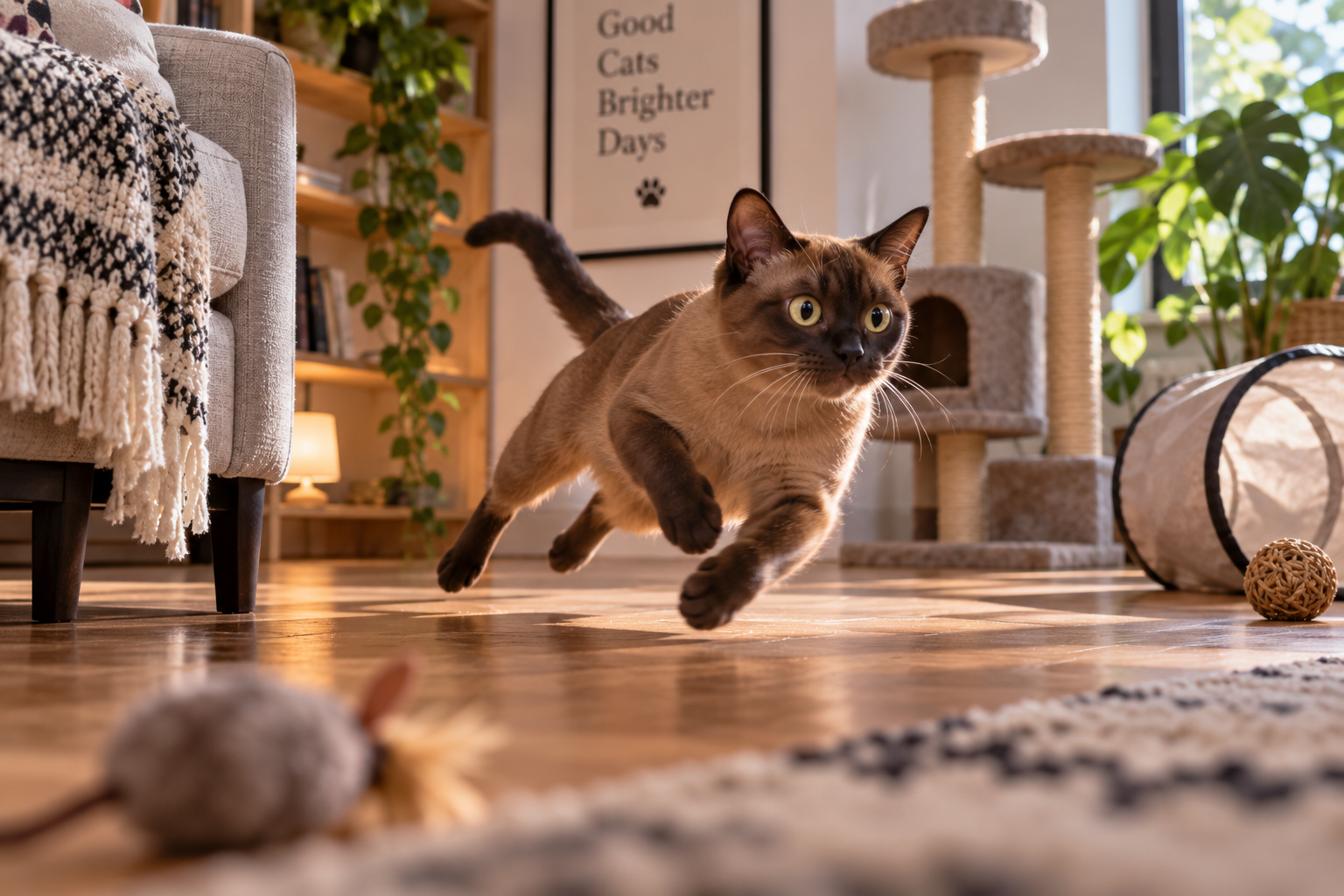
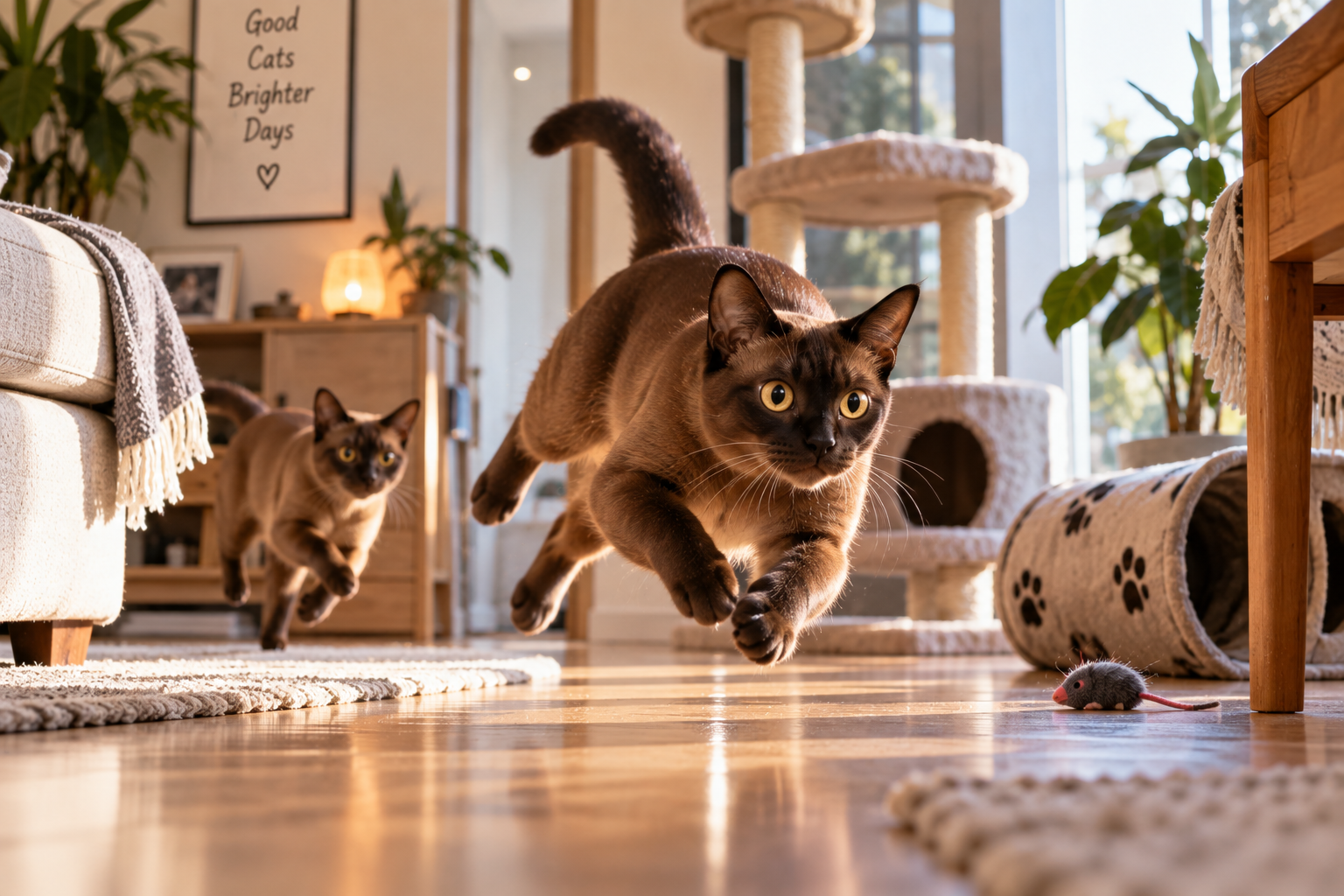
Five minutes later, they are racing down the hallway, jumping onto furniture, making a sharp turn around the table, and disappearing into another room at a speed that seems completely unnecessary.
Then, almost as quickly as it started, everything stops.
Your cat sits down, begins grooming, and behaves as if nothing unusual happened.
These sudden bursts of activity are commonly called “zoomies.” If you have ever wondered why do cats get the zoomies, the answer usually involves normal feline activity patterns, stored energy, play, stimulation, and the natural behaviors domestic cats still carry with them.
What Are Cat Zoomies?
Zoomies are short periods of intense activity in which a cat suddenly runs, jumps, climbs, or darts around the environment.
They may race between rooms, leap onto furniture, chase an imaginary target, or repeatedly follow the same route through the house.
The technical behavior is sometimes described as a frenetic random activity period, although what looks random to us may still follow a familiar route for the cat.
In many otherwise healthy cats, occasional zoomies are simply part of normal behavior.
The more interesting question is why they seem to appear so suddenly.
Cats Do Not Always Spend Energy Gradually
Humans often imagine energy as something used steadily throughout the day.
Cats can behave differently.
A cat may spend a large part of the day resting, observing the environment, or sleeping. When activity finally begins, it can arrive as a concentrated burst rather than a long period of moderate movement.
This makes the transition look dramatic.
Your cat has not necessarily gone from exhausted to hyperactive in five minutes. They may simply be switching from a resting phase into a short, highly active one.
Cats Are Built for Short Bursts of Movement
Domestic cats may live in bedrooms and apartments, but their bodies still support behaviors associated with stalking, chasing, pouncing, and capturing prey.
Those activities do not require hours of continuous running.
They often involve waiting, watching, followed by explosive movement.
A house cat sprinting through a hallway obviously is not performing a complete hunting sequence, but the style of movement can reflect the same capacity for sudden acceleration.
That is one reason zoomies can look so intense despite lasting only a short time.
Why Zoomies Often Happen in the Evening
Many owners notice their cats becoming especially active around evening or early morning.
Cats are often described as crepuscular, meaning activity commonly increases around dawn and dusk, although individual household routines can influence the exact pattern.
This can create an awkward mismatch.
You are preparing to relax.
Your cat has decided that the living room is now a racetrack.
If the cat spent much of the afternoon sleeping, the contrast can become even more noticeable.
Rather than assuming the cat is deliberately disrupting your evening, it helps to recognize that their activity schedule may simply be different from yours.
Indoor Cats May Have Energy With Nowhere to Put It
An indoor environment provides safety and predictability, but it can also become repetitive.
Food appears in a bowl.
There is no prey to search for.
The temperature remains comfortable.
Many interesting outdoor stimuli are absent.
If the environment provides few opportunities for climbing, chasing, exploring, scratching, or interactive play, a cat may have limited ways to express active behavior.
A sudden sprint through the house can become one outlet.
This does not mean every cat with zoomies is bored. But the cat’s overall daily activity is worth considering.
Play Can Give That Energy More Structure
One useful approach is regular interactive play.
Toys that allow a cat to stalk, chase, and pounce can create a more structured outlet for active behavior.
Instead of simply placing toys on the floor indefinitely, make some play sessions interactive.
Move the toy in ways that encourage attention and pursuit.
Let the cat pause and watch.
Allow opportunities to chase and catch rather than making the target permanently impossible to reach.
A short, engaging session can sometimes be more satisfying than leaving a large collection of unused toys around the house.
A Toy Does Not Stay Interesting Forever
Cats can lose interest in objects that never change.
A toy that was fascinating when introduced may become part of the background after sitting in the same place for weeks.
Rotation can help.
Keep some toys available while storing others, then swap them periodically. The goal is not to constantly buy new products but to make the environment less predictable.
Cardboard boxes, tunnels, safe climbing areas, and different resting locations can also provide variety without turning the home into an elaborate playground.
Vertical Space Changes the Environment
For a cat, usable territory is not limited to the floor.
Height matters.
Cat trees, sturdy shelves designed for feline use, window perches, and other safe elevated areas can expand the amount of usable space without increasing the size of the room.
This gives cats additional opportunities to climb, observe, rest, and move between locations.
Vertical options can be particularly useful in smaller homes where floor space is limited.
Make sure any elevated setup is stable and appropriate for the size and mobility of the cat using it.
The Window Can Be Entertainment
A secure window view can provide a large amount of visual stimulation.
Birds move.
People walk past.
Leaves blow in the wind.
Light changes throughout the day.
For an indoor cat, these small events can make the environment more interesting.
However, window access should be safe. Screens and barriers need to be secure enough that the cat cannot push through them or reach a dangerous exterior area.
The objective is stimulation without creating an escape or fall risk.
Some Cats Get Zoomies After Using the Litter Box
Owners sometimes report a particularly strange version of the behavior: the cat uses the litter box and immediately races away.
There are several proposed explanations for post-litter-box running, and there may not be one universal reason that applies to every cat.
For some cats, it may simply be part of their individual behavioral pattern.
What matters is distinguishing an energetic dash from signs that using the litter box itself is uncomfortable.
If a cat is straining, repeatedly entering the box, vocalizing, producing little or no urine, or showing other unusual elimination behavior, that is different from ordinary zoomies and warrants prompt veterinary attention.
Younger Cats May Have More Dramatic Energy Bursts
Age can influence activity.
Kittens and younger cats typically have substantial energy and may switch quickly between sleep and intense play.
A kitten can appear completely exhausted, nap briefly, then wake up ready for another round.
Adult cats often develop more predictable routines, although plenty remain highly playful.
Senior cats may become less physically intense as mobility and activity patterns change.
Instead of comparing one cat with videos of another cat online, compare behavior with that individual cat’s normal pattern.
Personality Matters Too
Some cats simply move more than others.
One may calmly walk from room to room.
Another treats every hallway like a sprinting lane.
Breed tendencies can sometimes influence general activity levels, but they do not determine the personality of every individual cat.
Age, health, environment, previous experiences, routine, and individual temperament all contribute.
Zoomies are therefore better understood in the context of the cat you actually live with rather than an idealized description of what cats are “supposed” to do.
Do Not Punish Normal Bursts of Energy
A cat running around the house can be inconvenient.
They may make noise.
They may jump onto furniture.
They may interrupt whatever you are doing.
But punishing a cat simply for being energetic does not teach them where that energy should go.
Instead, make the environment safer and redirect appropriate activity toward play, climbing, scratching, and other acceptable outlets.
If certain surfaces are genuinely dangerous or off-limits, manage access and provide alternatives rather than expecting the cat to understand an inconsistent rule during a high-energy moment.
Make the Zoomies Route Safer
Observe where your cat tends to run.
Many cats develop surprisingly consistent routes.
If that route crosses unstable furniture, loose cables, breakable decorations, open windows, or slippery objects, small environmental changes can reduce risk.
Secure items that can fall.
Keep dangerous objects away from common launch points.
Make sure tall cat furniture is stable.
You do not have to stop the cat from running. You can make the places where they naturally run safer.
A Predictable Routine Can Help
Cats often respond well to predictable daily patterns.
Meals, play, interaction, and quiet periods do not need to happen at the exact minute every day, but a reasonably consistent routine can give activity some structure.
If nighttime energy is becoming disruptive, an interactive play session earlier in the evening may be worth trying.
Follow the cat’s interest rather than forcing prolonged exercise.
Some cats prefer several short play sessions over one long session.
The goal is appropriate engagement, not exhausting the cat until they refuse to move.
Zoomies Are Not Automatically a Sign Something Is Wrong
This distinction is important when answering why do cats get the zoomies.
A cat that occasionally races through the house and then returns to normal behavior is not necessarily displaying a problem.
Look at the whole picture.
Are they eating normally?
Using the litter box normally?
Moving comfortably?
Resting normally afterward?
Is the behavior consistent with what they have done before?
Context matters much more than the fact that the cat ran very fast for thirty seconds.
Sudden Behavioral Changes Deserve More Attention
A new behavior is different from a familiar one.
If a normally calm cat suddenly becomes unusually restless, repeatedly runs as though frightened, cannot settle, vocalizes differently, appears uncomfortable, or shows other physical or behavioral changes, do not automatically label everything as zoomies.
Changes in behavior can have many possible causes.
A veterinarian can assess the cat in context, particularly when the change is persistent or accompanied by changes in appetite, elimination, movement, breathing, grooming, or general behavior.
The same principle applies in the opposite direction.
A very active cat that suddenly becomes unusually inactive also deserves attention.
Let Your Cat Be a Cat
It is easy to design a home entirely around human convenience.
Everything stays still.
Everything is quiet.
Nothing gets climbed.
Nothing gets scratched.
Nothing gets chased.
But cats need appropriate ways to perform normal feline behaviors.
That does not mean accepting destroyed furniture or unsafe behavior. It means providing acceptable alternatives: scratching surfaces, climbing opportunities, resting spots, play, hiding areas, and room to move.
A good indoor environment allows both the human and the cat to live comfortably.
Conclusion
So, why do cats get the zoomies?
In many cases, those sudden sprints are simply a normal expression of feline energy and activity. Cats naturally alternate between periods of rest and shorter bursts of movement, and indoor cats may use running, jumping, climbing, and play as outlets for behaviors connected to exploration and hunting.
Regular interactive play, environmental variety, vertical space, safe observation areas, and a predictable routine can give that energy more appropriate places to go.
Most importantly, learn what is normal for your individual cat.
A familiar thirty-second race through the hallway followed by a peaceful nap may simply be part of life with them.
And sometimes the most accurate explanation for the midnight sprint is also the simplest: your cat finished resting, had energy to spend, and unfortunately decided your furniture was the perfect obstacle course.