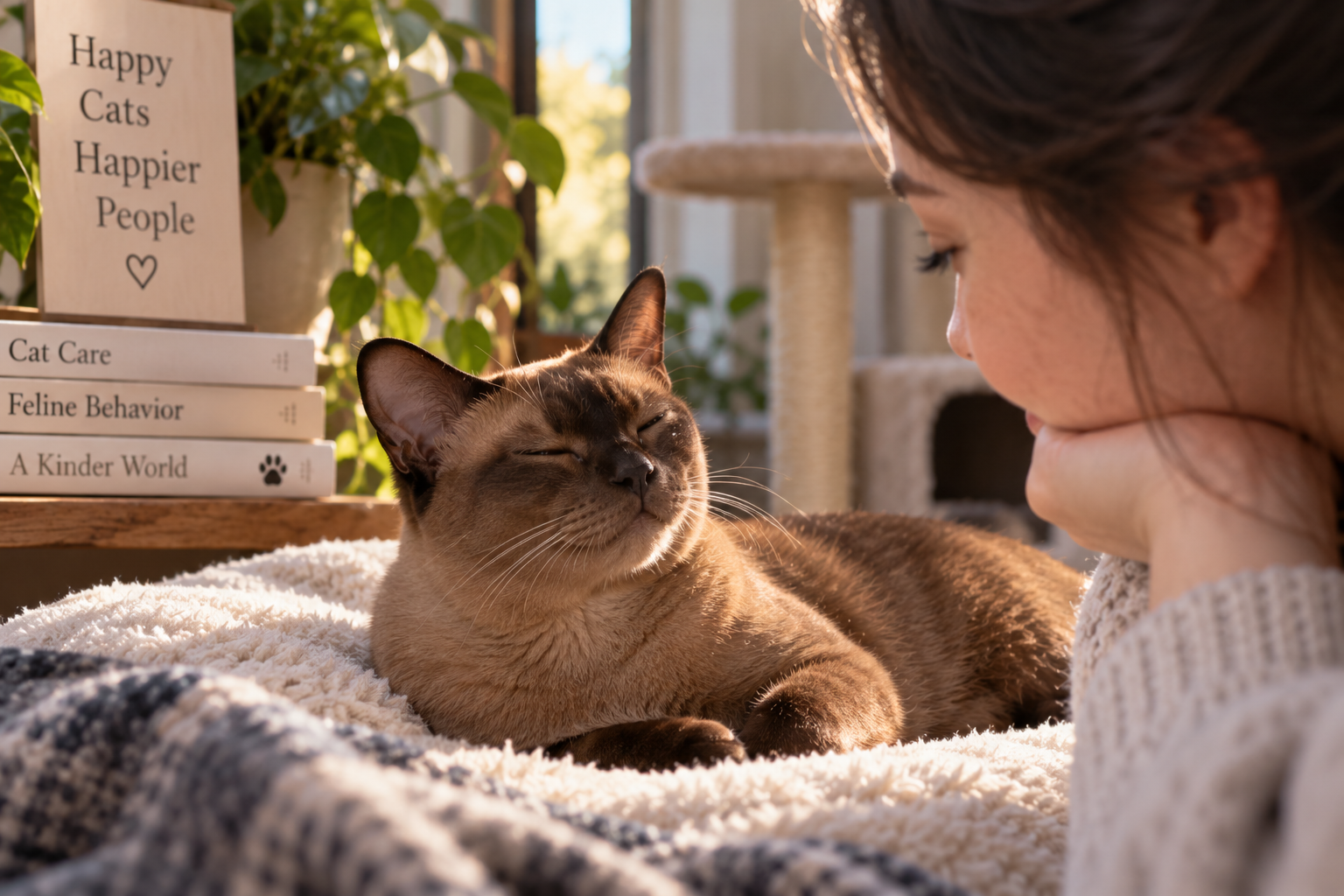
You are sitting across the room when your cat looks directly at you. For a moment, neither of you moves. Then your cat slowly lowers its eyelids, keeps them nearly closed for a second, and gently opens them again.
It can look like your cat is becoming sleepy. But then it happens again.
This small expression is commonly known as a slow blink, and it has become one of the most recognizable behaviors in feline communication. Understanding why cats slow blink at you can reveal something about how cats use their eyes, posture, distance, and environment to communicate comfort around people.
A Cat’s Eyes Communicate More Than Attention

Humans naturally interpret eye contact through human social rules. Cats operate differently.
Direct staring can sometimes carry tension in feline interactions, particularly when it appears alongside a stiff body, flattened ears, defensive posture, or other signs of discomfort.
A relaxed gaze is different.
When a cat looks toward you with a loose body and gradually narrows or closes its eyes, the overall interaction is usually much softer. Instead of remaining intensely vigilant, the cat appears comfortable enough to briefly reduce its visual awareness.
Context is what gives the slow blink meaning.
Why Closing the Eyes Can Signal Comfort
Cats depend heavily on awareness of their surroundings.
Their senses help them detect movement, possible threats, prey, unfamiliar animals, and changes in the environment. Remaining alert is useful when a situation feels uncertain.
Closing the eyes, even briefly, means giving up some of that visual monitoring.
That is why a slow blink from a relaxed cat can be meaningful. The animal is not behaving as though it needs to watch your every movement.
In simple terms, your presence does not appear to require constant vigilance.
Is a Slow Blink Really a Cat’s Version of “I Love You”?
The phrase “cat kiss” is often used online to describe slow blinking.
It is a charming description, but it can oversimplify feline communication.
A slow blink does not necessarily translate into one specific human sentence such as “I love you.” Animal communication rarely works like direct word-for-word translation.
It is more useful to think of the behavior as part of a relaxed social interaction.
Depending on the situation, it may indicate comfort, familiarity, low tension, or willingness to engage peacefully.
That may not sound as romantic as a “cat kiss,” but it tells you something valuable about how comfortable the cat feels around you.
Look at the Rest of the Body
Never interpret a cat’s eyes in isolation.
Imagine two cats narrowing their eyes.
One is curled comfortably on a sofa with loose muscles, neutral ears, relaxed whiskers, and paws tucked underneath the body.
The other is crouched beneath a chair with ears turned back, muscles tense, and tail held tightly against the body.
Those situations do not communicate the same emotional state.
When trying to understand cat body language, combine the eyes with posture, ears, whiskers, tail position, movement, vocalization, and the situation around the animal.
The complete picture is more reliable than one gesture.
Can You Slow Blink Back at Your Cat?
Yes, you can try.
Start when your cat already appears comfortable rather than approaching during a tense moment.
Look toward the cat without creating an intense stare. Relax your face, gently lower your eyelids, pause briefly, and slowly open them again.
Then give the cat space to respond.
Some cats may blink back almost immediately. Others may look away, continue resting, or show no obvious response.
Do not turn it into a test of your relationship.
Cats differ in personality and communication style, and a cat that does not slow blink back is not necessarily less attached to you.
Looking Away Can Also Be Part of the Conversation
People sometimes assume that maintaining eye contact demonstrates affection.
With cats, softer interactions can involve deliberately reducing visual pressure.
After slowly blinking, you might look slightly away rather than continuing to stare.
This can make the interaction feel less confrontational.
The same principle is useful when meeting an unfamiliar cat. Instead of leaning over the animal and staring directly into its face, remaining calm and allowing the cat to decide whether to approach can create a more comfortable introduction.
Why Some Cats Slow Blink More Than Others
Cats are individuals.
One cat may frequently communicate through obvious facial expressions. Another may show comfort by sitting nearby, following you between rooms, sleeping in the same space, rubbing against furniture near you, or simply remaining relaxed when you approach.
Age, temperament, previous experiences, socialization, and the relationship with a particular person can all influence behavior.
This is why comparing your cat with viral videos can be misleading.
Your cat does not need to reproduce every popular “sign your cat loves you” behavior to have a strong relationship with you.
Slow Blinking Can Be Easier to Notice During Quiet Moments
Think about when you are most likely to observe the behavior.
It often happens when nothing dramatic is occurring.
Your cat may be resting on a windowsill while you work nearby. Perhaps you are sitting on the sofa in the evening, or the cat is relaxing at the opposite end of the bed.
Quiet situations make subtle communication easier to notice.
During feeding, active play, unfamiliar noise, or intense exploration, the cat’s attention may be directed toward something else.
The absence of slow blinking during those moments tells you very little.
Familiarity Can Change How Cats Communicate Around People
A cat that has lived with someone for years has had thousands of opportunities to learn their movements, routines, voice, and habits.
It knows approximately when food appears, which chair you usually sit in, how you walk through the house, and whether your approach normally predicts play, petting, feeding, or simply passing by.
Predictability can support comfort.
This is one reason building trust with a cat often has less to do with constantly trying to create affection and more to do with becoming a calm, reliable part of the environment.
Do Not Force Affection After a Slow Blink
A slow blink is not necessarily an invitation to immediately pick up the cat.
This is an important distinction.
Your cat may be perfectly comfortable interacting with you from two meters away while having no interest in physical contact at that moment.
If you respond to every relaxed signal by moving closer, touching, or lifting the animal, you may unintentionally change a comfortable interaction into an unwanted one.
Allowing the cat to choose whether to approach gives it more control over the encounter.
Learn Your Cat’s Preferred Distance
Some cats want to sleep against their owner’s chest.
Others prefer the opposite end of the sofa.
Another may spend most of the day independently but appear every evening to sit a short distance away.
Affection does not have one required distance.
Pay attention to where your cat voluntarily chooses to position itself when it has multiple options. That preference can tell you more than repeatedly placing the cat where you want it to stay.
Respecting preferred distance often makes future interactions easier.
Slow Blinking Is Only One Part of Feline Trust
A comfortable relationship can appear through many small behaviors.
A cat may approach with its tail held comfortably upright, rest in exposed areas of the home, groom itself nearby, initiate play, rub its face against familiar objects, or choose to remain in the same room.
None of these behaviors should be interpreted through a rigid checklist.
The useful question is broader:
Does this cat generally appear relaxed and able to make choices around me?
For cat-care conversations at Traditional Burmese Cattery, understanding those everyday signals can be more useful than trying to translate every movement into a human emotion.
Sudden Changes in Eye Behavior Deserve Attention
Normal slow blinking should not be confused with a cat repeatedly squinting because an eye is uncomfortable.
If one eye remains partly closed, the cat suddenly begins squinting frequently, or you notice redness, swelling, discharge, cloudiness, excessive tearing, or repeated pawing at the eye, the issue may not be social communication.
Eye problems can require prompt veterinary attention.
The key difference is context.
A relaxed, occasional slow blink during a comfortable interaction is very different from persistent abnormal eye closure accompanied by physical symptoms.
Conclusion
Understanding why cats slow blink at you is less about discovering a secret feline word and more about learning to recognize relaxed communication.
A slow blink accompanied by comfortable posture and calm behavior can indicate that a cat does not feel the need to remain intensely alert around you. You can gently return the gesture, reduce direct staring, and allow the cat to decide what happens next.
The most meaningful part may not be the blink itself. It is the fact that an animal capable of watching every movement around it feels comfortable enough, in your presence, to close its eyes.