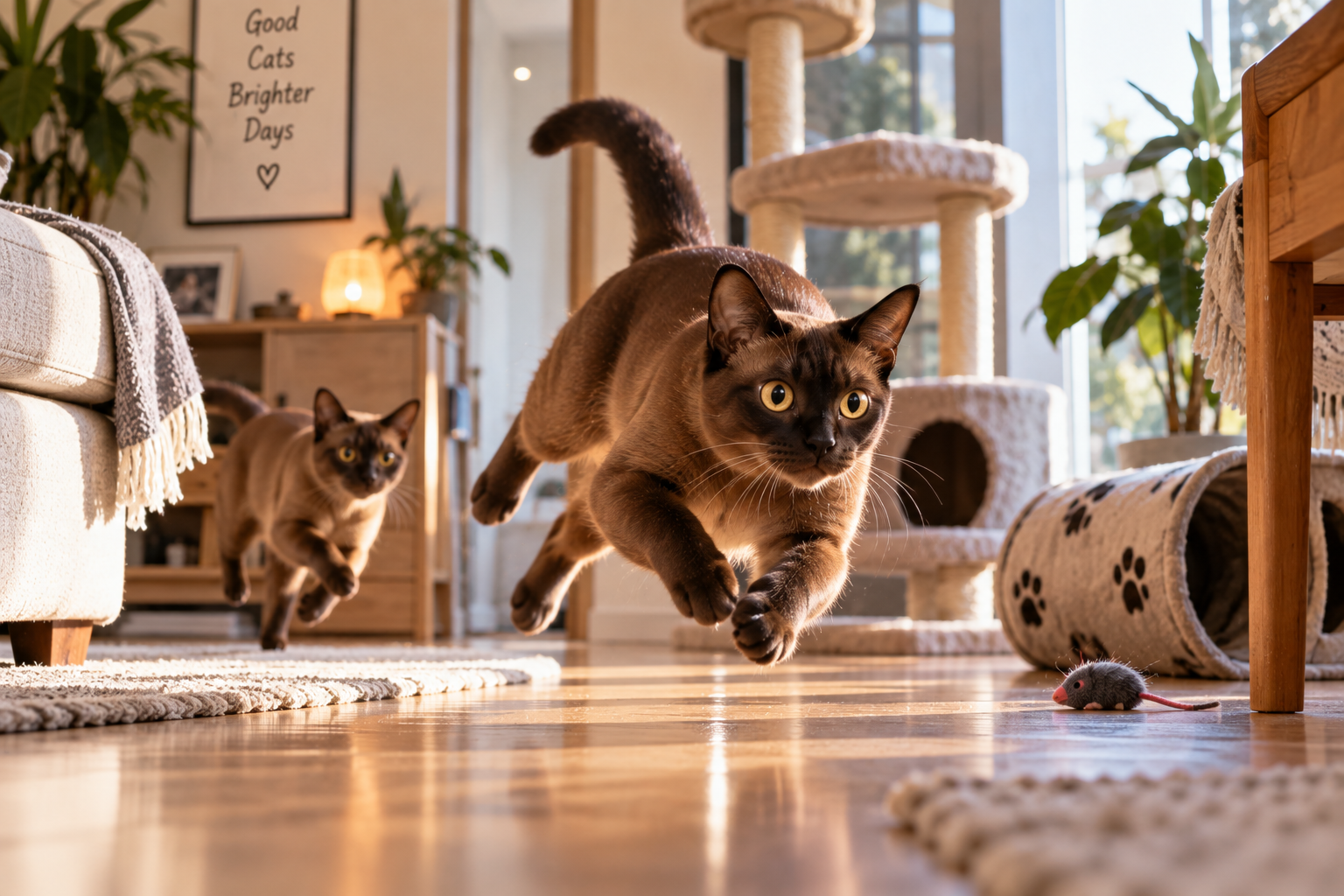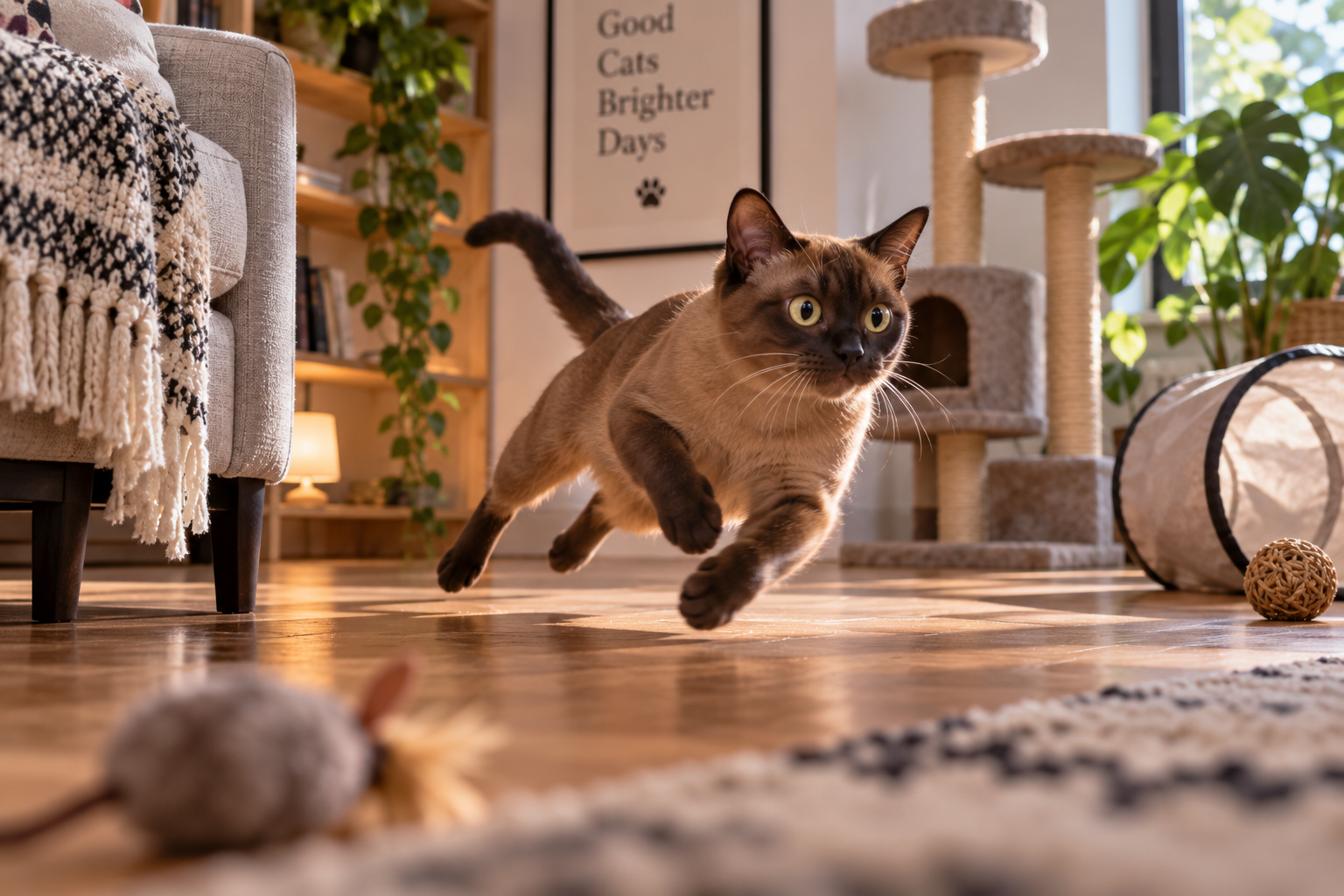
Five minutes ago, your cat was curled into a perfect ball on the couch.
Now they are racing down the hallway, launching themselves onto a chair, disappearing around a corner, and returning at full speed as though something invisible is chasing them.
Then, almost as suddenly as it started, everything stops.
Your cat sits down and begins grooming.
These sudden bursts of frantic activity are commonly called the “zoomies.” If you have ever wondered why do cats get the zoomies, the answer usually involves normal feline activity patterns, stored energy, play behavior, environmental stimulation, and the simple fact that indoor cats do not always spend their energy gradually throughout the day.
Zoomies Are Short Bursts of Intense Activity
Cat zoomies can look chaotic, but the pattern is usually easy to recognize.
A cat suddenly runs at high speed, changes direction rapidly, jumps onto furniture, races through rooms, or briefly behaves far more energetically than they did moments earlier.
The episode may last only a short time.
These bursts are often discussed using the term FRAPs, or frenetic random activity periods.
The name sounds dramatic, but occasional zoomies can be part of normal behavior, particularly when the cat otherwise appears comfortable and healthy.
Cats Can Go From Resting to Full Speed Very Quickly
Humans often imagine energy as something that gradually increases and decreases.
Cats do not always behave that way.
A cat may spend a large portion of the day resting and then become intensely active for a relatively short period. Their body is capable of switching quickly between stillness and explosive movement.
That makes the transition look more dramatic than it really is.
The sleeping cat and the hallway sprinter are not necessarily showing contradictory behavior.
They are simply using energy differently from us.
Your Cat May Not Actually Be “Random”
Zoomies often appear unpredictable because humans are not always paying attention to what happened immediately beforehand.
Start observing the timing.
Do they happen after your cat wakes from a long nap?
Before a regular meal?
After using the litter box?
When you return home?
Around the same period every evening?
Patterns often emerge once you stop treating each episode as an isolated event.
Why Do Cats Get Zoomies at Night?
Many owners notice the phenomenon most strongly after sunset.
The house becomes quiet, people are preparing for bed, and the cat suddenly decides it is time for a personal athletics championship.
Cats are often described as nocturnal, but their natural activity patterns are more accurately associated with periods around dawn and dusk.
Individual cats and household routines vary, of course.
But an evening increase in activity is not particularly surprising, especially after a day containing plenty of rest.
Indoor Life Can Create Stored Energy
An outdoor environment naturally presents a cat with many small opportunities for activity.
There are scents to investigate, surfaces to climb, movements to watch, spaces to patrol, and potential prey behavior to respond to.
Indoor cats can live rich and stimulating lives, but the environment does not automatically provide those opportunities.
If much of the day involves sleeping on the same sofa with little active engagement, energy can emerge later in one concentrated burst.
The result is the classic sprint from one side of the house to the other.
Play Gives Energy Somewhere to Go
A useful play session allows a cat to perform behaviors such as stalking, chasing, pouncing, and grabbing.
The toy matters less than the interaction it creates.
A toy that simply lies on the floor may be interesting occasionally, while a moving toy can create a more engaging sequence.
Try allowing the cat to watch first.
Then move the toy.
Let them chase.
Allow successful catches rather than keeping the target permanently impossible to reach.
Play becomes more satisfying when the cat can participate in the complete sequence instead of endlessly chasing something they never capture.
Timing Play Can Matter More Than Buying More Toys
A house can contain twenty cat toys and still provide very little meaningful play.
If every toy sits motionless in a basket, quantity is not solving the problem.
Short interactive sessions at useful times may be more valuable.
If your cat consistently becomes extremely active late at night, consider adding an appropriate play session earlier in the evening.
The objective is not to guarantee that zoomies disappear.
It is to give some of that energy a structured outlet before everyone else wants to sleep.
Rotate Toys Instead of Leaving Everything Out
Cats can become familiar with objects that remain available constantly.
One way to keep the environment more interesting is rotating some toys.
A toy that disappears for several days may attract renewed attention when it returns.
This does not require constantly purchasing new products.
Often, changing availability is enough to make existing objects feel less predictable.
Just make sure toys are appropriate for unsupervised access if they are going to remain available when nobody is watching.
Vertical Space Can Add Activity Without a Bigger House
Floor area is not the only usable space for a cat.
Cat trees, secure climbing areas, shelves designed for feline use, and elevated resting spots can add another dimension to an indoor environment.
Climbing involves movement.
So does moving between observation points.
Vertical territory can also give cats more choices about where they spend time.
For households with limited floor space, thinking upward can make the environment much richer without requiring another room.
Scratching Is Activity Too
A scratching surface is not simply there to protect furniture.
Scratching allows cats to stretch, use muscles, maintain claws, and perform a natural marking behavior.
Different cats may prefer different orientations and materials.
Some enjoy tall vertical scratchers.
Others prefer horizontal surfaces.
If a cat ignores the scratching post, the problem may not be that they “don’t like scratchers.” Its location, stability, height, or texture may simply be less appealing than the sofa.
Windows Can Provide Passive Enrichment
A safe window view can be surprisingly engaging.
Birds, insects, people, changing light, trees, and outdoor movement create constantly changing visual information.
A secure resting place near a suitable window can give an indoor cat something to observe even when humans are busy.
However, passive observation does not necessarily replace physical activity.
Watching a bird and chasing a toy provide different forms of stimulation.
A balanced environment can include both.
Zoomies After the Litter Box Are a Familiar Pattern
Some cats suddenly race away after using the litter box.
Owners often joke about this because the timing can be remarkably consistent.
There are several proposed explanations for this behavior, but there is no need to assign one universal motive to every cat.
What matters is context.
If your cat has always done a quick celebratory sprint after using the litter box and otherwise behaves normally, that pattern is different from a cat that suddenly begins running away while showing signs of discomfort.
Behavior should be interpreted alongside other changes.
Do Not Punish Normal Bursts of Energy
A cat running around the house can be inconvenient.
Punishment, however, does not teach the cat an appropriate alternative for using that energy.
Instead, make the environment safer.
Secure fragile objects.
Provide appropriate climbing and scratching options.
Keep play opportunities available.
If nighttime activity is consistently disruptive, adjust the daily routine rather than treating normal movement as deliberate misbehavior.
The cat is not sprinting down the hallway at midnight because they have developed a personal grudge against your sleep schedule.
Make the Zoomie Route Safer
Once you know your cat’s favorite running route, look at it from their perspective.
Are there unstable objects on shelves?
Loose cables?
Slippery rugs?
Furniture with sharp or fragile items nearby?
Can a window screen be pushed loose if the cat jumps against it?
Zoomies involve speed, and speed reduces the opportunity for careful navigation.
A little environmental preparation can prevent an ordinary burst of energy from becoming an accident.
Kittens and Young Cats May Have Plenty of Energy to Burn
Age can influence activity.
Kittens and young cats are often highly playful and may produce impressive bursts of movement.
They are learning how their bodies work while exploring the environment.
That does not mean older cats never get zoomies.
Many adult cats continue having energetic episodes.
What matters more is understanding what is typical for the individual cat rather than expecting every age group to behave exactly the same way.
Older Cats Still Benefit From Appropriate Play
A cat becoming older does not mean enrichment should disappear.
The type and intensity of activity may need to change.
A younger cat may happily launch across furniture repeatedly, while an older cat might prefer slower interactive play closer to the ground.
Pay attention to mobility and interest.
The goal is not to force an older cat to perform like a kitten.
It is to continue providing appropriate opportunities to move, investigate, and interact.
Multiple Cats Can Amplify the Chaos
One cat starts running.
The second cat notices.
Suddenly the hallway becomes a racetrack.
In multi-cat households, movement itself can become stimulation. Cats may chase, follow, or respond to each other’s activity.
That can be normal play when both animals are participating comfortably.
But chasing should not automatically be assumed to be friendly.
Watch body language and whether one cat repeatedly tries to escape or hide.
Mutual play and persistent harassment are different situations.
Zoomies Are Not a Reliable Measure of Happiness
A cat having zoomies is not automatically proof that they are extremely happy.
A cat that rarely zooms is not automatically bored or unhappy either.
Behavior has to be interpreted as a broader pattern.
Look at appetite, play, resting behavior, social interaction, grooming, litter-box habits, movement, and the cat’s normal personality.
One entertaining behavior should not become a complete emotional diagnosis.
A Routine Can Make Indoor Life More Predictable
Cats often benefit from some consistency in their daily environment.
Meals, interactive play, quiet periods, and household activity naturally create a rhythm.
That does not mean every day must follow a minute-by-minute schedule.
But if the cat receives most of their interaction only when humans suddenly remember, activity may become concentrated at inconvenient times.
A simple routine can distribute stimulation more intentionally across the day.
Sometimes the Best Solution Is Not Stopping the Zoomies
It is tempting to search for a way to eliminate the behavior.
That may be the wrong goal.
If a healthy cat occasionally runs around energetically in a safe environment, the behavior itself may not need fixing.
Instead, focus on whether the cat has appropriate opportunities for play and movement and whether the home can safely accommodate those bursts.
A few minutes of ridiculous hallway sprinting can simply be part of living with a cat.
Pay Attention When the Pattern Suddenly Changes
Normal behavior is easiest to interpret when you know your cat’s baseline.
A cat that has always had evening zoomies is different from a cat that suddenly develops unusual frantic behavior alongside other changes.
Likewise, a normally active cat becoming dramatically less willing to move deserves attention.
Look for additional signs such as changes in appetite, litter-box habits, vocalization, mobility, breathing, grooming, or apparent discomfort.
The combination matters more than the zoomies alone.
When Veterinary Advice Makes Sense
Occasional zoomies in an otherwise normal cat are generally different from sudden unexplained behavioral changes.
If intense activity is accompanied by apparent pain, difficulty using the litter box, unusual vocalization, breathing problems, disorientation, significant changes in eating or drinking, or other concerning symptoms, contact a veterinarian.
The same applies if an older cat develops a substantial new behavioral pattern without an obvious environmental explanation.
Online descriptions can explain common behavior.
They cannot determine what is happening with an individual animal when health concerns are involved.
Observe Before Trying to Fix
If you want to understand why do cats get the zoomies in your own home, become a detective for a few days.
Notice the time.
Notice what happened before the sprint.
Was the cat sleeping?
Eating?
Playing?
Using the litter box?
Did someone just arrive home?
Patterns can reveal whether the behavior is connected to routine, pent-up energy, social interaction, or a particular event.
That information is more useful than assuming every burst has the same cause.
Conclusion
So, why do cats get the zoomies?
Often, those sudden sprints are simply short bursts of intense feline activity. Resting for long periods, natural activity rhythms, indoor routines, play opportunities, and environmental stimulation can all influence when they appear.
Rather than trying to eliminate every energetic episode, give your cat appropriate ways to move and explore. Interactive play, scratching surfaces, safe climbing opportunities, rotating toys, and a stimulating indoor environment can help provide outlets throughout the day.
At the same time, learn what is normal for your individual cat.
If they have been racing down the hallway every evening for years and then calmly returning to the couch, you may simply be witnessing one of the more entertaining parts of normal cat behavior.
And if your cat launches past you at full speed tonight?
You probably do not need to know what invisible emergency they are responding to.
Just move the coffee cup away from the edge of the table.