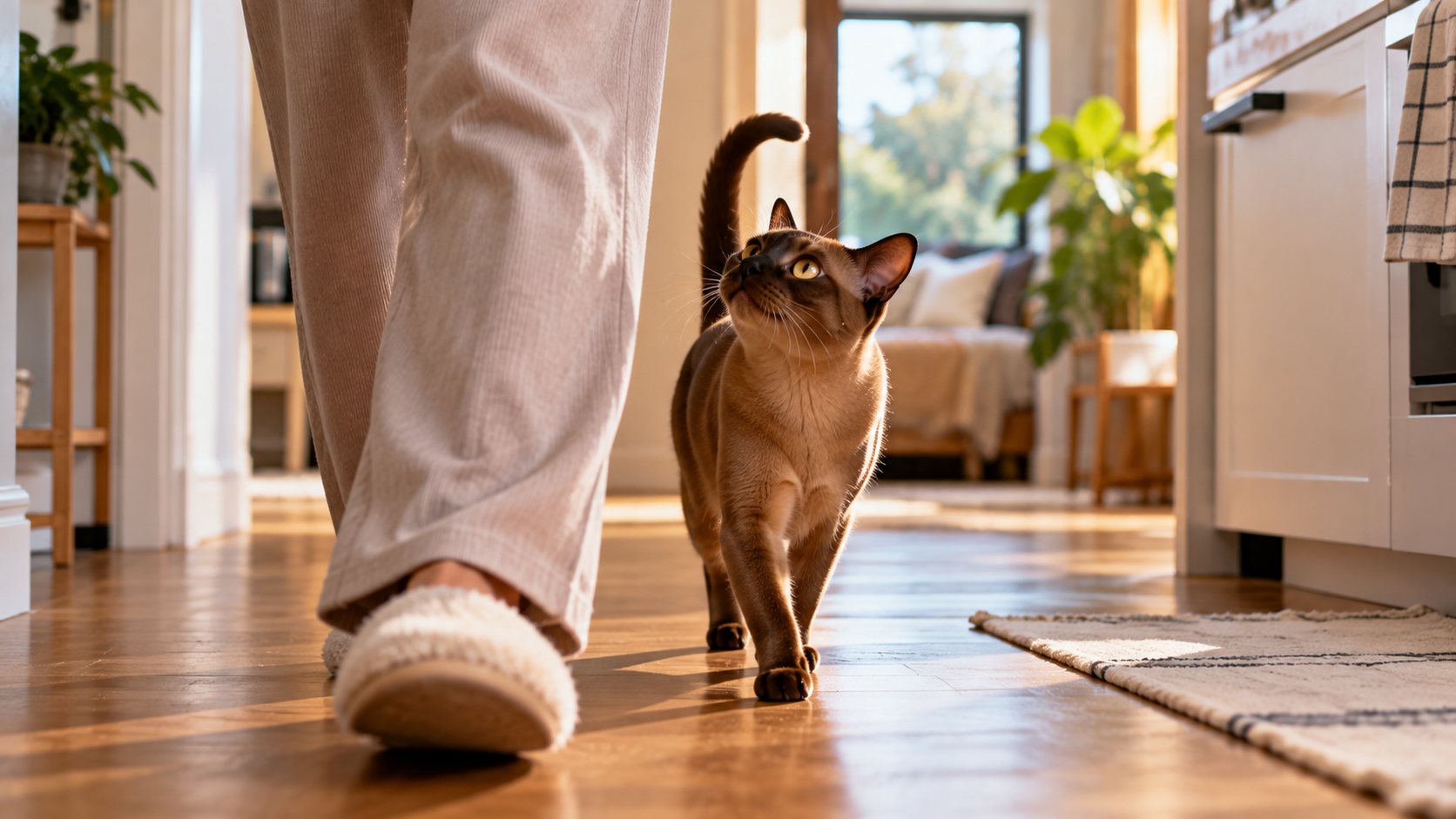
You stand up from the sofa.
Your cat stands up too.
You walk into the kitchen.
They follow.
You go to the bathroom.
They wait outside the door—or decide that privacy is no longer part of your household.
You return to your desk.
A few minutes later, your cat is sitting beside the keyboard.
At night, they may follow you into the bedroom and settle somewhere nearby.
For many cat owners, this behavior creates the same question:
Why does my cat follow me everywhere when they already have everything they need?
It is easy to assume that cats only approach people when they want food.
Sometimes that is exactly what is happening.
But persistent cat following behavior can involve much more than an empty food bowl.
Cats learn routines, build social relationships, become curious about movement around their territory, and discover that following a particular person often leads to something interesting.
Understanding the reason behind the behavior can help you distinguish ordinary feline companionship from a sudden behavioral change that deserves closer attention.
Cats Are More Social Than Their Reputation Suggests
Cats are often described as independent animals.
That description is not completely wrong.
Many cats are perfectly comfortable spending time alone and do not need constant interaction.
But independence does not mean indifference.
A cat can value personal space while also forming a strong relationship with the people around them.
Some cats want frequent physical affection.
Others prefer simply being nearby.
They may sit at the opposite end of the sofa, sleep beside your chair, or quietly move from room to room with you.
Following can therefore be a form of social proximity.
Your cat may not necessarily be asking you to do anything.
They may simply prefer being where you are.
Following You Can Become Part of Their Daily Routine
Cats pay close attention to patterns.
They notice when you wake up.
When breakfast appears.
When you open certain cupboards.
When you sit at your desk.
When you usually prepare dinner.
When you turn off the lights at night.
After enough repetition, your movements become predictable.
Your cat may follow you because they have learned what usually happens next.
Walk toward the kitchen in the morning?
Food might appear.
Open the bedroom door?
The bed becomes available.
Sit on the sofa in the evening?
There may be a chance for attention.
The behavior can look intensely personal while also being partly driven by routine.
For your cat, you are one of the most predictable moving parts of the household.
Your Cat May Simply Be Curious
Imagine spending most of your life inside one home.
Someone suddenly gets up and walks toward another room.
Of course you might want to know what is happening.
Cats are naturally interested in changes within their environment.
A door opening can reveal a previously inaccessible space.
A bag being placed on the floor creates something new to investigate.
A cupboard opening may expose unfamiliar smells.
Laundry being folded creates a temporary landscape of warm fabric.
When you move around the house, you frequently create small events.
Following you gives your cat access to those events.
Sometimes the explanation is not complicated.
Something happened.
The cat wants to inspect it.
You Are Connected to Many of the Things Your Cat Values
From your cat’s perspective, humans have unusual powers.
We open doors.
Fill bowls.
Move furniture.
Produce toys.
Turn taps on.
Open windows.
Create warm blankets.
Retrieve objects from inaccessible cabinets.
Your movement can therefore predict opportunities.
If following you has occasionally resulted in food, play, affection, or access to an interesting room, the behavior has been rewarded.
Not necessarily intentionally.
You may have trained your cat without realizing it.
Food Is Still One of the Obvious Explanations
Sometimes the simplest explanation is correct.
Your cat follows you because they think food might happen.
This becomes especially obvious around regular meal times.
You stand up.
The cat immediately becomes alert.
You walk toward the kitchen.
They accelerate.
Suddenly you have a tiny escort.
Cats can become remarkably good at recognizing the chain of events preceding a meal.
They may react to your alarm.
Your morning routine.
The sound of a particular cabinet.
Even the time you normally stop working.
If following behavior becomes much stronger around meals, food anticipation is probably part of the explanation.
But Constant Treats Can Accidentally Reinforce Following
Suppose your cat follows you into the kitchen.
You think it is cute.
You give them a treat.
Later, they follow you again.
Another treat.
Soon, following has become a successful strategy.
This does not mean you should never reward your cat.
It simply helps to understand how behavior develops.
If every persistent attempt to follow, meow, or interrupt eventually produces food, your cat learns that persistence works.
Sometimes the easiest way to change an unwanted routine is to examine what happens immediately after the behavior.
Some Cats Follow Because They Want Interaction
Food is not the only reward.
Attention can be just as important.
Your cat may want:
petting,
play,
grooming,
conversation,
lap time,
or simply acknowledgment.
You may notice that the following ends once you sit down and interact with them.
That is useful information.
The cat was probably trying to initiate a social activity.
Rather than treating the behavior as annoying, consider whether your cat has had enough meaningful interaction that day.
Indoor Cats Need Things to Do
An indoor environment is safe and comfortable, but it can also become predictable.
The same rooms.
The same furniture.
The same view.
The same toys lying in the same places.
In that environment, you may become the most interesting source of movement.
If your cat follows you constantly and immediately investigates everything you do, boredom may contribute to the behavior.
The solution is not necessarily giving them more toys.
It is making their environment more engaging.
Ten Toys on the Floor Are Not the Same as Enrichment
A toy that never moves can eventually become part of the furniture.
Cats are often stimulated by unpredictability.
Movement.
Searching.
Climbing.
Hiding.
Chasing.
Observing.
Exploring.
Instead of permanently leaving every toy available, try rotating some of them.
A toy that disappears for several days may feel interesting again when it returns.
Interactive play is also different from simply owning toys.
A wand toy controlled by a person can imitate unpredictable movement in a way that a motionless stuffed mouse cannot.
Play Should Give the Cat Something to Pursue
Effective play often works better when the toy behaves like something worth hunting.
Move it away.
Let it disappear behind furniture.
Pause.
Allow the cat to stalk.
Change direction.
Give them opportunities to catch it.
Constantly waving a toy directly in the cat’s face may be less engaging than creating a small pursuit.
The goal is not merely to exhaust the cat.
It is to provide an outlet for natural behavioral patterns.
A satisfying play session can sometimes reduce attention-seeking behavior later.
Vertical Space Can Make a Home Feel Larger
Humans usually think about floor area.
Cats also think vertically.
A shelf.
Cat tree.
Window perch.
Secure furniture.
Elevated resting spot.
These can significantly expand the usable environment without increasing the physical size of the home.
A cat that can move between different heights has more options for observing the household.
This can be especially useful in homes with multiple pets or people.
Sometimes a cat follows you because your location is the best available source of security or stimulation.
Giving them alternative observation points can change that.
Windows Can Provide Hours of Passive Enrichment
A secure window view can offer changing stimulation throughout the day.
Birds.
Leaves.
People.
Vehicles.
Light.
Rain.
Insects.
Outdoor sounds.
Not every cat will spend hours watching outside, but many enjoy having access to a safe observation point.
Place a comfortable perch near an appropriate window if possible.
Make sure the setup is secure.
An interesting environment gives your cat something else to monitor besides your ankles.
Following Can Be a Sign of Attachment
Some cats simply develop particularly strong preferences for certain people.
They may choose one person’s room.
Sleep on their belongings.
Wait near the door when that person leaves.
Follow them more frequently than other members of the household.
That does not necessarily mean the cat dislikes everyone else.
Relationships can differ.
One person may provide food.
Another may be the preferred play partner.
Someone else may offer the best lap.
Cats can build different associations with different people.
Burmese Cats Are Often Described as People-Oriented
Individual personality always matters more than stereotypes.
Still, Burmese cats are commonly associated with sociable, interactive behavior and a strong interest in human companionship.
That means a Burmese cat wanting to participate in household activity may not be particularly surprising.
One may follow you around, investigate what you are doing, or prefer staying close rather than spending the entire day alone in another room.
But breed tendencies should never be treated as guarantees.
Two cats of the same breed can have very different personalities.
Learn the individual cat in front of you.
Kittens Often Follow Because Everything Is New
For a kitten, the household is enormous.
Every room contains information.
Every movement deserves investigation.
And you may represent safety.
Young cats can therefore become tiny shadows.
They follow feet.
Climb onto furniture after you.
Investigate whatever you touch.
Appear every time a door opens.
Part of this is social.
Part is curiosity.
Part is learning.
As the kitten becomes more confident and familiar with the environment, the intensity may change.
Be Careful When a Kitten Follows Your Feet
Cute behavior can create practical risks.
Kittens are small, fast, and surprisingly talented at appearing exactly where you are about to step.
Be particularly careful around:
stairs,
doors,
reclining furniture,
kitchens,
laundry areas,
and anywhere heavy objects are being moved.
Before closing a door or operating equipment, know where the kitten is.
A curious young cat does not understand household hazards automatically.
Adult Cats Can Suddenly Become More Affectionate Too
A cat that has always followed you is one situation.
A cat that suddenly starts following you constantly after years of behaving differently is another.
Behavioral changes deserve context.
Maybe something changed in the home.
A new pet.
A visitor.
Construction noise.
Furniture rearrangement.
A change in work schedule.
Someone moved out.
A familiar person is away.
Cats notice environmental changes that humans may consider insignificant.
Following can sometimes be a response to uncertainty.
Changes in Routine Can Make a Cat Seek Reassurance
Suppose you normally leave for work every morning.
Then suddenly you work from home.
Your cat’s routine changes.
Or the opposite happens.
You spend several months at home and then begin leaving regularly.
Again, the routine changes.
Cats can adapt.
But adaptation may take time.
During transitions, some cats become more vocal or stay closer to familiar people.
Providing predictable feeding, play, and rest routines can help create stability even when other parts of life change.
A New Pet Can Change Following Behavior
Introducing another cat or dog changes the social environment.
Your cat may suddenly spend more time near you.
That does not automatically mean jealousy in the human sense.
Your presence may simply feel predictable and secure.
They may also be monitoring how you interact with the newcomer.
Make sure each animal has access to important resources without unnecessary competition.
Food.
Water.
Resting places.
Litter areas.
Safe retreat spaces.
Attention.
Reducing resource pressure can help the household settle.
Following Is Not Always the Same as Separation Anxiety
It is tempting to label any extremely attached cat as having separation anxiety.
But following you while you are home does not automatically prove distress when you leave.
Look at the broader pattern.
What happens when the cat is alone?
Can they settle independently?
Do they eat normally?
Use the litter box normally?
Rest?
Play?
Or does your departure consistently trigger significant distress?
The distinction matters.
A social cat that enjoys your company is not necessarily an anxious cat.
Your Cat May Follow You Because You Are Warm
There are emotional explanations.
There are behavioral explanations.
And then there is basic physics.
Humans are warm.
Beds are warm.
Laptops are warm.
Blankets are warm.
The chair you just left is warm.
A cat settling beside you may appreciate companionship and body heat at the same time.
Those motivations are not mutually exclusive.
Sometimes affection is conveniently heated.
Bathrooms Are Weirdly Interesting to Cats
Many cat owners discover that the bathroom apparently requires feline supervision.
There are several possible reasons.
You are temporarily stationary.
The door may usually be closed, making the room more interesting.
There are unusual smells.
Running water.
Cool surfaces.
Towels.
Small spaces.
And, most importantly, you are suddenly available.
If your cat sits outside a closed bathroom door complaining dramatically, it may simply dislike losing access to you—or to a room they consider part of their territory.
Closed Doors Can Be More Interesting Than Open Ones
A cat may ignore a room for six hours.
Close the door.
Suddenly that room becomes the most important location on Earth.
Cats often want information about their environment.
A closed door prevents inspection.
If you repeatedly enter rooms and shut them out, following may partly reflect their desire to maintain access.
This does not mean every door must remain open.
Boundaries are fine.
But the behavior becomes easier to understand when viewed from the cat’s perspective.
Meowing While Following Provides Another Clue
A silent follower may simply want company.
A cat following while repeatedly vocalizing may be communicating a more specific request.
Look at where they lead you.
Toward the food bowl?
Water?
Door?
Toy?
Litter area?
Favorite resting place?
Sometimes humans assume the cat is following them.
In reality, the cat may be trying to make the human follow.
Pay attention to direction.
Check the Basics Before Assuming It Is Purely Behavioral
When your cat repeatedly seeks you out, make sure their essential needs are actually being met.
Is fresh water available?
Is the feeding routine appropriate?
Is the litter area clean?
Can they access their usual resting spaces?
Is the room unusually hot or cold?
Has something blocked a favorite location?
A cat cannot explain a household problem directly.
Behavior is often the message.
Water Preferences Can Be Surprisingly Specific
A bowl can technically contain water while the cat still does not find the setup appealing.
Some cats prefer water placed away from food.
Some prefer wider bowls.
Some enjoy moving water.
Others are perfectly satisfied with a normal bowl.
The important thing is observing actual drinking habits and maintaining clean, accessible water.
If your cat suddenly starts following you toward sinks or repeatedly asking for water in an unusual way, pay attention to the change rather than assuming it is a quirky new habit.
Litter Box Problems Can Also Change Behavior
Cats generally value clean, accessible toileting areas.
If something about the litter setup changes, behavior elsewhere can change too.
Maybe the box is dirtier than usual.
Another pet is guarding access.
The litter changed.
The box was moved.
The surrounding area became noisy.
Following and vocalizing may occur alongside other signs that something is wrong.
Never punish a cat for communicating discomfort through behavior.
Investigate the cause.
Give Your Cat Predictable Attention Before They Demand It
Imagine attention only happens after the cat follows you for twenty minutes and repeatedly interrupts your work.
From the cat’s perspective, persistence succeeded.
A better approach can be creating predictable moments for interaction.
A short play session in the morning.
Another later in the day.
Quiet affection when you sit down.
Grooming if the cat enjoys it.
The exact routine depends on the individual animal.
Predictability can reduce the need to constantly ask.
You Do Not Have to Respond Every Single Time
Loving your cat does not mean entertaining them continuously.
Cats also need the ability to settle independently.
If every meow immediately produces food, play, or attention, demanding behavior can become stronger.
Make sure their needs are met.
Provide appropriate enrichment.
Then allow quiet moments too.
Your cat can learn that being near you does not always result in an activity.
Sometimes you are simply sharing the room.
Independent Resting Spots Are Useful
Create comfortable places that belong to the cat’s routine.
A bed near your desk.
A perch beside a window.
A blanket on a chair.
A cat tree in the living room.
A quiet hideaway elsewhere.
This gives the cat options.
If they want proximity, they can rest near you without sitting directly on the keyboard.
If they want solitude, they have somewhere secure to go.
Good cat care is often about providing choices.
Do Not Force Independence
If your cat enjoys sitting near you, there is usually no reason to push them away simply because someone said cats are supposed to be independent.
Temperaments vary.
Some cats spend hours alone.
Others are highly social.
As long as the relationship is healthy and the cat can function comfortably when you are unavailable, companionship is not a problem that needs fixing.
The goal is balance.
Not emotional distance.
Sudden Clinginess Deserves More Attention Than Familiar Clinginess
This is one of the most useful distinctions.
If your cat has followed you everywhere for five years, that may simply be their personality.
If a previously independent cat suddenly refuses to leave your side, something changed.
It might be environmental.
Emotional.
Routine-related.
Or potentially physical.
Observe the whole cat.
Not just the following.
Look for Changes in Eating, Drinking, and Litter Habits
Behavioral changes become more significant when they appear alongside other changes.
Pay attention to appetite.
Water consumption.
Urination.
Defecation.
Activity.
Sleep.
Grooming.
Mobility.
Vocalization.
Weight.
A single unusual afternoon may mean very little.
A persistent change involving multiple areas deserves more attention.
Cats can be subtle when something is bothering them.
Knowing their normal behavior gives you a valuable baseline.
Pain Can Change Social Behavior
A cat experiencing discomfort does not always hide.
Some do.
Others seek more contact.
That is why sudden affection or following should not automatically be interpreted as the cat simply becoming friendlier.
Watch movement.
Are they reluctant to jump?
Moving differently?
Avoiding stairs?
Reacting when touched?
Sleeping in unusual places?
Changes like these are useful information.
If you suspect pain or illness, veterinary evaluation is more appropriate than trying to solve the issue solely as a behavior problem.
Older Cats May Need Different Support
As cats age, their routines and abilities can change.
Jumping may become harder.
Vision or hearing can change.
They may prefer easier access to resources.
A familiar person can also become an important source of predictability.
An older cat following more frequently deserves thoughtful observation.
Make the environment easy to navigate.
Keep essential resources accessible.
And discuss significant behavioral changes with a veterinarian.
Aging is not a reason to dismiss every change as “just getting old.”
Do Not Punish a Cat for Following
Following is not bad behavior by itself.
Shouting, spraying water, or frightening the cat does not teach them what you actually want.
It can simply make your presence less predictable or more stressful.
If following becomes inconvenient, change the environment and routine.
Provide an attractive resting spot near your workspace.
Schedule play.
Avoid rewarding every interruption with food.
Close a door when necessary without turning it into a confrontation.
Management usually works better than punishment.
Learn What Your Cat Is Asking For
The same behavior can have different meanings in different cats.
One follows because dinner is approaching.
Another wants play.
Another wants to sleep beside you.
Another is bored.
Another is unsettled by a change in the household.
Another may not be asking for anything at all.
They simply like you.
Instead of searching for one universal explanation, look for patterns.
When does the following happen?
Where does the cat follow you?
What happens immediately beforehand?
What does the cat do when you stop moving?
What makes the behavior end?
Those details tell you far more than the behavior alone.
A Cat That Follows You May Already Be Telling You Something Positive
Sometimes there is no problem to solve.
Your cat feels comfortable around you.
Your movements are interesting.
Your routine is familiar.
Your presence predicts safety, warmth, interaction, or enjoyable activities.
They choose to stay nearby.
For an animal capable of leaving the room whenever they want, that choice means something.
You do not need to romanticize every trip to the bathroom as a profound declaration of love.
But you also do not need to reduce every interaction to food.
Cats are more complicated than either explanation.
Conclusion
Persistent cat following behavior can come from many ordinary parts of feline life.
Your cat may be curious about what you are doing, anticipating food, looking for play, responding to a familiar routine, seeking warmth, or simply choosing to spend time near someone they trust.
For social cats—including many Burmese cats—moving around the home with their people can become a normal part of daily life.
The most important thing is knowing what is normal for your individual cat.
A lifelong shadow who follows you into every room is different from an independent cat who suddenly becomes unusually clingy.
Pay attention to context.
Provide play, climbing opportunities, comfortable resting areas, predictable interaction, clean resources, and enough choice within the home.
And when following appears suddenly alongside changes in appetite, drinking, litter habits, movement, grooming, vocalization, or general behavior, take the change seriously and consider veterinary guidance.
Sometimes your cat follows because something is wrong.
Sometimes they want dinner.
And sometimes the explanation is much simpler:
You are going somewhere.
They like being with you.
So naturally, they are coming too.