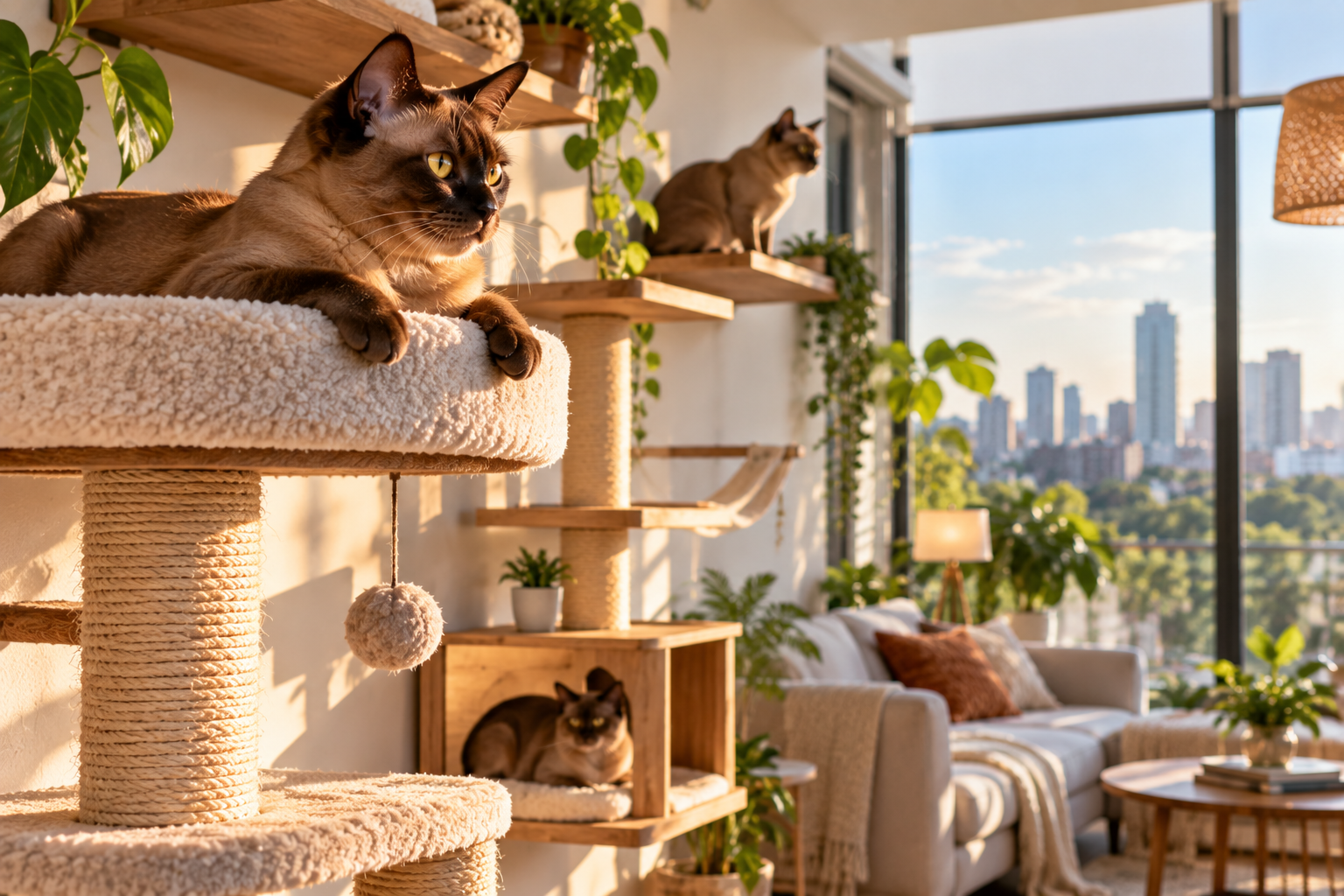
You bought the soft bed.
Then another one.
There is a padded spot beside the sofa, a blanket near the window, and possibly an expensive cat bed that your cat inspected once before walking away.
Yet every afternoon, you find them somewhere else.
On top of a cabinet.
Balanced across the back of the sofa.
Sitting on a bookshelf.
Watching the room from a windowsill.
Or staring down at you from a piece of furniture you never intended to become cat territory.
It can look like your cat is simply choosing the most inconvenient sleeping place available.
But height can offer something a floor-level bed cannot.
For many cats, cat vertical space adds usable territory, observation points, climbing opportunities, and places where they can retreat without completely leaving the room.
The goal is not to cover every wall with cat furniture.
It is to understand why height matters and then create a few safe, useful options that actually fit the cat and the home.
Your Cat Does Not See the Room the Same Way You Do
Humans usually think about a room in terms of floor space.
The sofa occupies this area.
The table occupies another.
The walkway needs to remain clear.
The cabinet sits against the wall.
To a cat, the room can also extend upward.
The sofa back is another surface.
The windowsill is another destination.
The top of sturdy furniture can become an observation point.
A shelf may function like a pathway.
That means a relatively small room can feel more usable when safe vertical levels are available.
You do not necessarily need a larger home.
Sometimes you need to think about the existing home differently.
Height Can Provide a Better View
Imagine sitting on the floor while several people move around you.
Feet pass nearby.
Doors open.
Objects move.
Someone approaches from behind furniture.
Now imagine watching the same room from a stable elevated platform.
You can see more.
You can notice movement earlier.
You have more information about what is happening around you.
For a cat, an elevated position can provide a useful vantage point.
This helps explain why a cat may choose a firm shelf over a luxurious bed placed directly in the middle of a busy room.
Comfort is not only about softness.
Location matters too.
A Good Resting Place Should Feel Safe
People often choose cat beds based on material.
Plush.
Soft.
Warm.
Cute.
But the cat is also evaluating the environment around that bed.
Is it beside a busy doorway?
Can someone walk past constantly?
Is it near a noisy appliance?
Can another pet approach easily?
Is there somewhere to retreat?
A cheap blanket in a quiet elevated location may become more valuable than an expensive bed positioned somewhere the cat does not feel comfortable relaxing.
Instead of asking why the cat dislikes the bed, ask whether the location makes sense from the cat’s perspective.
Vertical Space Can Increase Usable Territory
This becomes especially valuable in apartments and smaller homes.
Suppose the room has ten square meters of accessible floor.
Adding a tall cat tree does not change the floor dimensions dramatically.
But now the cat may have several additional surfaces at different heights.
One lower platform.
One middle platform.
One high perch.
Perhaps a covered resting area.
A small footprint can therefore create several usable zones.
That is one reason cat vertical space can be so useful when floor area is limited.
Start With Places Your Cat Already Chooses
Before buying anything, observe.
Where does your cat naturally go?
The back of the sofa?
A particular windowsill?
Dining chairs?
Top of a cabinet?
Stairs?
A desk?
Cats often reveal their preferences before we design anything for them.
If your cat constantly tries to reach one specific cabinet, that tells you height or location has value.
Instead of repeatedly removing the cat without offering an alternative, consider whether a safer elevated option can be placed nearby.
Observation should come before shopping.
A Cat Tree Does Not Automatically Solve the Problem
You buy a huge cat tree.
Put it in the corner.
Your cat ignores it.
This does not necessarily mean your cat dislikes cat trees.
Look at where it was placed.
If the cat tree is hidden in a quiet corner with nothing interesting around it, while the bookshelf overlooks the entire living room, the bookshelf may simply have the better location.
Try placing vertical resources where something happens.
Near a window.
Near a room where the family spends time.
Close to an existing route the cat already uses.
Location can be more important than size.
Windows Can Make Elevated Perches Much More Interesting
A window adds movement.
Birds.
People.
Trees.
Light.
Weather.
Vehicles.
Shadows.
Even an ordinary street can provide changing visual stimulation throughout the day.
A stable perch near a secure window may therefore become highly attractive.
Make sure the window itself is safe.
Screens and fittings should be secure where needed, and a cat should not have access to a dangerous opening simply because a perch has been placed nearby.
The goal is enrichment without creating a new hazard.
Not Every Window Is Equally Useful
A window facing a blank wall may attract less attention than one overlooking trees or regular outdoor activity.
Sun exposure also changes throughout the day.
One windowsill may become extremely warm in the afternoon.
Another may be cold or drafty.
Watch where your cat chooses to sit at different times.
You may discover that they already have a preferred morning location and another afternoon location.
Cats can be surprisingly specific about where they want to rest.
Think in Routes, Not Isolated Platforms
A shelf high on a wall may look fantastic.
But how does the cat reach it?
Can they jump there comfortably?
Where do they land?
How do they come down?
Is the surface below slippery?
A useful vertical environment needs a route.
For example:
floor → stool → cat tree platform → shelf.
That can be more practical than expecting one enormous jump.
The exact arrangement depends on the cat’s size, confidence, age, mobility, and the available space.
Getting Down Matters as Much as Getting Up
Cats are often excellent climbers, but descending can require different movement.
A young agile cat may leap from a high platform without hesitation.
That does not mean every cat should have to.
Provide sensible intermediate levels where possible.
This becomes particularly important for kittens still developing coordination and for older cats whose mobility may change.
A vertical setup should not become a one-way trip.
Stability Comes Before Appearance
A beautiful cat tower that wobbles every time the cat jumps onto it may not remain attractive for long.
Cats need confidence in the surface supporting them.
Check whether furniture is stable.
Tall cat trees may need appropriate securing depending on their design.
Wall-mounted platforms must be installed correctly for the wall type and expected load.
Shelves should not shift under weight.
Do not assume something is safe simply because it is marketed for cats.
Installation still matters.
Be Careful With Ordinary Furniture
Your cat may already use bookshelves, cabinets, or wardrobes as vertical territory.
Before allowing this, inspect the area.
Could the furniture tip?
Are heavy objects near the edge?
Are there fragile decorations?
Could the cat become trapped behind something?
Are there cables?
Is there a safe route down?
A cabinet that seems solid during normal human use may behave differently when a cat repeatedly launches onto one side.
Tall furniture should be appropriately secured where tipping is a risk.
Clear the Landing Zone
Cats do not always land exactly where expected.
If a shelf contains:
glass decorations,
candles,
small electronics,
picture frames,
or unstable objects,
the first enthusiastic jump may rearrange everything.
Give the cat enough clear surface to land and turn around comfortably.
A perch should function as an actual perch, not a narrow strip between objects.
If you want the cat to use the space, design it for use.
Surface Grip Matters
A polished wooden shelf may look elegant but provide poor traction.
A small non-slip mat, securely attached carpet section, or another suitable surface can make a platform easier to use.
This is especially relevant when the cat needs to jump from one level to another.
Loose fabric is not always ideal because it can slide with the cat.
The covering should improve stability rather than introduce another moving surface.
Scratching Can Be Part of the Vertical Route
Scratching posts are often treated as separate furniture.
They do not have to be.
A tall scratching surface can become part of the transition between floor-level activity and elevated territory.
Many cats enjoy stretching upward while scratching.
Place an appropriate scratching surface near a route the cat frequently uses.
The important part is that it should be tall enough for the cat to stretch comfortably and stable enough not to wobble or fall.
A scratching post that moves during use may quickly lose appeal.
Height Can Be Useful in Multi-Cat Homes
When multiple cats share a home, usable space becomes more complicated.
Two cats may technically share one room while preferring different locations within it.
One chooses the sofa.
Another chooses the windowsill.
A third prefers the top of the cat tree.
Vertical levels can create more options without requiring additional rooms.
But simply adding one premium high perch is not necessarily enough.
If every cat wants the same location, that single perch can become a contested resource.
Avoid Creating Dead Ends
Imagine one cat is resting on a high shelf.
Another cat sits at the only route down.
Now the elevated location is no longer much of a retreat.
Where possible, think about alternative routes.
Can the cat move to another platform?
Can they descend somewhere else?
Does one cat have to pass directly beside another to leave?
This becomes particularly important if cats in the household sometimes avoid or compete with one another.
A good vertical environment should increase options rather than create traps.
More Cats Usually Mean More Choice Is Helpful
One water bowl.
One sleeping spot.
One high perch.
One scratching post.
Technically, resources exist.
But all cats may not want to share them at the same time.
Distributing resources around the home can reduce the need for every cat to use the same place.
This applies to vertical resting areas too.
Several useful locations can be better than one elaborate “cat zone” containing everything.
Kittens Need Safe Challenges
Kittens are curious.
They climb.
They jump.
They make decisions that occasionally seem to have been made without any planning whatsoever.
Providing appropriate climbing opportunities can help direct that behavior toward safer areas.
But do not assume a kitten has perfect judgment.
Check gaps.
Unstable furniture.
Blind cords.
Open windows.
Fragile shelves.
Spaces where a small kitten could squeeze behind furniture and become difficult to reach.
Enrichment should challenge the kitten without turning the room into an obstacle course full of hazards.
Senior Cats May Still Want Height
A common mistake is removing elevated spaces completely when a cat becomes older.
An older cat may still value the same favorite window or resting location.
The problem may be access rather than preference.
Instead of eliminating the destination, modify the route.
Add intermediate steps.
Use a stable stool.
Provide a ramp where appropriate.
Reduce the height of individual jumps.
Add non-slip surfaces.
The objective is to preserve access while adapting it to changing mobility.
Watch for Changes in Jumping Behavior
A cat that has always jumped onto a favorite surface but suddenly stops deserves attention.
Maybe the furniture changed.
Maybe the surface became slippery.
But changes in mobility can also be associated with discomfort or health issues.
Do not automatically interpret a sudden reluctance to jump as laziness.
If the change is persistent or accompanied by other concerning signs, discuss it with a veterinarian.
Environmental enrichment works best when it respects the cat’s physical condition.
Bigger Is Not Always Better
You do not need a cat tree reaching the ceiling simply because taller products exist.
Ask what the cat actually needs.
For some cats, a medium-height platform beside a window becomes the most valuable piece of furniture in the house.
For others, a tall tower with multiple levels is heavily used.
Some prefer shelves.
Some prefer furniture they already know.
The best vertical setup is the one the individual cat consistently uses safely.
Expensive Is Not Automatically Better
Cat furniture can become surprisingly expensive.
Before spending heavily, test the concept.
A sturdy chair beside a secure window can reveal whether your cat likes that location.
A safe existing shelf can reveal preferred height.
A simple scratching tower can show whether climbing is interesting.
Once you understand the pattern, buying or building something more permanent becomes easier.
The cat does not know how much the furniture cost.
They only know whether it works for them.
Cardboard Still Has a Place
A carefully designed vertical environment does not make simple enrichment useless.
Cats may still love:
cardboard boxes,
paper bags without handles where safe,
blankets,
small hiding spaces,
or ordinary furniture.
That is fine.
Enrichment is not an interior-design competition.
The goal is to provide opportunities for natural behaviors.
A cardboard box beneath an elegant cat wall does not mean the design failed.
It means your cat likes cardboard too.
Vertical Space Should Not Replace Play
A tall cat tree is not a complete enrichment plan.
It creates opportunities for climbing, resting, scratching, and observing.
Interactive play provides something different.
Movement.
Chasing.
Stalking.
Pouncing.
Timing.
Engagement with a moving target.
Use vertical resources as part of the environment, not as a substitute for interaction.
A cat can have an incredible climbing wall and still benefit from regular play.
Use Vertical Levels During Play
Vertical territory can actually make interactive play more interesting.
A toy can move around the base of a cat tree.
Disappear behind a platform.
Move upward.
Pause.
Reappear.
The cat gets opportunities to stalk and change elevation.
Avoid forcing dangerous jumps or encouraging the cat to launch blindly from excessive heights.
Play should use the environment safely.
The objective is movement and engagement, not acrobatics for its own sake.
Rotate Interest Instead of Constantly Buying Furniture
If a perch is ignored, you may not need a replacement immediately.
Try changing the environment around it.
Move it to another safe location.
Place a familiar blanket there.
Use play nearby.
Open access to a useful view.
Sometimes the problem is not the object.
It is that the object currently has no reason to be interesting.
Small environmental changes can produce more information before another purchase.
Give New Furniture Time
Some cats inspect new objects immediately.
Others act as if the new cat tree is a suspicious structure that appeared overnight.
Do not force the cat onto it.
Allow exploration.
Use familiar scent by placing a regularly used blanket nearby or on an appropriate surface.
Play around the structure.
Reward voluntary exploration if that works for the individual cat.
Confidence built voluntarily is more useful than repeatedly placing a reluctant cat on the top platform.
Do Not Turn Every High Surface Into Cat Territory
Cats benefit from choices, but humans still need functional homes.
Kitchen preparation areas may need to remain off-limits.
Shelves with fragile items are poor choices.
Certain rooms may contain hazards.
Instead of trying to make every elevated surface accessible, create alternatives that are more appealing.
If the cat constantly wants one forbidden location, ask what that location provides.
Height?
Warmth?
A view?
Proximity to you?
Then try to reproduce those qualities somewhere appropriate.
Placement Near People Can Matter
A cat may not want isolation.
They may want distance while still being involved.
That is an important distinction.
A high perch in the living room lets a cat observe family activity without sitting directly in the middle of it.
This can be particularly useful for cats that enjoy being nearby but do not always want physical interaction.
The cat is still participating in the room.
Just from a position they selected.
Hiding and Height Serve Different Purposes
A cat under the bed and a cat on top of a wardrobe are both creating distance, but the experiences are different.
A hiding place provides concealment.
A high perch provides visibility.
Many cats benefit from having both options.
That might mean:
a covered bed in a quiet area,
a cardboard hide,
and an elevated open perch elsewhere.
Do not assume one safe place fulfills every preference.
Choice is part of environmental quality.
Put Resources Where the Cat Actually Lives
There is little value in creating an elaborate cat room if the cat spends nearly all day following the family around the living room.
Spread useful resources through the areas the cat naturally uses.
A perch in the living room.
A scratching surface near a common route.
A window spot.
A quiet resting area.
Perhaps another elevated option in the bedroom.
The home can support the cat without looking like one giant piece of cat furniture.
Observe Before Redesigning the Entire House
Spend several days noticing behavior.
Where does the cat sleep in the morning?
Where in the afternoon?
Where do they go when visitors arrive?
Where do they watch outside?
Which furniture do they climb?
Which scratching surface do they prefer?
When do they leave the room?
This information is more useful than copying a perfect-looking cat room from social media.
Design around the cat that actually lives in the home.
Your Cat’s Preferences Can Change
A kitten may climb constantly.
An adult cat may settle into several favorite locations.
A senior cat may want the same destinations with easier access.
Season also matters.
A sunny perch can be popular in cooler weather and abandoned when the room becomes hot.
Furniture moves.
Households change.
New pets arrive.
Environmental enrichment should not be treated as a one-time installation.
Occasionally reassess what the cat is actually using.
The Goal Is Choice, Not Maximum Height
It is easy to reduce vertical enrichment to:
“Cats like being high.”
That is too simple.
The useful part is providing options.
A cat can choose:
higher or lower,
open or hidden,
social or quiet,
sunny or shaded,
active or resting.
That ability to select an appropriate location gives the environment flexibility.
Sometimes the cat will choose the highest perch.
Sometimes they will sleep in a box on the floor.
Both can be completely normal.
Conclusion
Cat vertical space can turn parts of the home that humans barely consider into useful territory for climbing, observing, scratching, resting, and moving away from activity when a cat wants more control over its surroundings.
But good vertical enrichment is not about buying the tallest cat tree available.
Start by watching the cat.
Notice which heights, rooms, windows, and surfaces they already prefer. Then provide stable platforms, sensible routes up and down, secure furniture, adequate grip, and more than one useful option where possible.
Think about the individual cat as well.
Kittens may need safer boundaries while they develop coordination. Multi-cat homes benefit from multiple choices and routes. Older cats may still value elevated locations but need steps, ramps, or lower jumps to reach them comfortably.
Most importantly, combine cat vertical space with hiding places, scratching opportunities, interactive play, comfortable resting areas, and the other resources a cat uses throughout the day.
Your cat choosing the top of the cabinet instead of the expensive bed is not necessarily rejecting comfort.
They may simply be telling you that, from up there, the room works better.