
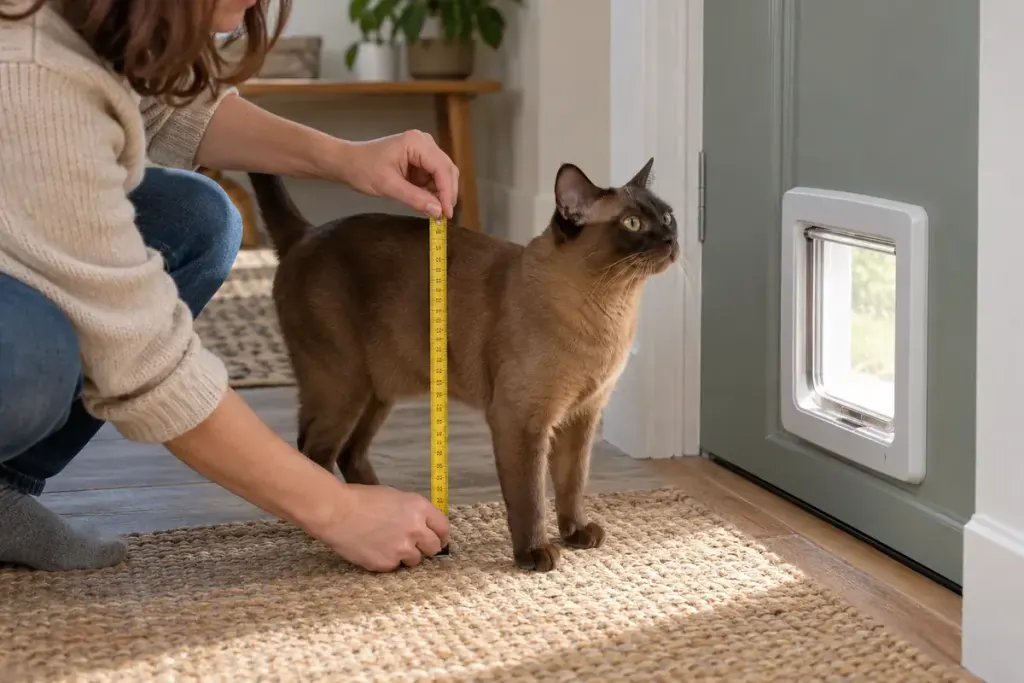
A cat flap looks generous in a product photograph, but the large outer frame is not the space the cat passes through. Before buying or cutting an opening, find the dimensions of the usable passage and compare them with your cat.
PetSafe’s sizing guidance starts with the widest part of the cat’s body and a relevant body-height measurement, then directs owners to the product’s sizing information. Follow the instructions for the particular flap rather than using a photograph of another cat as a scale.
Keep three measurements separate
- Passage opening: the clear space available to the animal.
- Cutout: the opening required in the door or installation surface.
- Outer frame: the overall area occupied by the product.
These numbers are related but not interchangeable. Installation depth, tunnel extensions and the flap mechanism can also affect the finished arrangement. Check the complete model specification before making a permanent change.
Measure calmly while the cat is comfortable. Do not force the animal through a rigid test opening or restrain it to obtain a perfect number. Ask the manufacturer for help if the size sits near a boundary, and consider how a growing cat’s needs may change.
Look at the approach on both sides
A suitable opening can still be awkward if it is mounted too high, opens onto a cramped ledge or requires a difficult turn. Follow the mounting-height guidance and consider the individual cat’s mobility. A veterinary discussion may be appropriate if movement is painful or limited.
Use a qualified installer for glazing or other surfaces that require specialist work. A cutting template is not permission to modify every type of door or window yourself.
Plan safe access and a gradual introduction separately from sizing. Even a correctly fitted flap does not establish that unsupervised outdoor access is suitable for your cat or location. The fit check answers one practical question before you make the larger access decision.