
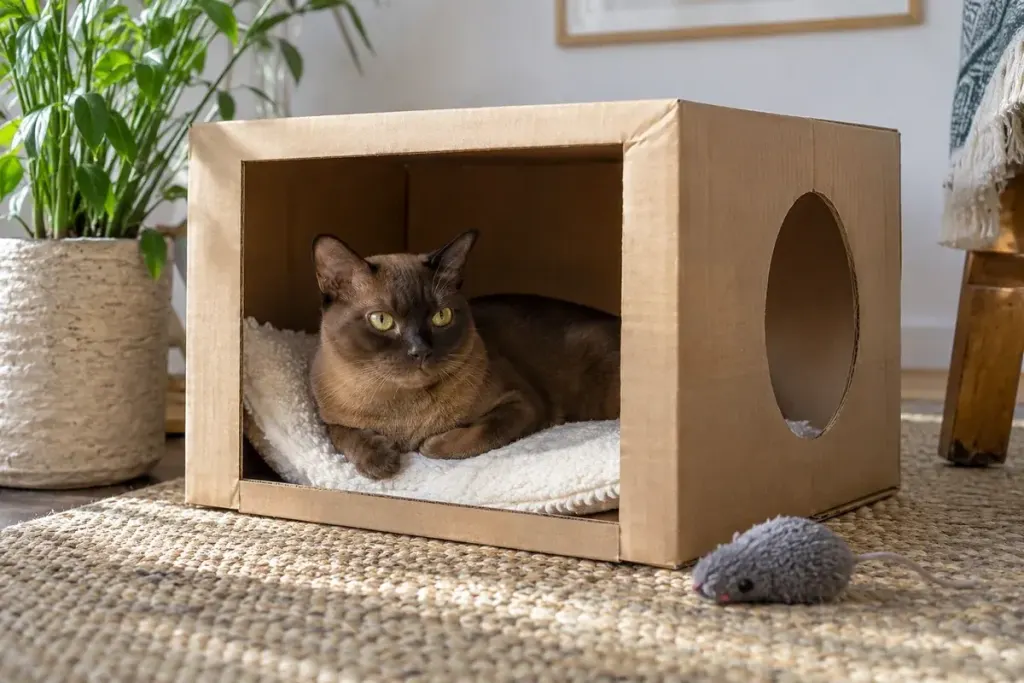
A room can contain a comfortable bed and still offer nowhere a cat feels concealed. A safe retreat gives the cat another way to use the space without being continuously visible or approached.
The Feline Veterinary Medical Association’s environmental guidance includes safe places among cats’ needs. The right arrangement depends on the individual; an expensive enclosed bed is not automatically preferable to a suitable simple box.
Let the location do some work
Choose a quiet, accessible position away from repeated disturbance. Keep the retreat stable and free of staples, loose strings or other hazards. In a multi-cat home, consider whether another cat can block the only exit. More than one suitable retreat can offer meaningful choice.
Do not place the cat inside and insist that it stay. Allow investigation at its own pace, and avoid reaching in repeatedly to pull it out. The retreat becomes less useful if entering it reliably brings unwanted handling.
Observe without making a diagnosis
Notice when the cat uses the space: during visitors, noisy household work or ordinary naps. That can help you improve the environment. It does not prove that every change in hiding is caused by stress.
A sudden increase in hiding, reduced appetite, changes in movement or other concerning signs should prompt veterinary advice. Do not assume a cat is merely enjoying its new box if its overall behaviour has changed. A Burmese cat’s reputation for sociability does not remove its individual need for rest and privacy.
Keep the retreat clean using appropriate materials and replace damaged cardboard or fabric. If the cat prefers another safe location, learn from that choice. The useful result is a room with options the cat actually uses, rather than a purchased hideaway that only satisfies a human decorating plan.