
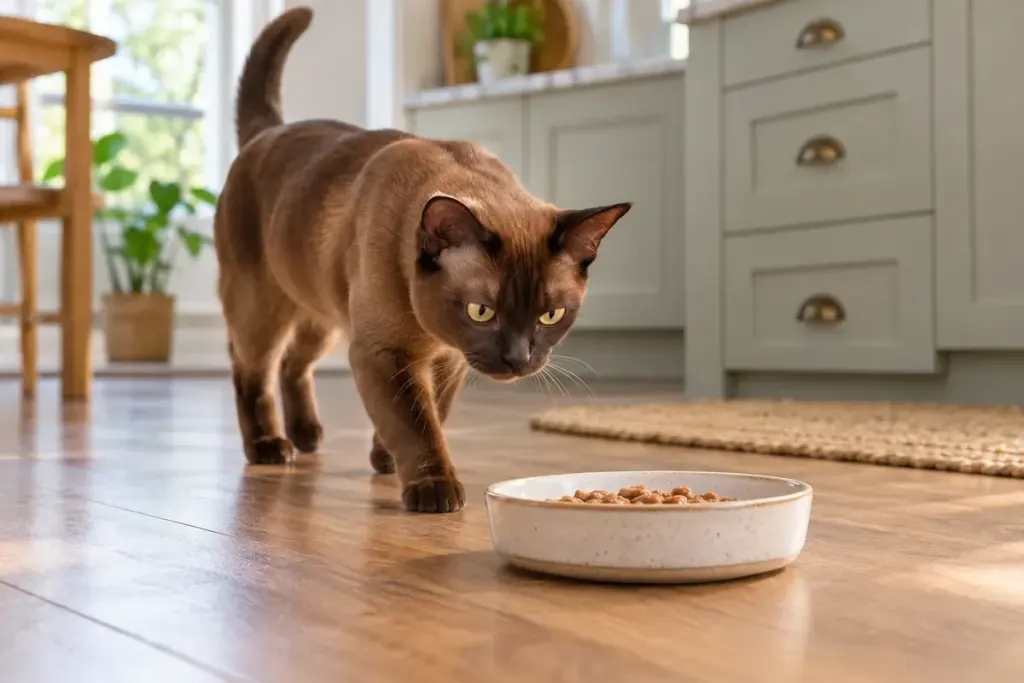
A cat takes a few bites, moves food onto the floor and returns to the edge of the bowl. The shape of the dish is one possible thing to examine, but the behaviour alone does not diagnose a problem or prove that the whiskers are uncomfortable.
Cats Protection’s feeding guidance discusses practical bowl choices and feeding arrangements. Individual cats differ, so observation is more useful than treating one preferred bowl shape as a cure.
Change one part of the setup
Try a clean, stable, food-safe shallow dish of an appropriate size. Keep the food, portion, location and timing as consistent as possible for the comparison. Otherwise, you may be observing a new food or quieter location rather than the bowl.
Watch from a respectful distance. Note whether the cat approaches readily, eats comfortably and leaves a similar amount. Do not repeatedly move the dish while the cat is eating or force it to use a particular position.
Keep the observation modest
A preference for one dish does not establish a medical explanation. Likewise, leaving food can have causes unrelated to the container. Record what you see rather than labelling it from a short online description.
If appetite decreases, eating appears painful, the cat drops food unusually, drools or seems unwell, contact a veterinarian promptly. Do not keep running bowl experiments while a possible health problem goes unassessed.
Clean the chosen dish according to its material and food-safety requirements. Check for chips, rough edges or instability that could make an otherwise suitable shape uncomfortable.
The useful result is a feeding arrangement that the individual cat uses comfortably, backed by ordinary observation and appropriate veterinary help when needed. A bowl can be improved without turning every small behaviour into a diagnosis.