
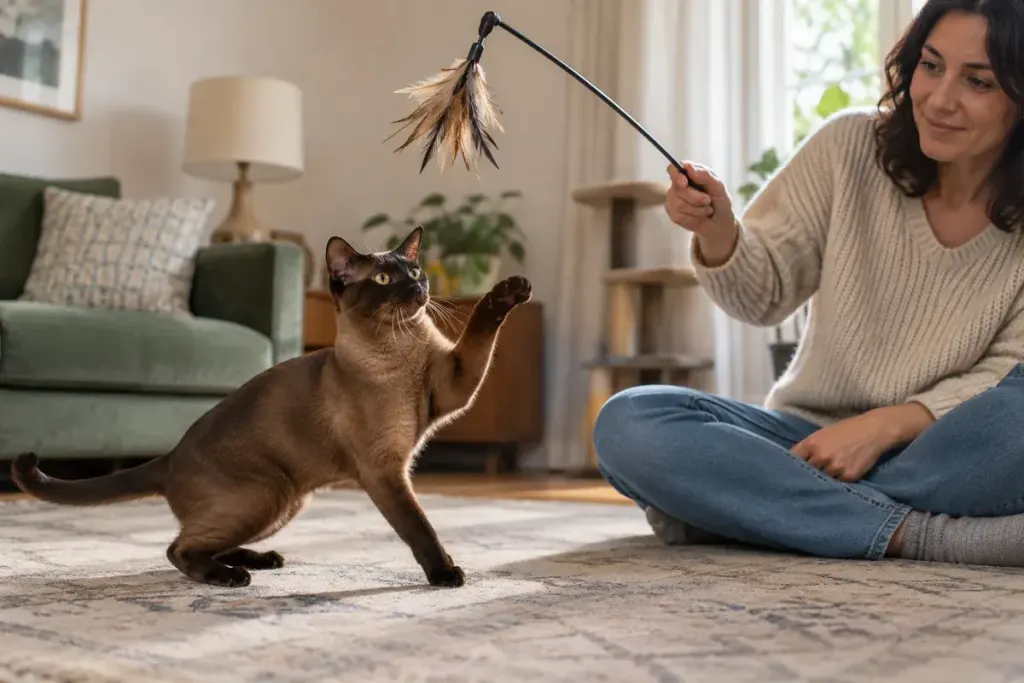
A toy waved continuously in front of a cat’s face may be less interesting than one that disappears briefly behind a box. Play involves watching, waiting and choosing a moment, not only energetic chasing. A short session can be worthwhile when it gives the cat room to participate on its own terms.
Burmese cats are often described as sociable, but a breed description cannot tell you exactly how your cat wants to play today. Age, health, surroundings and personal preference matter. A sudden change in activity deserves attention, particularly if accompanied by other changes.
Move the toy with a purpose
Use a suitable toy and imitate small, varied movements away from the cat rather than repeatedly pushing it towards the face. Pause and let the cat watch. A moment spent crouching or tracking the toy is part of the session, even when it does not look active to a person.
Allow opportunities to catch the toy. Cats Protection’s play guidance describes short games and chances to capture prey-like toys. The guidance also warns against leaving cats alone with toys that can be swallowed or cause entanglement.
Keep hands out of the game
Use an appropriate toy rather than fingers or toes as the target. A game that seems harmless with a kitten can become painful with an adult cat. Check toys for loose or damaged parts before use and put string or wand toys away after supervised play.
An illustrative session might involve a few slow movements behind a cardboard box, a pause, a short chase and a successful catch. Repeat only while the cat remains interested and comfortable. There is no need to keep escalating speed to obtain a dramatic leap.
Finish while the interaction is still positive
Watch for disengagement and do not force the cat to continue. Offer safe opportunities to climb, hide and observe at other times as well; interactive play is one part of a suitable environment.
Rotate a few safe toys rather than putting every toy out permanently. Make a note of movements and times of day the cat enjoys. If play becomes unusually limited, painful or aggressive, consult a veterinarian or appropriately qualified behaviour professional. A better session is one that suits the cat, not one that produces the most impressive video.