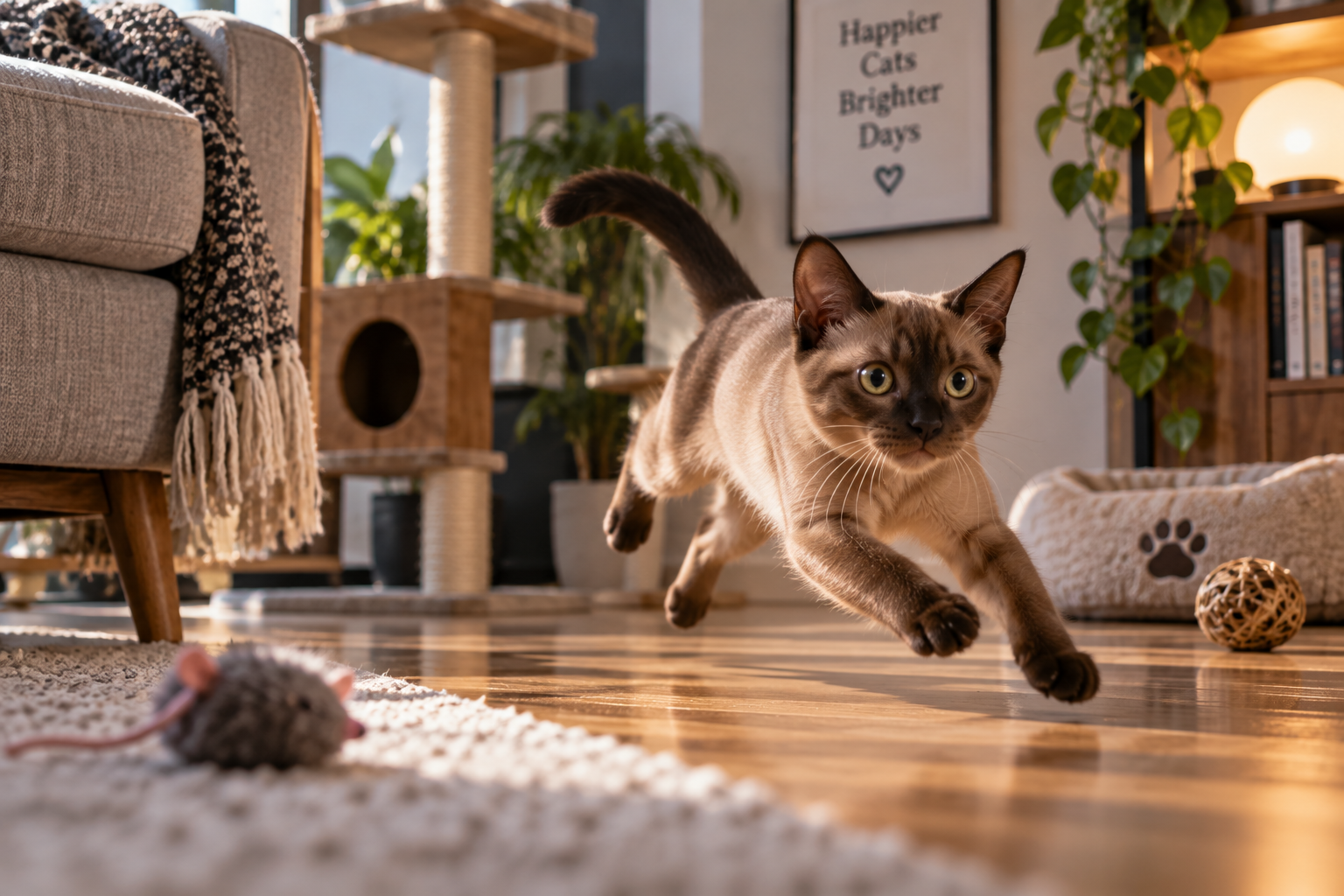
A few minutes ago, your cat was asleep.
Now it is racing down the hallway, launching itself onto the sofa, making a sharp turn around the table, disappearing into another room, and returning at approximately the speed of a small motorcycle.
Then, almost as suddenly as it started, everything stops.
The cat sits down.
Maybe it begins grooming.
Perhaps it goes straight back to sleep as though nothing unusual just happened.
These sudden bursts of activity are commonly called the zoomies, and if you have ever wondered why do cats get the zoomies, the behavior usually makes more sense when you consider how cats naturally use energy, play, and short periods of intense activity.
What Are Cat Zoomies?
Zoomies are short bursts of energetic behavior.
A cat may sprint through several rooms, jump onto furniture, chase an imaginary target, rapidly change direction, or repeatedly run the same route.
The behavior often lasts only a short time.
It can look chaotic from a human perspective, but the cat is usually displaying a concentrated burst of physical activity rather than exercising steadily for a long period.
The technical term sometimes used for similar sudden bursts in animals is a frenetic random activity period, or FRAP.
For most cat owners, “zoomies” is considerably easier to remember.
Cats Do Not Use Energy the Same Way Humans Do
Humans often think about exercise in sustained periods.
Walk for thirty minutes.
Run several miles.
Spend an hour at the gym.
Cats evolved around a very different activity pattern.
Feline hunting behavior involves periods of observation and waiting followed by relatively short bursts of stalking, chasing, pouncing, and capturing.
A domestic cat may therefore spend a large portion of the day appearing extremely inactive and then suddenly become intensely energetic.
Sleeping for hours does not necessarily mean the cat wants to remain inactive for the rest of the evening.
It may simply be between bursts.
Why Do Zoomies Often Happen at Night?
Many owners notice the phenomenon at particularly inconvenient times.
The household is finally quiet.
Everyone is preparing for bed.
Then the cat decides the hallway is a racetrack.
Cats are often described as nocturnal, but crepuscular is generally a more useful description of their natural activity pattern. Cats commonly show increased activity around dawn and dusk.
Domestic life can modify that rhythm considerably.
Still, evening can naturally become a period when a cat is ready to become more active—especially after spending much of the day resting.
Your Schedule Can Amplify the Evening Energy Burst
Imagine an indoor cat whose household leaves for work in the morning.
The environment becomes quiet.
There is less social interaction.
The cat sleeps for significant portions of the day.
Then everyone comes home.
Lights turn on.
People move around.
Food appears.
Doors open.
There are sounds and opportunities for interaction.
From the cat’s perspective, the interesting part of the day may have just begun.
By the time the humans want to sleep, the cat may be ready for activity.
Kittens Can Take Zoomies to Another Level
Young cats generally have substantial energy.
They are also learning about movement, coordination, boundaries, objects, and social interaction.
A cardboard box can become an ambush point.
A paper ball becomes prey.
A hallway becomes a sprint track.
A curtain may unfortunately become a climbing challenge.
Frequent energetic bursts can therefore be especially noticeable in kittens and young cats.
As cats mature, their activity patterns can change, although adult cats can absolutely continue having zoomies.
Indoor Cats Need Opportunities to Express Hunting-Like Behavior
An indoor environment protects cats from many outdoor hazards.
But a safe home can also become predictable.
Food arrives in a bowl.
There is no need to search for prey.
The same furniture occupies the same locations.
If a cat has few opportunities for interactive play, climbing, chasing, exploring, or problem-solving, some of its physical and behavioral needs may not be getting much stimulation.
Zoomies can be one way energy becomes visible.
That does not mean every energetic sprint proves a cat is bored.
It means the cat’s overall daily environment is worth considering.
Play Before Bed Can Help Change the Evening Rhythm
If midnight zoomies regularly disrupt the household, increasing appropriate interactive play earlier in the evening may help some cats settle more comfortably afterward.
Use toys that allow the cat to chase and pounce.
Wand-style toys can be particularly useful because the human can control movement while keeping hands away from claws and teeth.
Rather than waving the toy directly in the cat’s face, make it behave more like something worth hunting.
Move it behind furniture.
Pause.
Let it disappear.
Allow the cat to stalk before chasing.
The objective is not simply making the cat run until exhausted. It is creating engaging activity that uses both body and attention.
Let the Cat Catch the Toy Sometimes
Imagine playing a game where you can chase something but never succeed.
Eventually, the experience can become frustrating.
Interactive play can include opportunities for the cat to successfully capture the toy.
Let the cat pounce.
Allow a brief “catch.”
Then restart the movement if the cat remains interested.
This creates a more complete play sequence than continuously keeping the toy just beyond reach.
Different cats have different play preferences, so watch which movements produce genuine engagement.
Food Can Become Part of Enrichment
For many indoor cats, eating requires almost no effort.
Walk to bowl.
Eat.
Leave.
Puzzle feeders and other appropriate food-enrichment methods can make some meals more mentally engaging.
The cat may need to manipulate an object, search for portions of food, or spend more time obtaining the meal.
This does not mean every meal needs to become difficult.
The idea is simply to introduce safe opportunities for natural problem-solving and foraging behavior.
When food, play, climbing, scratching, and exploration are distributed throughout the day, the home becomes more behaviorally interesting.
Vertical Space Can Matter as Much as Floor Space
A small home does not necessarily provide a small world for a cat.
Cats use three-dimensional space.
A suitable cat tree, stable elevated resting area, window perch, or other safe vertical option can expand how the environment is used.
Height provides more than exercise.
It can also offer observation points and places where a cat feels less disturbed.
Instead of viewing enrichment only as buying more toys, consider how many ways the cat can move through and observe its environment.
Rotate Toys Instead of Leaving Everything Out Forever
A basket containing fifteen toys may seem like excellent enrichment.
But objects that remain in the same place every day can gradually become part of the background.
Try rotating some toys.
Keep several available, put others away, and reintroduce them later.
The toy has not become genuinely new, but temporary absence can restore some interest.
You can also vary play locations and movement patterns.
Novelty does not require buying something every week.
Sometimes it simply requires changing how existing resources are presented.
A Cardboard Box Can Be Excellent Enrichment
Cat enrichment does not need to be expensive.
Boxes, safe paper materials, tunnels, and simple hiding opportunities can create interesting environments.
A box can become a resting space one day and part of a play session the next.
The important considerations are safety and suitability.
Remove materials that could create hazards, avoid unstable setups, and supervise activities when necessary.
The goal is not to build an elaborate amusement park.
It is to give the cat opportunities to investigate and make choices.
Why Do Some Cats Get Zoomies After Using the Litter Box?
This is another pattern many owners notice.
The cat uses the litter box.
Then it launches out of the area and runs across the house.
There are several proposed explanations for post-litter-box zoomies, and not every cat is necessarily doing it for exactly the same reason.
For some cats, it may simply be part of a burst of activity associated with the experience.
What matters is distinguishing an energetic exit from signs that elimination itself is uncomfortable.
If a cat appears distressed, strains, repeatedly enters the litter box, vocalizes unusually, or shows other changes in bathroom behavior, that is not something to dismiss as funny zoomies.
Zoomies Are Usually Easy to Recognize in Context
A typical energetic burst has a playful or excited quality.
The cat moves rapidly but appears coordinated.
Afterward, behavior generally returns to normal.
The cat continues eating, resting, grooming, interacting, and using the litter box normally.
Context matters because “running suddenly” is only a description of movement.
It does not tell you why the cat is running.
A cat chasing a toy and a cat suddenly fleeing because something hurts may both move quickly, but the surrounding behavior is very different.
Watch for Sudden Changes in an Individual Cat
Knowing why do cats get the zoomies does not mean every unusual burst of movement should automatically receive that label.
You know your cat’s normal behavior better than a generic description does.
A young cat that has sprinted around the apartment every evening for years presents a different situation from an older cat that suddenly begins showing completely unfamiliar restless behavior.
Changes deserve attention.
Look at the whole picture rather than one isolated sprint.
Are appetite and water intake normal?
Has litter-box behavior changed?
Is the cat grooming normally?
Does movement look comfortable?
Has sleep or social behavior changed?
Patterns provide more useful information than a single dramatic moment.
Older Cats Can Still Play
Age does not automatically eliminate the desire for play.
Senior cats may prefer shorter sessions, slower movement, or different toys than they enjoyed when younger.
Some may no longer want repeated high jumps.
Enrichment should adapt to the individual cat’s mobility and interest.
A slower stalking game can still be engaging.
Food puzzles can vary in difficulty.
Accessible resting and observation areas can provide environmental choice without demanding difficult climbing.
The goal is not to make an older cat behave like a kitten.
It is to provide appropriate opportunities for activity throughout life.
Do Not Use Your Hands as Prey
A kitten attacking moving fingers can seem harmless.
The kitten is tiny.
The bites barely hurt.
Months later, the cat is larger and has learned that human hands are exciting objects to chase, grab, and bite.
Use appropriate toys for interactive hunting games.
This creates a clearer boundary between play objects and body parts.
If the cat becomes highly excited during a zoomie session, do not encourage it by grabbing or wrestling with it using bare hands.
Redirect energy toward appropriate play instead.
Never Punish a Cat for Having Energy
A cat running through the house is not deliberately trying to annoy you.
Shouting, chasing, spraying water, or frightening the cat does not teach it a healthier way to use energy.
It may simply teach the cat that the human becomes unpredictable during moments of activity.
If the behavior is occurring at an inconvenient time, change the routine and environment rather than treating normal energy as misconduct.
Increase appropriate play earlier.
Provide enrichment.
Protect fragile household items.
Make high-speed routes safer where practical.
Management is more useful than punishment.
Protect the House From the Racetrack
Zoomies can turn ordinary furniture into an obstacle course.
Make sure unstable objects cannot easily fall if bumped.
Keep breakable items away from edges.
Secure anything that could become dangerous if a cat jumps onto or through it.
Be especially careful with cords, open windows, unstable shelves, and objects that can trap a paw.
You may not be able to predict the exact route.
But if your cat repeatedly follows the same hallway-to-sofa-to-cat-tree circuit, you can at least make that area safer.
Multiple Cats Can Trigger Group Zoomies
One cat starts running.
The second notices.
Suddenly the house has a race.
In compatible multi-cat households, chase behavior can be part of play.
However, owners should still observe body language.
Mutual play usually involves some give-and-take.
One cat may chase, then roles change.
There are pauses.
Both animals voluntarily return to the interaction.
If one cat is constantly fleeing, hiding, cornered, or showing defensive behavior, the situation may not be equal play.
Running alone does not tell the whole story.
More Exercise Is Not the Only Answer
When people see an energetic cat, the obvious conclusion is: tire it out.
Physical activity is important.
Mental engagement matters too.
A cat can chase a toy, investigate a new box, search for food, observe birds safely through a window, explore vertical spaces, scratch appropriate surfaces, and interact socially.
A richer day contains different kinds of stimulation.
The objective is not to create a cat that is permanently exhausted.
A healthy routine allows opportunities for activity followed by opportunities to rest.
Routine Can Help
Cats often learn household patterns.
Meals occur around similar times.
People wake up.
People leave.
Evening activities begin.
Lights go out.
A relatively predictable routine can make it easier to place interactive play at useful points in the day.
For a cat that consistently becomes highly active late at night, an evening routine might include an engaging play session followed by the cat’s normal feeding schedule and a quieter environment.
No routine guarantees that a cat will never sprint at 2 a.m.
Cats retain their own preferences and rhythms.
But consistent daily activity can make energy patterns easier to manage.
Sometimes the Best Response Is Simply to Watch
Not every zoomie needs intervention.
If the environment is safe and the cat appears healthy, a short sprint around the home may simply be a cat being extremely enthusiastic about being a cat.
Let it run.
Move your coffee away from the edge of the table.
Enjoy the spectacle.
Five minutes later, there is a good chance the same animal will be curled up somewhere looking completely innocent.
When Should You Pay Closer Attention?
The key is not the existence of zoomies but the surrounding signs.
A sudden major change in activity, apparent disorientation, unusual vocalization, repeated litter-box problems, visible discomfort, difficulty moving, significant changes in eating or drinking, or other unexplained behavioral changes deserve more attention than ordinary playful running.
The same applies when behavior is intense enough to repeatedly cause injury or appears compulsive rather than playful.
In those situations, documenting what happens can be useful.
Note when it occurs, how long it lasts, what happened immediately beforehand, and any other behavioral changes. A video can also help a veterinarian understand an episode that may not occur during an appointment.
Conclusion
So, why do cats get the zoomies?
Often, the answer is much less mysterious than the behavior looks.
Cats naturally alternate substantial periods of rest with shorter bursts of activity. Indoor routines, evening activity patterns, age, play opportunities, and accumulated energy can all influence when those bursts appear.
For many cats, zoomies are simply part of normal energetic behavior.
Owners can support that energy with interactive play, climbing opportunities, scratching surfaces, food enrichment, safe exploration, and a daily environment that offers more than sleeping beside a food bowl.
At the same time, context matters.
A familiar five-minute sprint from an otherwise healthy cat is different from a sudden unexplained behavioral change accompanied by discomfort or other symptoms.
Learn your cat’s normal rhythm.
Then the next time a peaceful evening suddenly turns into a high-speed race through the hallway, you may have a better idea of what you are seeing.
Sometimes there is no emergency.
Your cat simply decided that right now was the perfect time to run.